

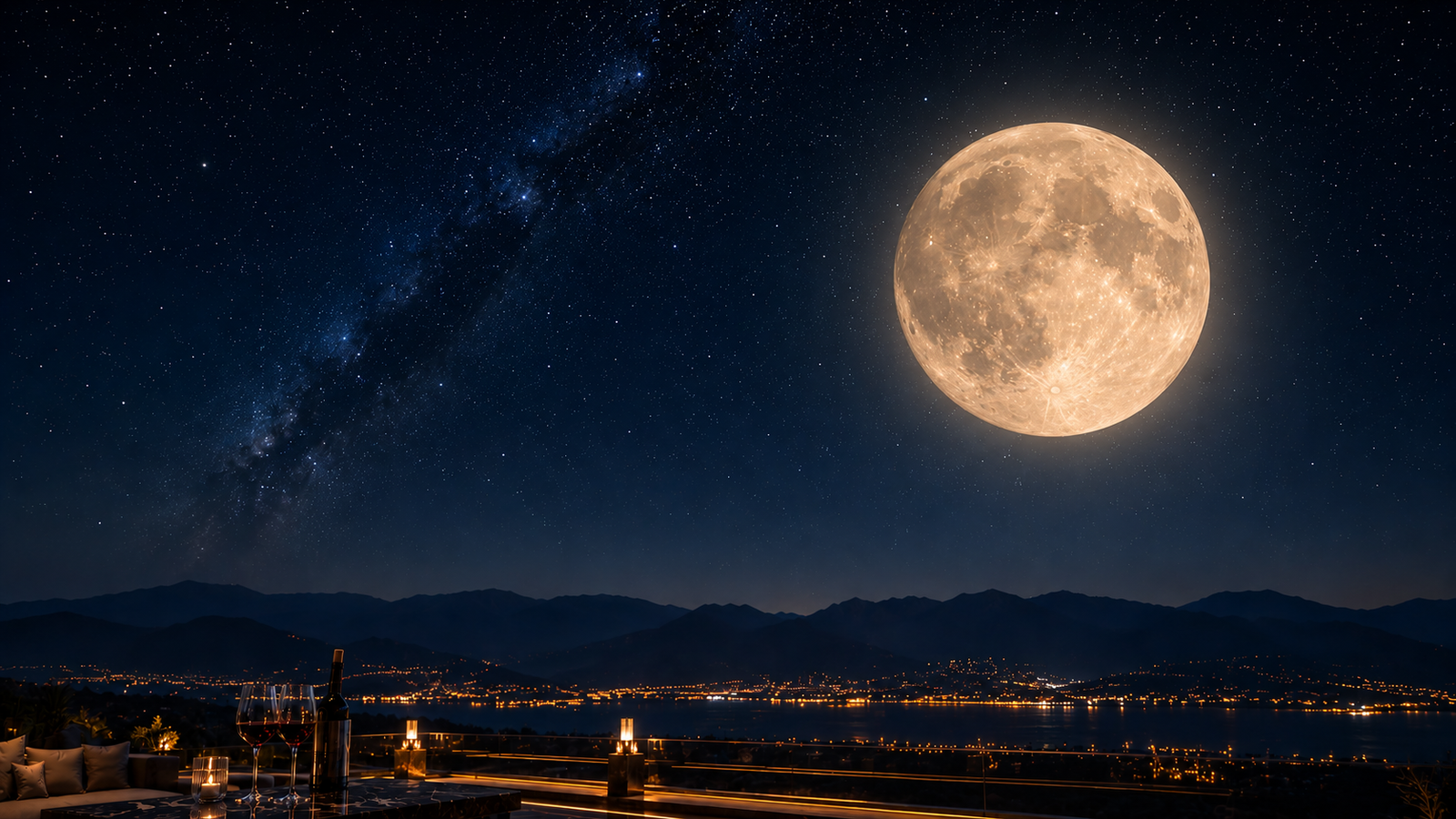
September’s full moon is not arriving quietly. On September 26, the Harvest Moon will rise into an already crowded sky, with Saturn nearby and Neptune reaching opposition at almost the same time. But the full moon is only the finale. Across September, the Moon will sweep past Mars, Jupiter and Venus; Venus will reach magnitude -4.8; the equinox will turn the Northern Hemisphere toward autumn; and the dark days around the new moon will briefly reopen the Milky Way for serious stargazing.
The month starts with a Moon on the move
The first half of September is where the action builds. Venus opens the month low in the western evening sky, close to Spica, the brightest star in Virgo. On September 3, the Moon passes the Pleiades. The Aurigids are active at the start of the month, while the September Epsilon Perseids peak around September 9.
On September 6 and 7, a waning crescent Moon will pass close to reddish Mars in Gemini before dawn. Astronomy’s Martin Ratcliffe and Alister Ling report that Mars begins September around magnitude 1.2 and ends near magnitude 1.1, while its apparent disk remains only about 5 arcseconds wide. The Moon then moves toward Jupiter. On September 8, the thin crescent will appear close to the giant planet in the eastern morning sky, and a lunar occultation of Jupiter will be visible from some locations, including parts of eastern Russia and Japan.
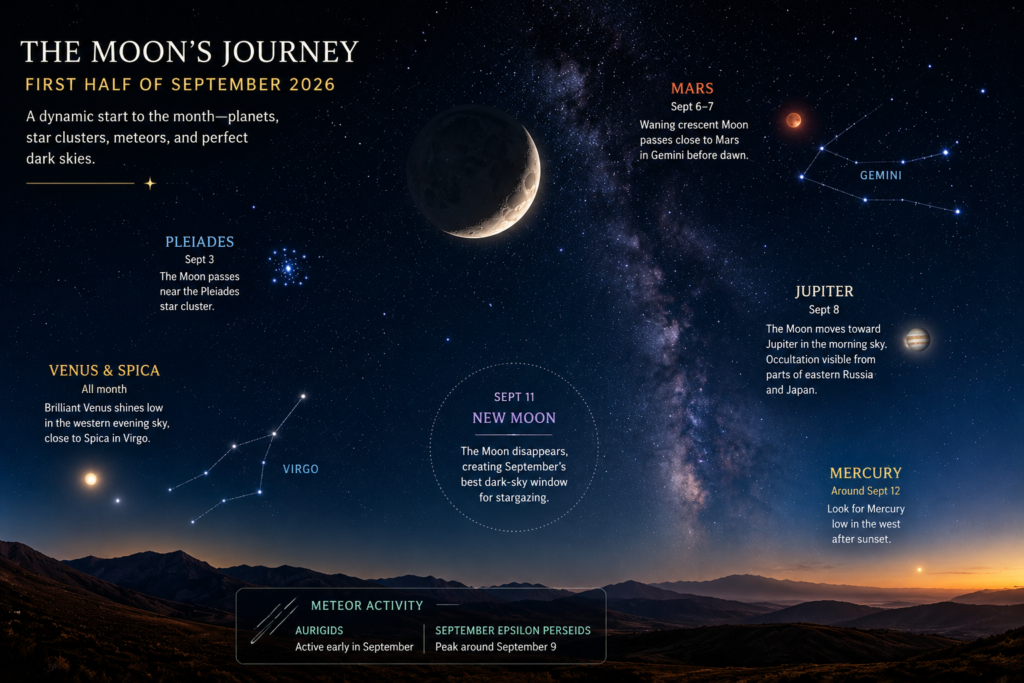
The Moon disappears around the new moon on September 11, creating September’s best dark-sky window. Moonlight can wash faint stars and galaxies out of the sky. Bruce Betts of The Planetary Society notes that darker nights make the Milky Way’s brighter regions easier to photograph. Around September 12, the Moon also pairs with Mercury, low in the west.
Also see: Total Solar Eclipse 2026 Set for Europe
Also see: Artemis II Moon Mission: NASA Sends Humans Back After 50 Years
Also see: Astronomers Say Six Red Dwarf Stars May Have Consumed Rocky Planets
Also see: AI Debt Panic Wipes $600 Billion Off SpaceX
September 2026 Night-Sky Calendar
| Date | What to Watch | Where / When |
| Sept. 3 | Moon near the Pleiades | Pre-dawn sky |
| Sept. 6–7 | Moon–Mars pairing | East, before sunrise |
| Sept. 8 | Moon meets Jupiter | Eastern sky, before sunrise |
| Sept. 11–12 | New Moon & darkest skies | Best nights for stargazing |
| Sept. 14 | Moon near Venus | West, after sunset |
| Sept. 18 | Venus at peak brightness | West, after sunset |
| Sept. 22 | Autumn equinox & aurora opportunity | Northern skies |
| Sept. 25 | Mars joins Gemini | East, before sunrise |
| Sept. 26 | September Full Moon + Saturn | Night sky |
Small note for the readers: The September full moon is the month’s headline event, but the surrounding planetary encounters make the entire month worth watching, not just one night.
Venus steals the evening, then the season turns
September 14 brings one of the month’s prettiest naked-eye scenes: a thin crescent Moon beside brilliant Venus shortly after sunset. From some locations, the Moon will actually occult Venus, temporarily passing in front of the planet. Dr. Wayne Wooten, writing for WUWF, notes that comparing the crescent Moon with crescent Venus through a telescope is “a graphic reminder that, like the Moon, the planets can show phases, as they too shine only by reflected sunlight.”
Venus reaches its greatest illuminated extent on September 18 at magnitude -4.8. The planet is sinking closer to the western horizon and becomes difficult to catch later in the month. The Moon reaches first quarter on September 18 and passes near Antares, the orange-red star marking the heart of Scorpius, around September 17.
Then comes the seasonal pivot. The September equinox occurs on September 22 at 20:05 UTC, according to Astronomy, although local calendars can place it on September 23. At the equinox, the Sun crosses the celestial equator heading south. In the Northern Hemisphere, autumn begins; south of the equator, spring begins. The equinox is also associated with increased opportunities for auroral activity, although no aurora is guaranteed on any particular night.
Also see: Strawberry Moon 2026: When to See June’s Rare Full Moon
Also see: Full Moon on July 29, 2026: Horoscope, Meaning & Rituals
Also see: AI-Run Store Opens in San Francisco Under AI Manager Luna
The full moon gets Saturn and Neptune gets its own close-up
By September 25, the sky becomes more interesting for telescope users. Neptune reaches opposition, meaning Earth sits between the planet and the Sun and Neptune is visible for much of the night. Astronomy puts Neptune at magnitude 7.7 and about 9.5 degrees west of Saturn. Neptune needs binoculars or a telescope, while the approaching full moon will make it harder to see.
Then comes September 26. The full moon reaches peak illumination at 16:49 UTC, or 10:19 p.m. in India, and is the Harvest Moon because it is the full moon closest to the September equinox. It will rise around sunset and remain visible through the night. For viewing, the evenings of September 25, 26 and 27 will all show an essentially full lunar disk.
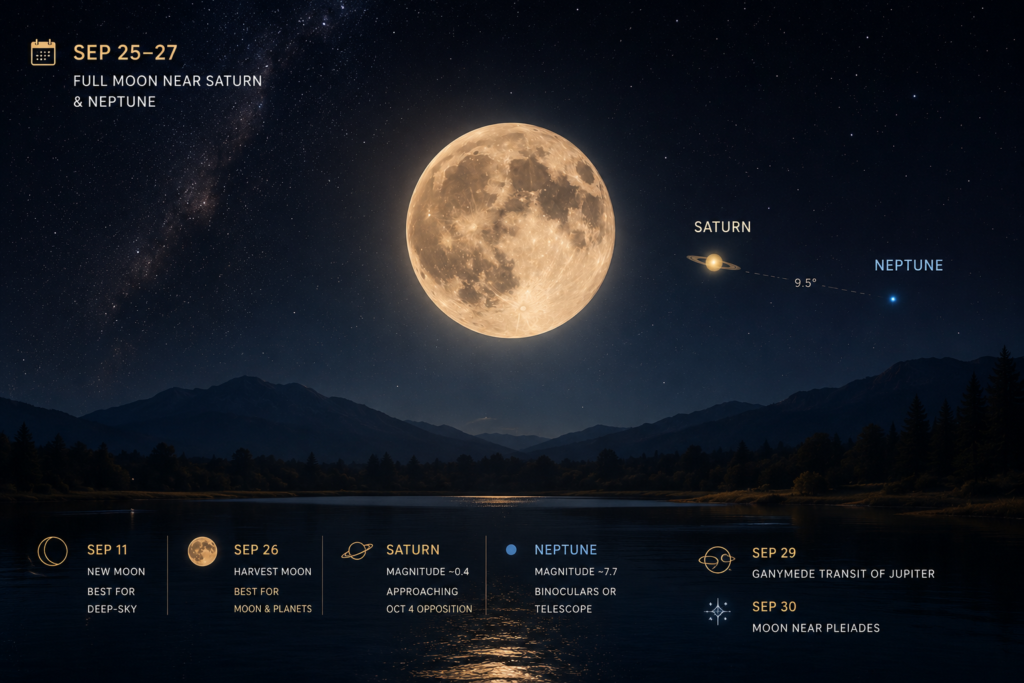
The full moon also arrives near Saturn. Astronomy reports Saturn at roughly magnitude 0.4 early in September, brightening as it approaches its October 4 opposition. On the September 26 night, the Moon sits near Saturn while Neptune forms a wider planetary pairing farther away. NASA’s Raquel Villanueva described the arrangement this way: “The Moon joins a tea party… Venus cranks up the brightness… the seasons officially change, and the Harvest Moon meets up with some planetary neighbors.”
There is a catch. The brightest object in the lineup can also be the biggest obstacle. The full moon’s glare will make Neptune, faint stars and many deep-sky objects harder to photograph. This is why the September 11 new moon is better for galaxies, nebulae and the Milky Way, while September 26 belongs to lunar and planetary observing.
And September refuses to end quietly. On September 29, Jupiter’s largest moon, Ganymede, crosses Jupiter’s disk in an event visible from parts of the United States. On September 30, the waning Moon again approaches the Pleiades. Between those dates are Mars, Venus, Jupiter, Saturn, Neptune, meteor activity, the equinox and the Milky Way. The full moon is the headline act, but the month keeps changing the view again. For casual viewers, the Moon wins; for telescope owners, Neptune is the challenge.
Also see: Aule Space: India’s ‘Power Bank’ for Satellites
Also see: August 2026 Astronomical Events: Eclipse, Meteor Shower & More
Also see: Best AI Tools for Students in 2026: 10 Free AI Apps That Actually Make Studying Smarter