

“AI debt panic swept through Wall Street as SpaceX lost more than $600 billion in market value over three trading sessions.”
SpaceX lost more than $600 billion in market value in just three trading sessions, wiping out nearly a quarter of its worth as investors abruptly shifted from celebrating the company’s blockbuster stock market debut to questioning how much money Elon Musk’s growing artificial intelligence ambitions will require.
The selloff accelerated on Monday after SpaceX disclosed plans for its first-ever investment-grade bond offering, a move that surprised many investors because the company had recently completed a record $75 billion initial public offering and reported a cash balance of $100.8 billion.
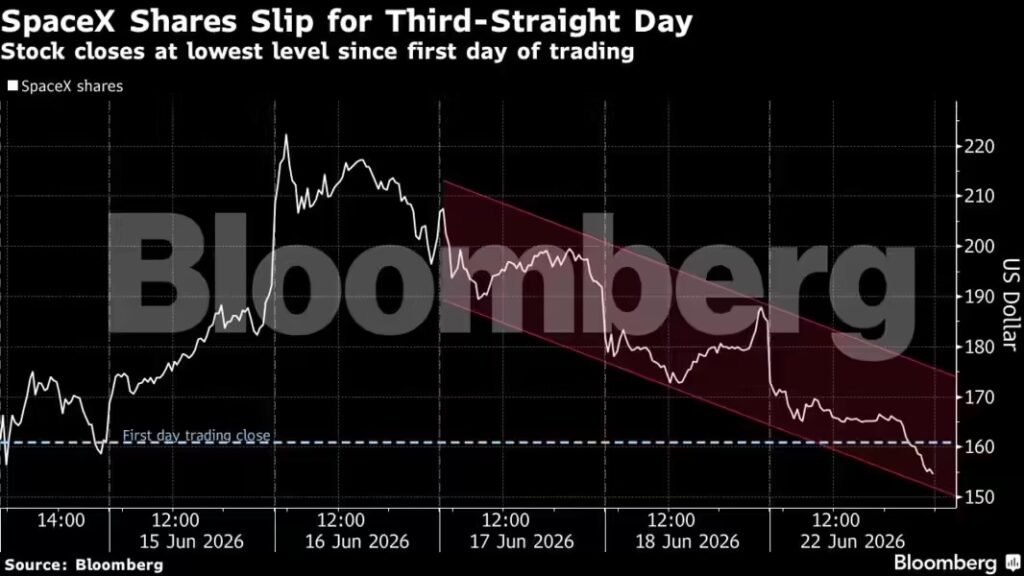
Shares fell 16% Monday to close at $154.60, their lowest level since the first day of trading. The decline pushed SpaceX’s three-day loss to 23% and erased more than $600 billion in market capitalization. The company is still valued at just above $2 trillion, but the speed of the reversal has become one of the biggest stories on Wall Street.
What’s happening around the world: Keir Starmer Resignation: Labour’s Civil War Begins
The stock had surged after its June IPO, fueled by retail investor enthusiasm and expectations that SpaceX would dominate both the commercial space industry and emerging artificial intelligence infrastructure markets. That rally briefly pushed the company’s valuation close to $3 trillion before sellers returned in force.
“Sellers are back in control. Anyone in the world who wanted to buy this has bought it already“, said Michael O’Rourke, chief market strategist at JonesTrading.
The market reaction was striking because the bond sale itself was not viewed as a sign of financial distress. The debt received investment-grade ratings and came alongside disclosures showing one of the strongest cash positions among publicly traded companies. Instead, investors appeared focused on what the borrowing might signal about future spending plans.
Why Is SpaceX Borrowing?
The company is seeking to raise at least $20 billion through its first bond offering, according to reporting cited in the disclosure. Management has linked the financing effort to expanding artificial intelligence operations and supporting a broader technology strategy that increasingly extends beyond rockets and satellites.
The bond announcement arrived just days after investors were already debating whether SpaceX’s valuation had run ahead of its fundamentals. Analysts and traders began asking a straightforward question: if the company has more than $100 billion in cash and raised $75 billion in its IPO, why does it need another $20 billion?
SpaceX has not publicly detailed exactly how much capital will be required for its AI initiatives. That uncertainty has become central to the market’s concerns.
The company recently completed the acquisition of Musk’s artificial intelligence venture xAI and has signed a multibillion-dollar agreement to provide computing resources to Reflection AI, a startup developing advanced AI systems. The agreement is expected to generate billions of dollars in revenue over several years, but it also reinforces the scale of infrastructure investments now underway.
Investors who originally bought into SpaceX because of Starlink and launch services are now being asked to evaluate a business that increasingly combines satellite communications, AI computing, data centers and large-scale software development. That shift has complicated the investment story.
Retail Investors Fueled the Rally
The stock’s dramatic swings were amplified by an unusually small public float.
Only 4.2% of SpaceX shares were available for trading when the company debuted on the public market. Such limited supply often creates sharp moves in both directions because relatively small amounts of buying or selling can have an outsized impact on the share price.
According to Vanda Research, retail investors purchased a net $405 million worth of SpaceX stock during the company’s first five trading sessions. The firm’s data showed retail buying in SpaceX exceeded purchases across all Magnificent Seven technology stocks combined during parts of the post-IPO rally.
That enthusiasm helped drive the stock sharply higher in its first days of trading. It also increased the risk of a rapid reversal once momentum changed.
SpaceX remains approximately 15% above its IPO price of $135 despite the recent decline. Yet analysts have increasingly argued that much of the company’s long-term growth story was already reflected in the stock price after the initial surge.
The first hold-equivalent rating tracked by Bloomberg came from KeyBanc Capital Markets, where analysts led by Michael Leshock acknowledged the company’s strengths while warning that investors may already be paying for much of its future success.
“SpaceX possesses significant disruptive growth avenues, though we believe this is reflected in current valuation and risk/reward appears balanced, in our view“, Leshock wrote.
The Bigger AI Question
The selloff comes amid broader investor scrutiny of artificial intelligence spending across the technology sector.
Major technology companies have committed hundreds of billions of dollars toward AI infrastructure, including data centers, chips and computing capacity. Investors have generally rewarded those investments when revenue growth appears capable of supporting them. They have become less enthusiastic when spending projections continue rising faster than expected.
SpaceX now finds itself at the center of that debate. The company reported revenue growth of roughly 33% while continuing to invest aggressively in future projects. At the same time, Musk’s strategy is transforming SpaceX from a company known primarily for rockets and satellite internet into a much broader technology platform tied closely to AI development.
For some investors, that vision remains compelling. For others, the recent bond offering signaled that the cost of building that future may be larger than previously understood.
The result was a brutal three-day reassessment that erased hundreds of billions of dollars in market value and ended one of the strongest post-IPO rallies in recent market history.
The bond sale may have triggered the selloff. The deeper issue appears to be whether investors are willing to finance the next phase of Musk’s AI ambitions at the valuation SpaceX achieved during its euphoric first days as a public company.
For more updates follow: First Report News