
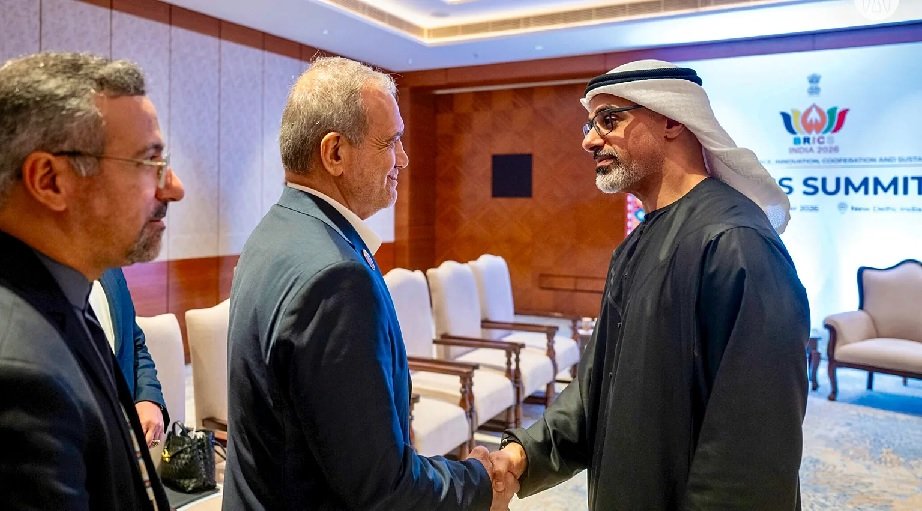
The UAE Iran BRICS meeting in New Delhi has opened a direct diplomatic channel between Abu Dhabi and Tehran at a moment when their relationship remains deeply strained. Abu Dhabi Crown Prince Sheikh Khaled bin Mohamed bin Zayed Al Nahyan met Iranian President Masoud Pezeshkian on 12 September 2026, on the sidelines of the 18th BRICS Summit. The meeting focused on regional and international issues, de-escalation and regional stability, according to the Abu Dhabi Media Office.
The date is significant because the meeting was reported in some coverage as taking place on Sunday. The UAE’s official record dates it to Saturday, 12 September, the first day of the New Delhi summit.
The encounter was not announced as a formal bilateral summit and produced no publicly declared agreement on trade, diplomatic relations or other outstanding disputes. Instead, the language from Abu Dhabi was deliberately focused on reducing tensions. The two leaders discussed issues of mutual interest and stressed the importance of supporting efforts to “ease tensions, promote de-escalation and strengthen regional stability,” while also discussing opportunities for peace and development.
Read the Declaration: BRICS New Delhi Declaration: Building for Resilience, Innovation, Cooperation and Sustainability (September 12, 2026)
Also see: BRICS New Delhi Declaration: 140 Points, One Message – The Global South Wants More Power
Also see: Xi Jinping India Visit Six Years After Galwan Clash
Also see: South China Sea: China Warned Philippines Mid-Speech
What was actually discussed at the UAE Iran BRICS meeting
The limited official readout is revealing.
Neither side published a detailed transcript of the conversation. The UAE statement does not identify individual disputes discussed in the room. It does not say that the two leaders reached a new bilateral agreement, nor does it announce the restoration of economic or diplomatic arrangements.
That leaves the central substance of the meeting in the wording both governments chose to release.
The UAE emphasized de-escalation, stability, peace and development. Iran’s account confirmed that Pezeshkian held talks with Khaled on the sidelines of the BRICS summit, while additional details were to follow.
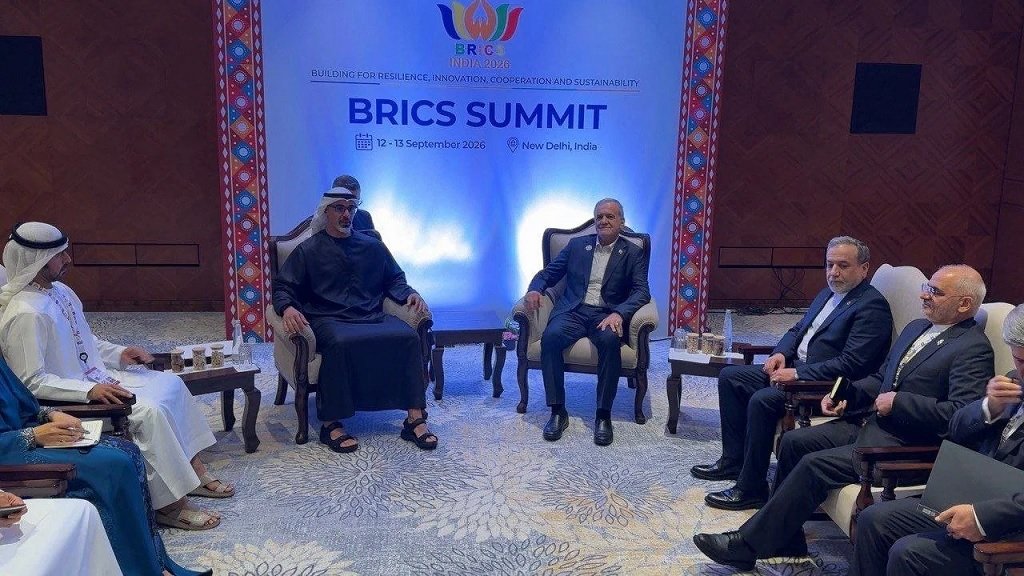
Pezeshkian later provided a more personal description of the discussion. Speaking after the meeting, he said the two sides had a “good talk” and discussed their concerns so they could “put the past behind us” and look toward building the future together. His comments were broadcasted on Iranian state television.
That statement goes further than the UAE’s formal readout. Abu Dhabi described the subjects of discussion in broad diplomatic terms. Pezeshkian publicly framed the encounter as an effort to move beyond the immediate dispute and consider future cooperation.
That difference in emphasis is important. Tehran presented the conversation as a possible reset. Abu Dhabi’s official language was more cautious.
Also see: PM Modi Uzbekistan Visit: $5 Billion Trade, Uranium Deal
Also see: Strait of Hormuz: US Strikes Iran, Trump Warns Tehran
Also see: Ali Khamenei Funeral: Granddaughter’s Coffin Draws Attention
Abu Dhabi is talking without declaring a reset
The UAE’s diplomatic adviser, Anwar Gargash, gave the clearest indication of how Abu Dhabi views the meeting.
Gargash said the encounter reflected the UAE’s approach based on “deterrence and diplomacy.” He argued that deterrence gives diplomacy credibility, while diplomacy works when conducted from a position of parity and capability. He also described Pezeshkian’s position during the crisis as showing “balance and rationality.”
That formulation places the New Delhi meeting inside a broader UAE strategy rather than presenting it as an unconditional reconciliation with Tehran.
The distinction is especially important because the meeting took place only weeks after Abu Dhabi suspended trade and financial dealings with Iran. The diplomatic contact therefore occurred alongside a much tougher economic position, rather than replacing it.
The geography of the two countries helps explain why that channel remains valuable. Iran and the UAE are separated by the Gulf, and both have direct interests in regional security, commercial movement and stability. But the New Delhi meeting shows that Abu Dhabi’s willingness to communicate with Tehran has survived the sharp deterioration in relations.
There was no public indication that the UAE’s economic restrictions were lifted as a result of the meeting.
Also see: Saudi Arabia, Pakistan, Türkiye Defence Alliance Explained
Also see: Sheikh Hasina News: Delhi Press Conference Fuels Row
Also see: Russian Ballistic Missile Strike on Kyiv Kills Two as Attacks Intensify Across Ukraine
BRICS gave Iran and the UAE room to talk
The setting was almost as important as the meeting itself.
Khaled and Pezeshkian were both in New Delhi for the 18th BRICS Summit. The encounter therefore took place within a multilateral gathering where both countries were already participating in discussions about regional stability.
The BRICS declaration adopted during the summit called for maximum restraint over the Middle East conflict, protection of civilians and civilian infrastructure, respect for sovereignty and territorial integrity, and continued movement of global trade, supply chains and energy. Iran and the UAE were able to support that common language despite their bilateral tensions.
That creates a narrow area of common ground. The two governments did not need to resolve every disagreement to agree that escalation should be contained. The New Delhi meeting appears to have operated within that limited space.
India’s role also matters. Prime Minister Narendra Modi met Pezeshkian separately on 11 September, one day before the UAE-Iran encounter. India’s official record says Modi and Pezeshkian discussed peace and stability in West Asia, along with the importance of freedom of navigation, uninterrupted commerce and the safety of seafarers.
Modi also met Khaled on 12 September, demonstrating that India was engaging both sides individually during the same summit.
The sequence gave New Delhi an unusual diplomatic setting in which the UAE and Iran could hold direct discussions while remaining inside a wider BRICS process.
The next test is whether the words produce another meeting
The most important fact about the UAE Iran BRICS meeting may be what it did not produce.
There was no announced timetable for renewed bilateral negotiations. No new trade agreement was unveiled. No public commitment was made to restore economic transactions. The two sides did not announce a formal mechanism for resolving all of their disputes.
For now, the clearest outcome is simpler: Abu Dhabi and Tehran chose to talk.
Also see: G7 Summit 2026: Modi Calls for Trust and Cooperation as Global Leaders Meet in France
Also see: Sanctions Against India Would ‘Boomerang’, Says Putin
Also see: US-Iran Deal or Diplomatic Mirage? Secretive Switzerland Talks Produce Surprise Breakthrough