

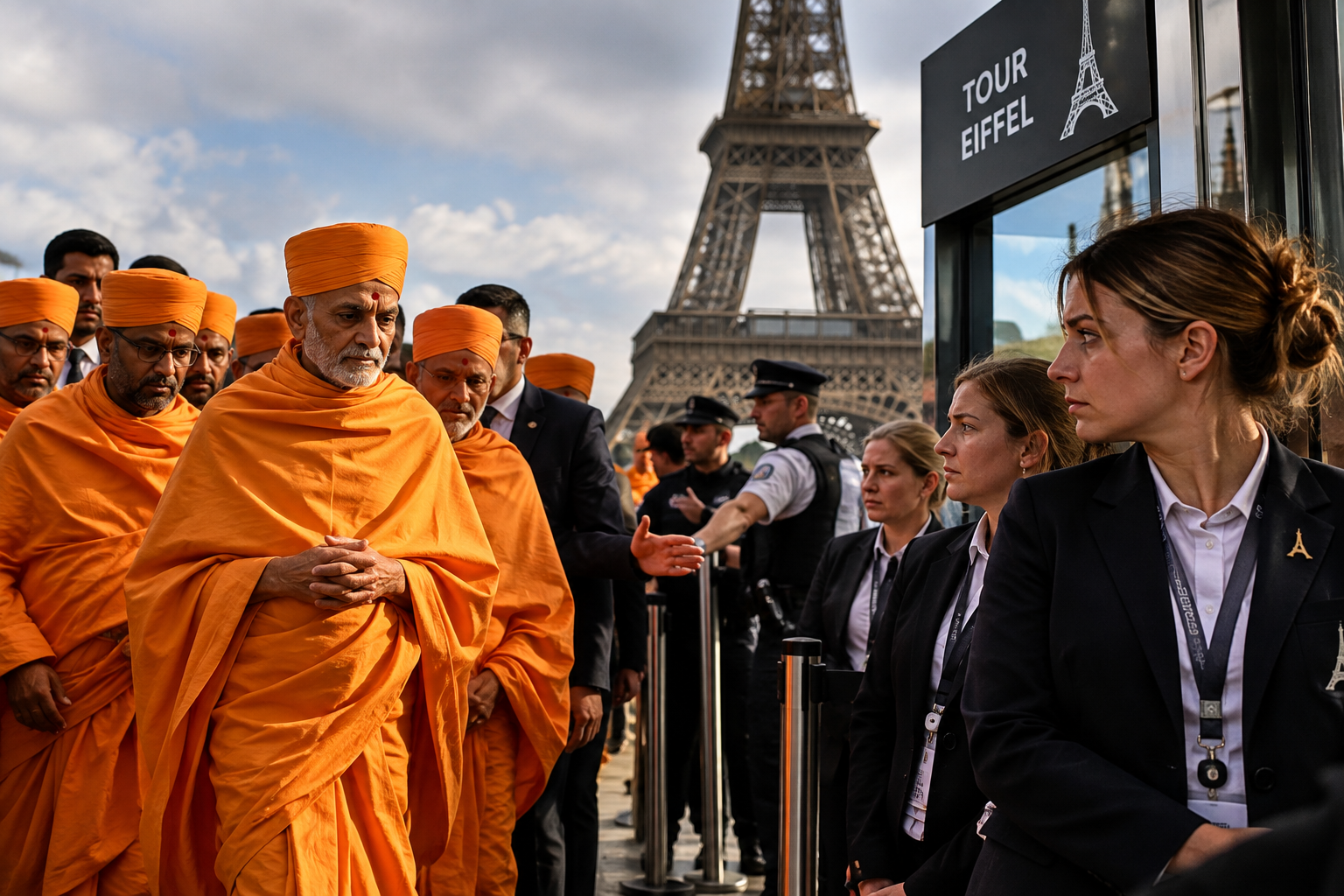
A Paris investigation has complicated the account of what happened when BAPS representatives visited the Eiffel Tower on September 5, 2026. The investigation found no explicit request from the Hindu religious delegation to remove women from the entire route, but it did identify an original request concerning “the lack of physical contact between religious figures and women.” Female employees were subsequently moved, replaced or kept away from parts of the delegation’s route.
The episode began with a request narrower than the outcome. It ended with women staff excluded from several positions and the Eiffel Tower’s operator announcing that its director general, Patrick Branco Ruivo, will leave at the end of 2026. The evidence does not support the claim that BAPS issued a written order to hide women. It does establish that a no-contact requirement associated with the delegation became part of the chain that resulted in women being sidelined.
Also see: From Sexual Harassment Allegations to Anti-Feminism Remarks: Elon Musk Faces Fresh Scrutiny
Also see: Modi Tells Putin Enough With the ‘Endless War’
Also see: Gloria Steinem: How She Built a Feminist Movement
What BAPS Is and Why Its Monks Avoid Contact With Women
BAPS, formally the Bochasanwasi Akshar Purushottam Swaminarayan Sanstha, is a global Hindu socio-spiritual organisation in the Swaminarayan tradition.
BAPS publishes material explaining the discipline followed by its sadhus, or monks. Its stated vow of brahmacharya requires sadhus to avoid contact and interaction with women. One BAPS publication says a Swaminarayan sadhu “could never talk, touch or associate with women.” Another describes eightfold celibacy as including avoiding women’s company, looking at women with intent and sexual contact.
The Paris visit was connected to BAPS events surrounding the inauguration of a new traditional Hindu temple at Bussy-Saint-Georges, east of Paris. BAPS records show more than 5,500 people participated in a cultural boat procession on the Seine on September 3; the temple was inaugurated on September 6.
The Eiffel Tower Visit and the No Contact Request
About 100 people associated with BAPS visited the Eiffel Tower privately on September 5. The tower’s operating company, Société d’Exploitation de la Tour Eiffel, or SETE, acknowledged after the controversy that the delegation had asked for arrangements limiting “interactions with women.” SETE said those conditions should not have been accepted.
The later investigation by the General Inspectorate of the City of Paris examined how the request was translated into instructions for employees. Investigators reportedly conducted 14 interviews and reviewed documents supplied by SETE. Their conclusion was not that nothing happened to women. Instead, they found women had indeed been excluded during the visit, while finding no “explicit request from the Hindu religious delegation to exclude women from the entire procession.”
The investigation identified the original request as concerning “the lack of physical contact between religious figures and women.” As the instruction moved through different levels of Eiffel Tower management, it was progressively converted into operational arrangements. Security posts were assigned to men, women were asked to leave certain positions, and at least one female employee was replaced by a male colleague.
Who Lost Their Job?
The person leaving over the fallout is Patrick Branco Ruivo, the director general of SETE, not a BAPS monk or official. Ruivo has headed the Eiffel Tower operating company since 2018 and is scheduled to leave at the end of 2026.
Ruivo has denied personally ordering women to be removed or replaced. “At no point did I give any instruction aimed at sidelining or replacing women along this delegation’s route,” he said. SETE nevertheless said an internal investigation found “operational flaws and shortcomings” that resulted in the “unacceptable” exclusion of female staff.
The episode triggered a staff protest and temporary closure of the Eiffel Tower on September 7. Paris authorities called for an investigation, while staff representatives said women had been sidelined, replaced and prevented from crossing certain areas while the delegation was present.
BAPS later said the coordination was operational courtesy for a large group and was “never, at any point, intended as a request rooted in gender.” It apologised for any pain or inconvenience caused.
The More Provocative Question
BAPS’s own writings make the monastic rule clear: its sadhus are expected to avoid talking to, touching or associating with women. That may be a sincerely held religious practice. But in a public workplace, the burden cannot automatically fall on female workers to disappear.
The question is therefore sharper than “Why are religious groups scared of women?”
The uncomfortable question is why the burden of religious modesty was placed on women who had done nothing wrong. If a religious rule tells a person not to touch, speak to or associate with women, that rule belongs to the person observing it, not to every woman in the building. A public landmark is not a religious compound and female employees should not be ordered out of sight because someone else’s beliefs make their presence inconvenient. If your faith requires you to stay away from women, then stay away from places where women work and live their lives! Do not demand that women disappear so you can practice your religion on your terms.
Also see: 261 Rapes, 762 Molestations and the Pain No Prison Sentence Can Erase