
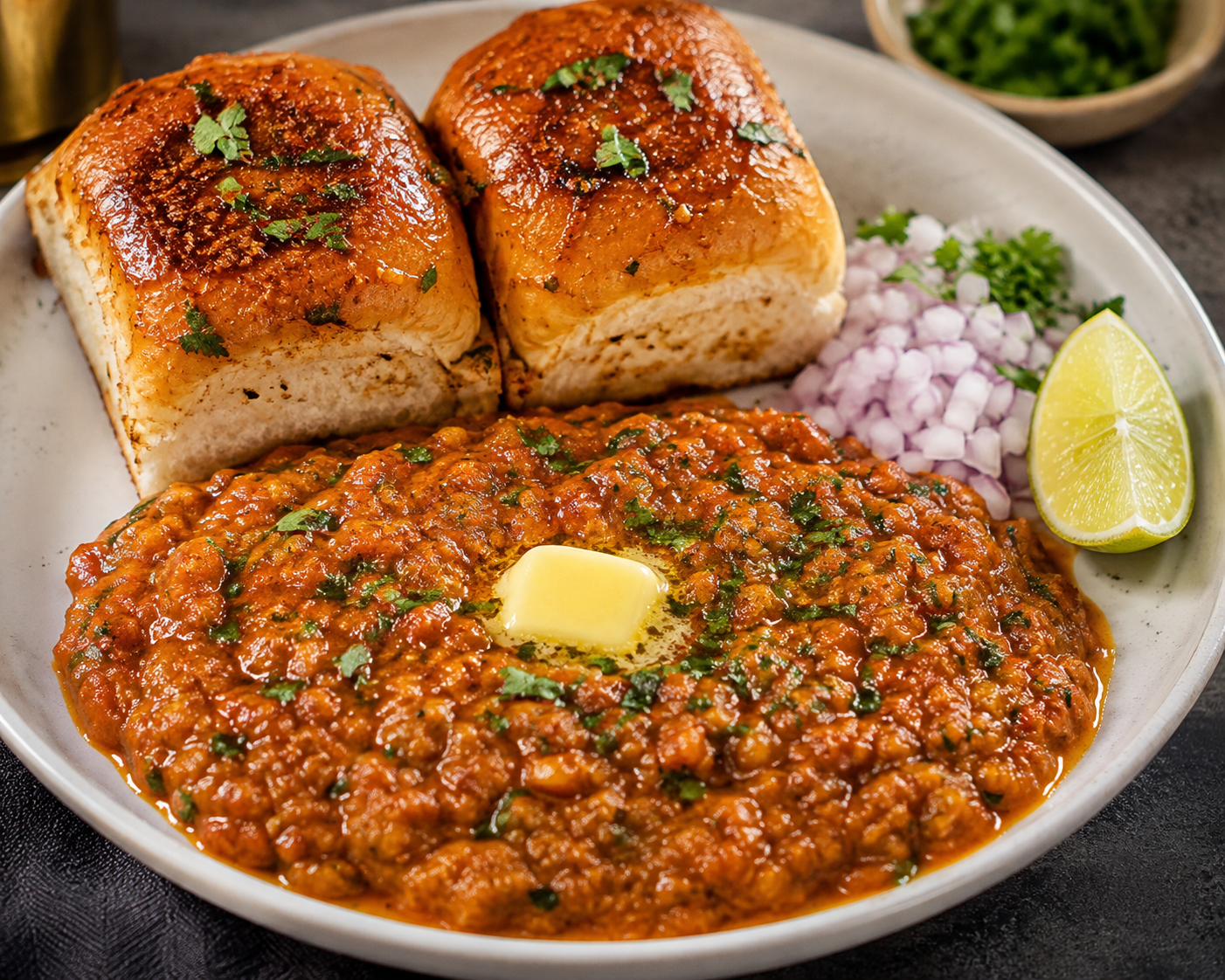
Pav Bhaji Michelin-Style Home Recipe
Total time: 1 hour 15 minutes | Difficulty: Beginner | Serves: 2 generous portions | Style: Traditional Mumbai pav bhaji with refined restaurant technique
The three techniques that matter most:
1) cooking the vegetables until completely tender
2) building the masala gradually rather than frying spices aggressively
3) finishing the bhaji with butter, acidity, and careful texture control.
Equipment
| Equipment | Size | Purpose | Substitute |
| Heavy saucepan/pressure cooker | 2–3 L | Cook vegetables | Deep pot with lid |
| Wide skillet/tawa | 28–30 cm | Make and mash bhaji | Large frying pan |
| Small frying pan | 20 cm | Toast pav | Same skillet, working in batches |
| Kitchen scale | Any | Weigh ingredients | Measuring cups/spoons |
| Measuring spoons | 1 ml–15 ml | Spices and liquids | Small measured spoons |
| Measuring jug | 500 ml | Water | Cup with markings |
| Chef’s knife | 18–20 cm | Cutting vegetables | Sharp kitchen knife |
| Cutting board | Large | Safe chopping | Clean flat board |
| Potato masher | Any | Crush vegetables | Sturdy wooden spoon |
| Wooden spoon/spatula | — | Stir and scrape | Silicone spatula |
| Ladle | 60–100 ml | Add water | Small cup |
| Fine sieve | Small | Optional smooth finish | Clean strainer |
| Blender | Any | Optional tomato puree | Very fine chopping |
| Tongs | — | Turn pav | Spatula |
| Thermometer | Instant-read | Check food temperature | Sensory cues |
| Bowls | 4–6 small | Mise en place | Plates |
| Pastry brush | Small | Butter pav evenly | Spoon |
| Serving plates | 25–28 cm | Plating | Any warm plate |
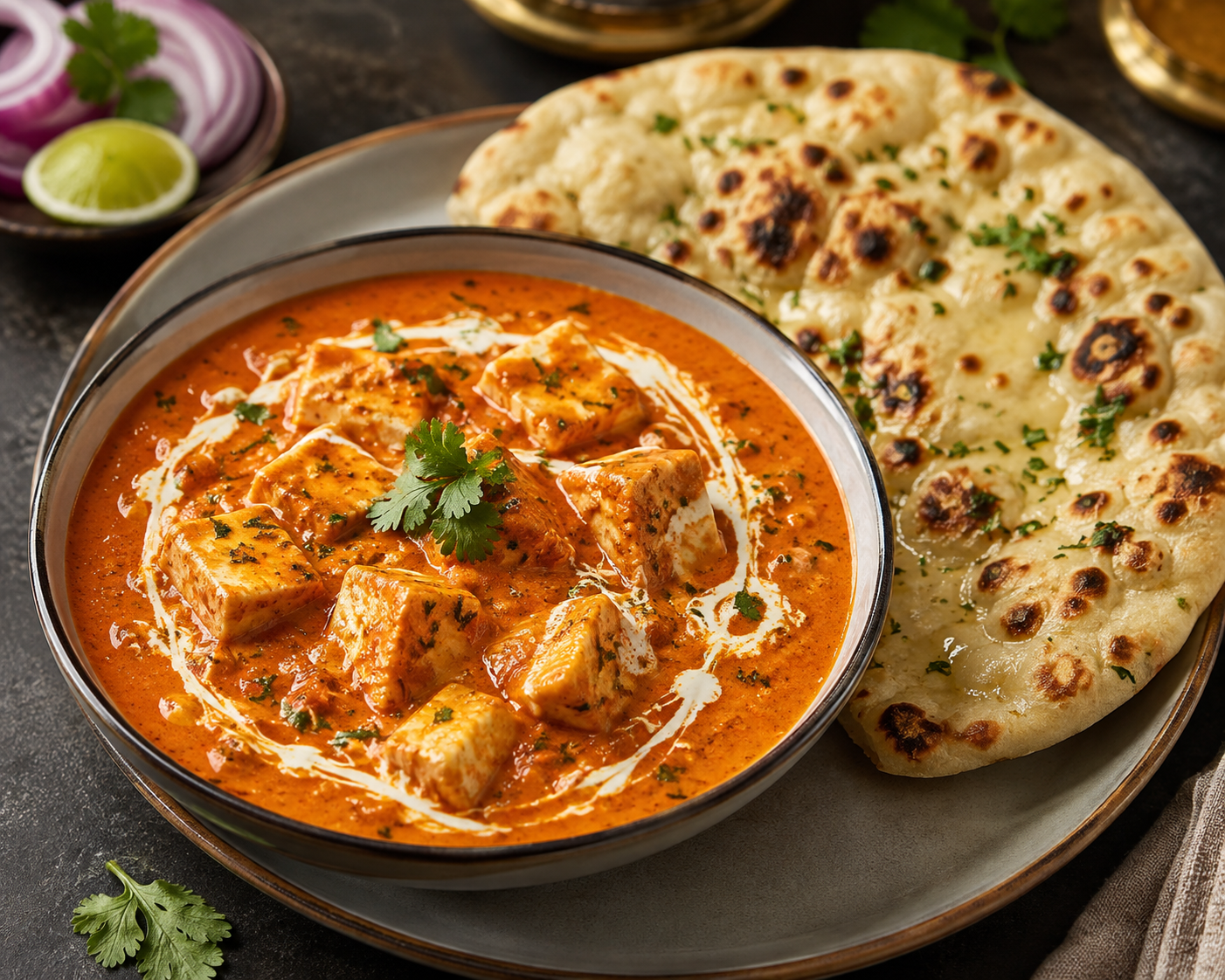
Also see: Shahi Paneer Recipe with Naan | Restaurant-Style Guide
Ingredients
Vegetable base
- Potato, peeled: 250 g; floury/starchy potatoes are best. They give body.
- Cauliflower florets: 100 g, fresh and firm; broccoli is a possible substitute but changes flavour.
- Green peas: 80 g, fresh or frozen. Frozen is fine; do not thaw.
- Carrot: 80 g, peeled. Adds sweetness and colour.
- Water: 450 ml, plus up to 150 ml for adjustment.
- Salt: 5 g initially.
Masala
- Unsalted butter: 50 g, divided; use good-quality butter.
- Neutral oil: 10 ml; sunflower or canola prevents butter from burning.
- Onion: 120 g, peeled and very finely diced.
- Green bell pepper/capsicum: 80 g, very finely diced.
- Garlic: 15 g, finely minced.
- Ginger: 10 g, finely grated.
- Green chilli: 5 g, finely minced; reduce to 2 g for mild bhaji.
- Tomatoes: 300 g, ripe, red, finely chopped or blended.
- Kashmiri chilli powder: 5 g; mainly colour with moderate heat.
- Hot red chilli powder: 1 g, optional.
- Pav bhaji masala: 10 g, preferably freshly opened.
- Ground cumin: 2 g.
- Turmeric: 1 g.
- Sugar: 3 g, only to balance acidic tomatoes.
- Salt: 3 g, then adjust after tasting.
- Lemon juice: 10–15 ml, fresh.
- Water: 100–250 ml, added gradually.
- Fresh coriander: 20 g, finely chopped.
- Extra butter: 20 g for finishing.
Pav
- Pav buns: 4, fresh and soft, approximately 45–50 g each.
- Butter: 25 g.
- Kashmiri chilli powder: 0.5 g, optional.
- Pav bhaji masala: 1 g, optional.
Garnish
- Finely diced onion: 50 g
- Lemon wedges: 2
- Coriander: 10 g
- Butter: 10 g, optional finishing dot.
Mise en place
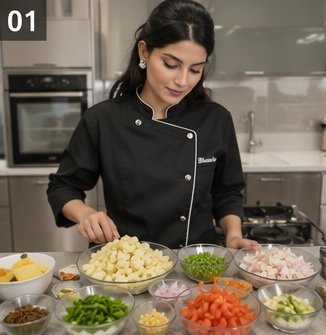
Wash the potatoes, cauliflower, carrot, tomatoes, capsicum, coriander, and green chilli under cool running water. Peel potatoes, carrot, ginger, and garlic.
Cut potatoes into approximately 2 cm cubes. Cut cauliflower into pieces about 2 cm. Cut carrot into 1 cm cubes so it cooks as quickly as the potato. Keep peas whole.
Dice onion and capsicum into pieces no larger than 3 mm. Finely mince garlic and chilli. Grate ginger. Chop tomatoes finely; blending them gives a smoother restaurant-style bhaji.
Measure every spice into one small bowl. Measure butter and oil separately. Keep lemon juice ready but do not add it yet.
Put the vegetable ingredients beside the stove in this order: potatoes, cauliflower, carrot, peas, then water and 5 g salt. Put the masala ingredients beside the skillet in cooking order.
Wash your hands, clear the work surface, and keep a clean kitchen towel nearby.
Timeline: 00:00 prep | 00:15 vegetables | 00:30 masala | 00:45 mash | 00:55 pav | 01:15 serve.
Cooking
Step 1 Cook the vegetables
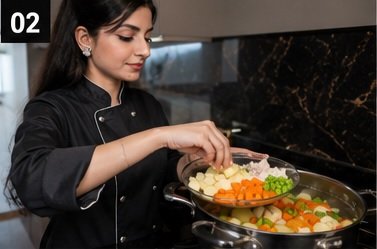
Place potatoes, cauliflower, carrot, peas, 450 ml water, and 5 g salt into the saucepan. Put the lid on.
Set the stove to medium-high. On a gas stove this is a flame about halfway between medium and maximum. On induction, roughly level 7 of 10; on electric, use medium-high and expect slower heating.
Bring the water to a gentle boil, approximately 98–100°C at sea level. A gentle boil has steady small-to-medium bubbles across the surface. Altitude changes boiling temperature, so the number is approximate.
Reduce to medium-low, roughly maintaining 90–98°C liquid temperature, and cook 15–20 minutes. You are not trying to keep a violent boil.
The vegetables are ready when a fork slides through a potato cube with almost no resistance. Press one potato against the side of the pot: it should crush easily. Carrot and cauliflower should also be soft enough to mash.
Hear: gentle bubbling, not loud splashing.
Smell: clean, sweet vegetable aroma.
See: vegetables look swollen, softened, and slightly duller in colour.
Feel: potato crushes easily.
Why: Complete softening is essential because pav bhaji gets its characteristic thick, spoonable texture from mashed vegetables, not from a separate thickener.
Checkpoint 1: If vegetables are firm, cook 3–5 minutes longer. If water has nearly disappeared, add 50 ml hot water.
Drain only if there is more than about 100 ml excess water; otherwise keep the cooking liquid because it contains flavour and starch.
Also see: Strawberry Moon 2026: When to See June’s Rare Full Moon
Also see: Full Moon on July 29, 2026: Horoscope, Meaning & Rituals
Also see: AI-Run Store Opens in San Francisco Under AI Manager Luna
Also see: G7 Summit 2026: Modi Calls for Trust and Cooperation as Global Leaders Meet in France
Step 2 Build the masala
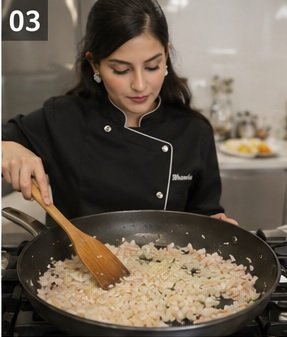
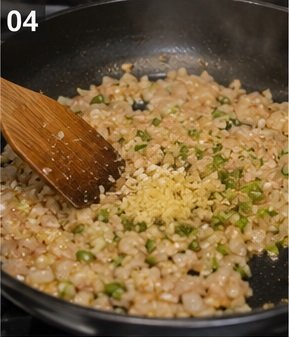
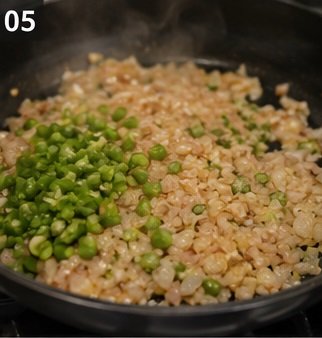
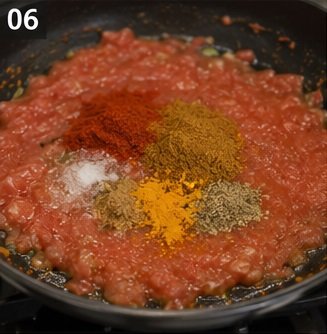
Heat the wide skillet for 60–90 seconds over medium heat, approximately a 150–180°C pan surface. A home thermometer can measure this, but pan-surface readings vary greatly, so sensory cues matter more.
Add 10 ml oil and 30 g butter. The butter should melt quietly and foam lightly. If it browns immediately, your pan is too hot.
Add the 120 g onion. Stir continuously for the first minute, then every 20–30 seconds. Cook 5–7 minutes.
Add garlic, ginger, and green chilli. Cook 60–90 seconds at medium-low heat. Stir constantly. The raw sharp smell should become rounded and aromatic.
Add 80 g capsicum. Cook 2–3 minutes. It should soften but retain a little structure.
Add tomatoes, Kashmiri chilli powder, hot chilli powder if using, cumin, turmeric, pav bhaji masala, sugar, and 3 g salt.
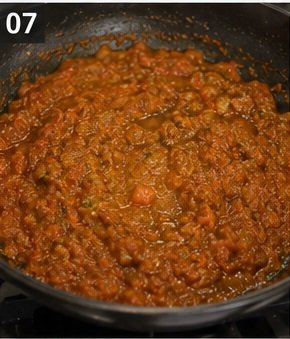
Reduce to medium-low. Cook 8–10 minutes, stirring every minute.
The tomato mixture should become thick and glossy. You should see butter/oil beginning to appear around the edges, but the mixture must not stick or blacken.
Why: Tomatoes need enough cooking to lose their raw acidity. Spices need contact with moisture and fat to release aroma without burning.
Checkpoint 2: Correct: thick, glossy, deep red-orange, sweet-spicy aroma. Incorrect: watery and raw-smelling means cook longer; dark black spots or bitter smell means heat was too high.
Step 3 Combine and mash
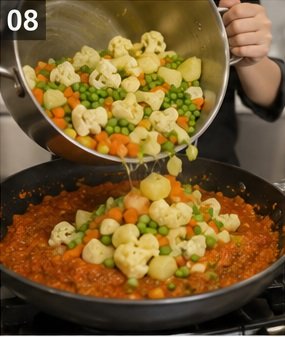
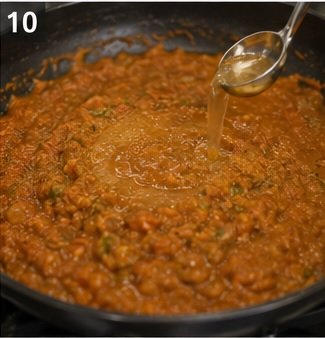
Add the cooked vegetables and their reserved liquid to the masala.
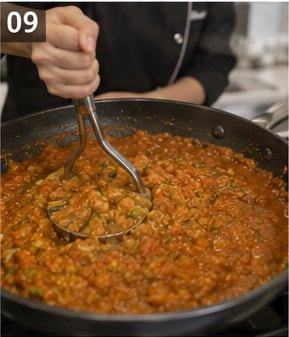
Set heat to medium-low. Use the potato masher to press and crush everything against the skillet for 5–7 minutes.
Mash until there are no large potato chunks. A few tiny vegetable pieces are desirable.
Add water 50 ml at a time, stirring after each addition. Usually 100–200 ml is sufficient.
Bring the bhaji to a gentle simmer, about 90–98°C, for 5 minutes. Small bubbles should rise occasionally. Do not allow aggressive boiling.
Why: Mashing releases potato starch, which naturally thickens and binds the vegetable mixture. Gentle simmering lets the spices integrate.
Taste one teaspoon after cooling it briefly.
You are checking five things:
- Salt: flavours should be clear, not flat.
- Acidity: tomato and lemon should brighten without tasting sour.
- Sweetness: only enough to soften tomato sharpness.
- Heat: chilli should be noticeable but not dominate.
- Spice: pav bhaji masala should be aromatic, not bitter.
If sticking occurs, add 15–30 ml water and scrape only the clean surface. If smoking occurs, remove the skillet from heat for 30 seconds and reduce the burner.
Step 4 Restaurant finishing
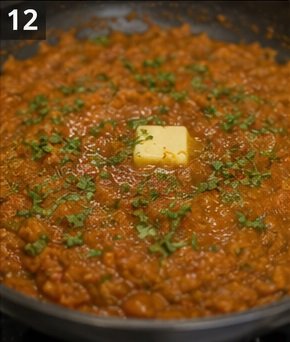
Lower heat to low, approximately maintaining the bhaji around 75–90°C rather than boiling.
Add 20 g finishing butter and stir until completely incorporated. This creates a glossy, richer texture.
Add 10 ml lemon juice and 15 g chopped coriander. Stir for 20 seconds.
Taste again. The final flavour should arrive in this order: buttery richness, tomato sweetness and acidity, roasted spice, gentle chilli heat, then fresh coriander and lemon.
If too thick, add 15–30 ml hot water. If too thin, simmer uncovered on low for 2–4 minutes, stirring frequently.
Why: Butter adds fat-soluble aroma and silkiness. Lemon added late preserves its fresh acidity. Coriander added late keeps its green aroma.
Turn off the heat. Cover for 2 minutes. This brief rest allows flavours to settle without continuing aggressive cooking.
Step 5 Toast the pav
Cut each pav horizontally, but do not cut completely through the hinge if you want it to open like a book.
Heat the small pan over medium, approximately 150–180°C surface temperature.
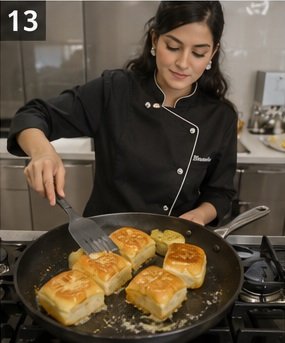
Add 25 g butter. When melted and lightly foaming, place the pav cut-side down.
Toast 45–75 seconds. Press gently with a spatula.
The cut surface should become golden, crisp at the edges, and buttery, while the inside remains soft.
If it darkens in under 30 seconds, lower the heat. If it remains pale after 90 seconds, increase heat slightly.
For a restaurant-style finish, dust the butter with 1 g pav bhaji masala and 0.5 g Kashmiri chilli powder before placing the pav down.
Do not toast until dry. Pav should contrast with the creamy bhaji: crisp edges, soft centre.
Quality-control checkpoints
Checkpoint 3 — Bhaji texture: Correct = smooth, thick, spoonable, with tiny vegetable flecks. Too coarse = mash longer. Too loose = simmer uncovered. Too stiff = add hot water gradually.
Checkpoint 4 — Seasoning: Correct = salty enough to taste lively, balanced by tomato acidity and butter. If you can taste one spice aggressively, the mixture is not integrated; simmer another 2 minutes.
Checkpoint 5 — Pav: Correct = golden-brown cut face, crisp edges, soft interior. Burnt = discard the burnt surface if minor; if bitter, replace the pav.
Also see: Ram Temple donation theft: VHP to await SIT probe on Rai
Also see: Meta India Head Named in FIR Over Morphed PM Modi Posts During CJP Protests
Also see: Sanctions Against India Would ‘Boomerang’, Says Putin
Also see: Pakistan Launches Cross-Border Operation After Karachi Attack, Says 29 Militants Killed
Plating

Michelin-style version
Use a warm 25–28 cm white coupe plate or shallow bowl. Warm it with hot water, dry it completely, and keep it warm rather than scorching.
Place approximately 300–350 g bhaji in the centre, forming a low, smooth oval rather than a tall mound. Create a shallow spoon mark across the surface.
Place two toasted pav halves beside the bhaji, angled slightly toward it. Leave generous negative space.
Add 25 g diced onion in a small neat pile, two lemon wedges, and 5 g coriander. Finish the bhaji with a tiny 5 g butter dot that melts naturally.
Simple home version
Use a warm dinner plate. Put bhaji in one side and two pav halves beside it. Add chopped onion, coriander, and lemon in separate small portions. Serve immediately.
Common beginner mistakes
- Cutting vegetables unevenly: large pieces stay hard. Cut potatoes 2 cm and carrots 1 cm.
- Adding all water at once: texture becomes thin. Add water gradually.
- Undercooking vegetables: the masher cannot create a creamy base. Cook until fork-tender.
- Skipping tasting: seasoning cannot be corrected blindly. Taste at the specified checkpoints.
- Boiling aggressively: texture becomes harsh and water evaporates unpredictably. Use a gentle simmer.
- Making the bhaji too smooth: a completely pureed texture can feel baby-food-like. Leave tiny vegetable flecks.
Troubleshooting
| Problem | Likely cause | Exact fix |
| Too salty | Excess salt | Add 50–75 g unsalted mashed potato or 50–100 ml water; retaste |
| Too watery | Too much liquid | Simmer uncovered 2–5 minutes on low, stirring |
| Too thick | Excess reduction | Add hot water 15–30 ml at a time |
| Burnt bottom | Excessive heat | Transfer unburnt top to clean pan; do not scrape burnt layer |
| Bland | Low seasoning/integration | Add 0.5 g salt first; then 2 ml lemon if needed |
| Too sour | Acidic tomatoes/lemon | Add 0.5–1 g sugar, taste, then add butter if needed |
| Bitter | Burnt spices/garlic | If bitterness is strong, restart; do not mask severe burning |
| Ingredient raw | Insufficient cooking | Add water and simmer until tender |
| Bhaji greasy | Too much butter/high heat | Stir vigorously with 15–30 ml hot water to re-emulsify |
Make-ahead plan
1 day before: Cook the vegetable base and prepare the tomato masala. Cool quickly, transfer to a shallow airtight container, and refrigerate at 4°C or below.
Immediately before serving: Add finishing butter, lemon, coriander, taste again, and toast pav fresh. This is the best approach because pav loses crispness quickly.
Also see: Pakistan Israel War of Words: “Burn in Hell” Amid Lebanon Strikes
Also see: Saudi Arabia Warns Iran Amid Gulf Attacks | Oil Risk
Also see: US-Iran Deal or Diplomatic Mirage? Secretive Switzerland Talks Produce Surprise Breakthrough
Also see: Summer Solstice 2026: Is the Universe Guiding You to Your True Purpose?
Storage and reheating
For conservative home safety, use refrigerated leftovers within 3–4 days.
Reheat only the portion you intend to eat. Heat the bhaji until steaming hot throughout; a practical target is 74°C in the centre. Stir several times so there are no cold pockets. Add 15–30 ml water if it has thickened.
Chef’s Notes
- Use ripe tomatoes with good acidity; bland tomatoes make bland bhaji.
- Potatoes are your natural thickener, so resist adding flour or cornstarch.
- Add water slowly. You can always loosen bhaji; rescuing an excessively watery batch takes longer.
- Unsalted butter gives you control over seasoning.
- For extra smoothness, mash the potato particularly thoroughly while leaving peas and tiny vegetable flecks intact.
- Always taste after the final butter and lemon because fat and acidity change perceived saltiness.
- Toast pav last. The contrast between hot creamy bhaji and warm crisp-edged bread is the point.
- The final dish should taste bold but balanced, not simply hot. If chilli is the first and only sensation, the seasoning needs correction.
Final Recipe Card
Serves: 2 | Total: 75 minutes
Ingredients: 250 g potato; 100 g cauliflower; 80 g peas; 80 g carrot; 450 ml water; 8 g initial total salt plus adjustment; 50 g butter; 10 ml oil; 120 g onion; 80 g capsicum; 15 g garlic; 10 g ginger; 5 g green chilli; 300 g tomatoes; 5 g Kashmiri chilli powder; 1 g hot chilli powder; 10 g pav bhaji masala; 2 g cumin; 1 g turmeric; 3 g sugar; 10–15 ml lemon; 20 g coriander; 4 pav; 25 g pav butter; garnish onion, lemon, coriander.
Method: Cook vegetables with 450 ml water and 5 g salt at a gentle boil, then medium-low, 15–20 minutes, until very soft. Heat skillet medium. Add oil and 30 g butter. Cook onion 5–7 minutes. Add garlic, ginger, chilli 60–90 seconds. Add capsicum 2–3 minutes. Add tomatoes, spices, sugar, and 3 g salt. Cook medium-low 8–10 minutes until glossy and thick. Add vegetables and liquid. Mash 5–7 minutes. Add water gradually until spoonable. Simmer 5 minutes at approximately 90–98°C. Taste and correct seasoning. Lower heat, add 20 g butter, lemon, coriander. Rest covered 2 minutes. Toast buttered pav 45–75 seconds per side as appropriate, watching constantly.
Final target: Bhaji should be thick, glossy, intensely savoury, gently acidic, buttery, and warmly spiced, with tiny vegetable pieces. Pav should be golden and buttery outside but soft inside. Serve hot, garnish simply, and eat immediately.
Also see: Astronomers Say Six Red Dwarf Stars May Have Consumed Rocky Planets
Also see: Total Solar Eclipse 2026 Set for Europe
Also see: Artemis II Moon Mission: NASA Sends Humans Back After 50 Years
Also see: Pav Bhaji Recipe By Master Chef Sanjeev Kapoor | बाज़ार जैसी पाव भाजी | Yummy!!! pav bhaji masala