
The Trump administration has barred eight companies from the US green card labour-certification programme, accusing them of abusing foreign-worker hiring rules without publicly showing company-specific evidence that they replaced American employees. Announced on October 8, the action could stall residency cases for Indian professionals, but it does not automatically cancel existing H-1B visas.
The companies are Microsoft, Adobe, Cognizant, Infosys, Tata Consultancy Services, Wipro, HCLTech and Capgemini. Labor Secretary Keith Sonderling said the government would stop accepting new permanent labour certification applications involving the firms and halt processing pending ones. The administration framed the move as protecting American workers.
What the suspension actually stops
PERM, administered by the US Department of Labor, is a labour-certification stage in many employer-sponsored green-card cases. Employers generally must show qualified, willing and available US workers are not available for the job and that hiring a foreign worker will not harm comparable American workers’ wages or conditions.
The suspension is narrower than a ban on H-1B visas. H-1B status permits eligible foreign professionals to work temporarily; PERM can help an employer sponsor a worker for permanent residence. Freezing PERM applications can interrupt that route without automatically ending existing immigration status.
The full operative suspension order and its legal reasoning were not available in the materials reviewed. The exact legal mechanism, duration, appeal route and company-specific findings therefore remain unclear. No end date emerged.
Also see: Tariff: India Chose Russian Oil. Now America Can Hit Its Exports
Also see: France Is Arming Its Nuclear Arsenal While Europe Talks About Peace
The numbers behind the accusation
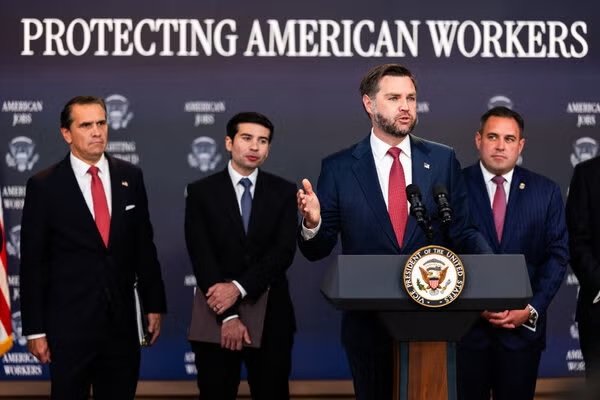
At an October 8 White House press conference, Vice President JD Vance accused Microsoft of replacing American workers with foreign employees. He said: “Our message to Microsoft is: You’re a great American company, but you’ve got to hire great American workers.”
Sonderling said that since 2009 the eight companies had requested almost three million foreign workers, received more than 230,000 H-1B approvals and obtained over 100,000 permanent labour certifications. The underlying dataset and precise definitions were not located. These categories measure different things; none alone establishes how many Americans lost jobs because of foreign hiring.
Microsoft disputed the implication that its H-1B filings mainly represented new recruits. In a statement on October 8, it said it submitted about 6,000 H-1B applications in the previous fiscal year and that 80% were extensions or status changes for existing employees. The remaining filings, it said, concerned people already legally in the United States and equalled about 1% of its US workforce.
Also see: Trump Iran Talks: “Annihilate Iran” UN Threat
Indian workers face uncertainty
For Indian technology workers, the practical risk is delay in a route to permanent residence. The affected employers include major Indian IT services firms with US operations that rely on skilled workers. The announcement does not establish how many individual applications are frozen at each company.
The impact may vary. Tata Consultancy Services said its PERM applications had been in the single digits over the previous two years and that the suspension would not materially affect its workforce strategy. It also said it planned to hire 15,000 employees locally in the United States over five years.
Industry group Nasscom argued that immigration and skilled-talent mobility are distinct and said Indian technology companies have expanded local hiring while reducing H-1B dependence.
The evidence still has to catch up
The administration has a responsibility to enforce labour-certification rules and investigate fraud. But an accusation is not a finding and aggregate visa counts cannot prove a particular American worker was displaced. The action also affects workers who are not accused of wrongdoing.
The decisive evidence would be the suspension order, records supporting the government’s totals, and company-specific findings explaining why each employer was targeted. Officials should disclose those grounds, subject to legitimate privacy and investigative limits and companies should respond with records rather than general assurances.
Until those documents are available, the confirmed development is a suspension from a green-card labour-certification pathway, not public proof that all eight companies committed fraud. For workers awaiting permanent residency, the immediate consequence is a blocked process and no clear timetable for its resumption.
Also see: Trump-Netanyahu Rift Explodes Over Lebanon Strikes as Iran Talks Stall
Also see: Trump Pauses Planned Iran Strike After Gulf Pressure as Oil, Security Fears Mount