
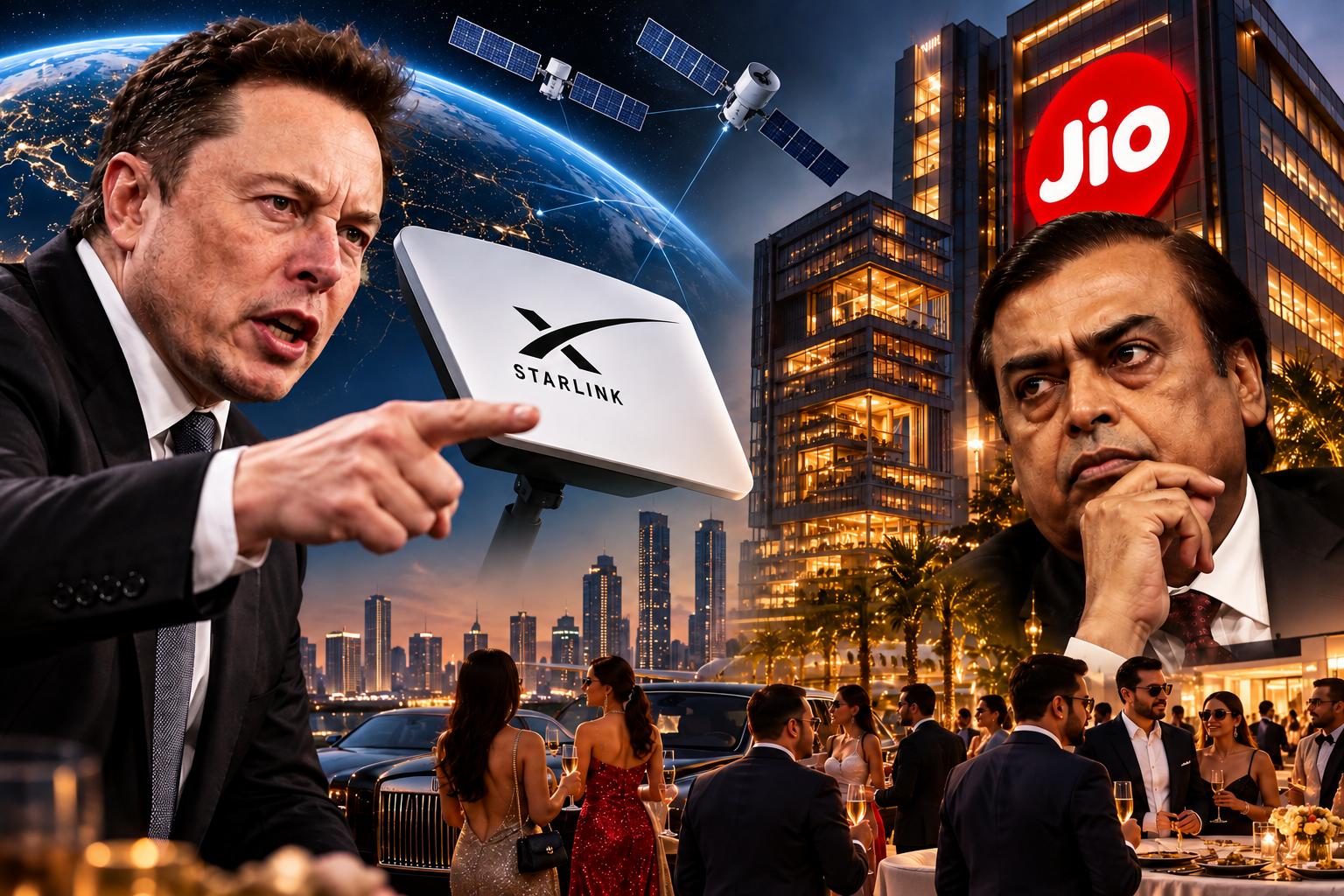
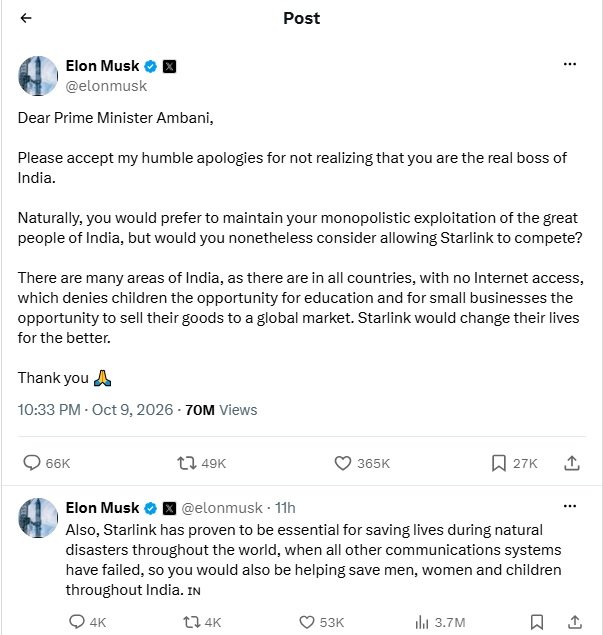
“Dear Prime Minister Ambani,” Elon Musk wrote on X on October 9, sarcastically apologising for not recognising Mukesh Ambani as “the real boss of India” and asking whether he would allow Starlink to compete. The SpaceX chief accused the Reliance Industries chairman of preferring a “monopolistic exploitation” of Indians.
The jab escalated a dispute over Starlink’s delayed commercial launch in India, a huge market where Reliance Jio and Bharti Airtel dominate mobile connectivity. India’s government says Starlink already holds a satellite communications licence but cannot begin service until it clears security requirements and receives a separate spectrum assignment. It also says Starlink and two other licensed operators are at broadly the same regulatory stage.
Musk says powerful business interests are blocking competition; the government says its process is fair.
Musk’s accusation and the government’s response
Musk’s October 9 post followed an earlier accusation on October 8 that “certain oligarchs” were blocking Starlink “in order to maintain their monopolistic chokehold on the Indian people.” He argued that internet gaps deny children educational opportunities and small businesses access to global markets and said Starlink could improve lives and preserve communications during disasters.
Also see: What Is Reliance Intelligence? Is Ambani Building India’s AI Future or His Own?
Also see: Warner Bros Deal Puts Skydance to the $80B Debt Test
Also see: Elon Musk’s Starlink Device Seized from Meitei Insurgent Group in Manipur
The Ministry of Communications responded on October 8 that India’s satellite-communications authorisation framework is “fair and non-discriminatory.” Its statement said licences had been granted to three non-geostationary satellite operators: Starlink Satellite Communication, Jio Satellite Communications and OneWeb India Communications. All three, it said, were undergoing security assessments and were at “broadly the same regulatory stage.”
Telecom Minister Jyotiraditya Scindia reinforced that position on October 9, saying, “India does not allow a monopoly in any sector.” Reliance Jio did not respond to a request for comment on Musk’s remarks, according to contemporaneous reporting. No public evidence cited in the dispute shows that Ambani personally directed officials to delay Starlink.
A licence is not permission to launch
The distinction at the heart of the row is regulatory, not semantic. The Department of Telecommunications’ official GMPCS service page lists Starlink Satellite Communication Private Limited among the three licensees as of June 10, 2025. But the same page explicitly says a GMPCS licence does not confer a right to use spectrum; a separate frequency assignment is required. Security compliance is also mandatory.
That means Musk’s public complaint about not having a licence is imprecise if read literally. Starlink has the relevant authorisation, but it has not yet completed every step needed for commercial operations. The government says the security assessment is still underway for all three licensees. The statement does not disclose each company’s submission dates, outstanding conditions or assessment timeline, preventing an independent comparison.
Also see: AI Chats Are Not Private After Florida Claude Arrest
Also see: Modi Tells Putin Enough With the ‘Endless War’
The dispute has a longer history. In November 2021, India directed Starlink to stop accepting pre-orders until it obtained authorisation. In 2024, authorities recovered Starlink equipment during a drug seizure in the Andaman and Nicobar Islands and an army search in Manipur. Musk said Starlink’s beams had never been active over India. Equipment recovery alone does not prove the service was operating or that SpaceX authorised its use.
Jio is rival and potential partner
On March 12, 2025, Jio Platforms announced an agreement with SpaceX to explore offering Starlink broadband to Jio customers, subject to SpaceX receiving Indian authorisations. The announcement said Jio could make Starlink solutions available through retail outlets and online stores, while the companies explored how their offerings could complement each other.
The agreement does not erase competition. Reliance owns Jio and is pursuing satellite communications through Jio Satellite Communications. Bharti Airtel is associated with OneWeb, another licensed operator. Their commercial interests in market entry, spectrum and fees justify scrutiny, but do not prove improper lobbying or political interference.
Spectrum policy has also been under review. The Telecom Regulatory Authority of India published recommendations on satellite spectrum in 2025 and opened a further consultation on satellite-network authorisation and spectrum assignment in April 2026. Media reports in September 2026 described a proposed usage charge of 5% of adjusted gross revenue, with a one-percentage-point reduction for qualifying rural and remote service. The final order must be checked before treating those figures as binding.
The unanswered question is the paper trail
India has more than a billion internet users and satellite broadband could reach remote communities where fibre or mobile towers are difficult to build. But users need equipment and a service plan; satellite access is not automatically cheaper. Musk’s promise of wider access does not prove Starlink will be affordable for underserved households.
Also see: From Sexual Harassment Allegations to Anti-Feminism Remarks: Elon Musk Faces Fresh Scrutiny
To establish whether Starlink has been treated unfairly, investigators need comparable records for all three licensees: licence dates, security submissions, government queries, responses, outstanding conditions and spectrum-assignment milestones. Meeting records and formal industry submissions could help establish whether competitors lobbied on specific rules. A delay or a meeting alone would not prove that a company caused a regulatory decision.
For now, the verified record supports a narrower conclusion than Musk’s accusation. Starlink has a licence, but security clearance and spectrum assignment remain prerequisites; the government says all three operators are at broadly the same stage. Ambani has been targeted, yet no evidence presented so far establishes that he blocked the launch. The next concrete development to watch is a documented clearance, spectrum decision or company-specific explanation from the government, not another tantrum on X.
Also see: Trump’s Green Card Crackdown Accuses Tech Giants, Shows No Proof
Also see: Russia Plague Lab Death and 5,000 Tests Raise Questions