
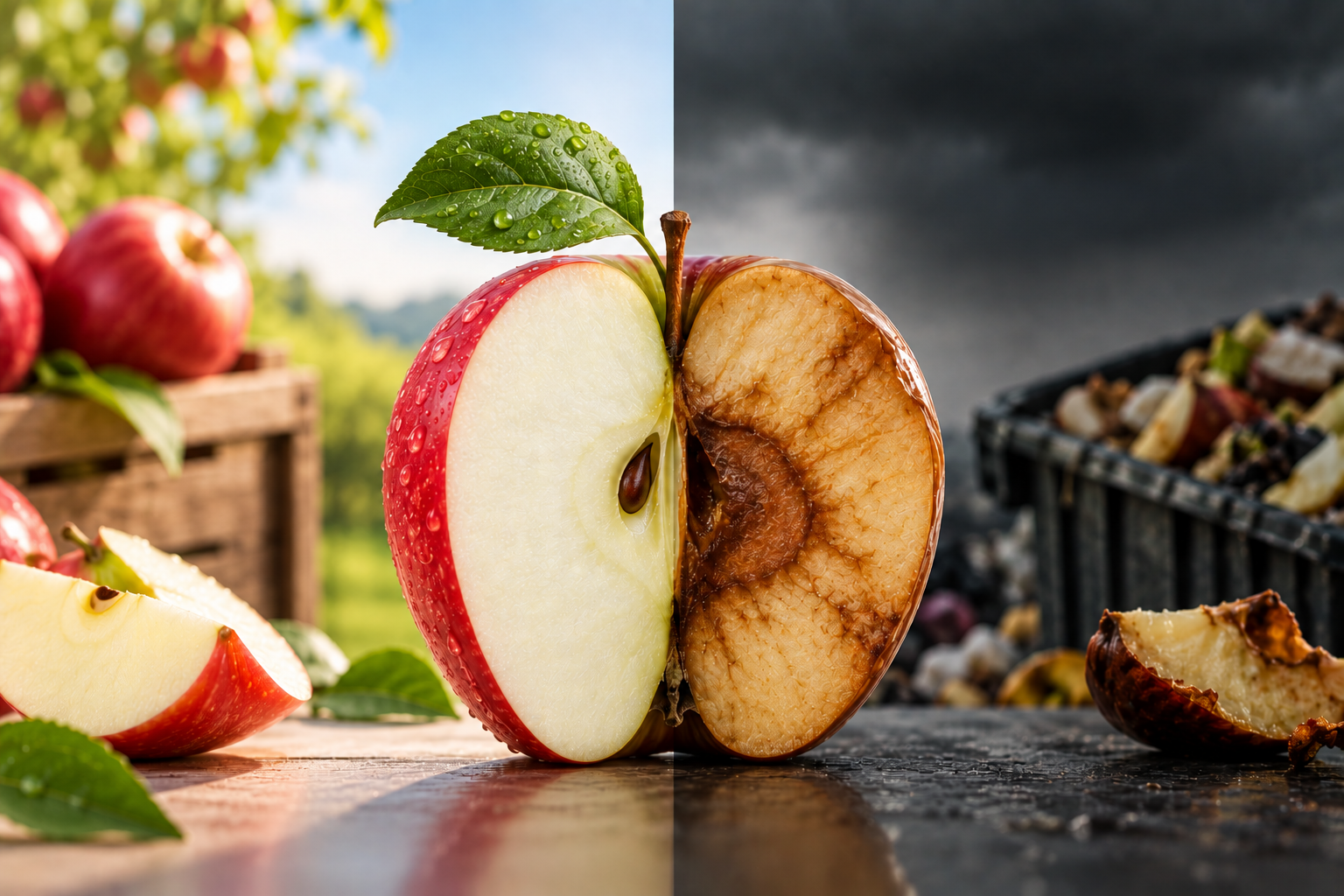
Genetically Modified Apples sound like something designed to solve a huge problem. But their main job is surprisingly simple: stop an apple from turning brown after it is cut. The best known example is the Arctic® apple, developed by Canadian company Okanagan Specialty Fruits. The company says the technology could reduce food waste and make apples easier to sell as ready-to-eat slices. But there is a much bigger question: have Genetically Modified Apples actually helped feed the world, or have they mainly created a new way to sell and store apples?
The Arctic apple was not genetically changed to grow faster, produce more fruit or survive drought. Scientists changed one specific process inside the apple. When a normal apple is cut, oxygen reaches the damaged cells. An enzyme called polyphenol oxidase, or PPO, then starts a chemical reaction that turns the flesh brown. Scientists used a technology called RNA interference, or RNAi, to reduce the activity of the genes that produce PPO. Less PPO means less browning. The apple can still be cut, stored and eaten, but it stays light-colored for much longer.
The idea has been in development for more than 20 years. Okanagan Specialty Fruits planted its first test trees in 2003. The first major regulatory approvals came more than a decade later. The United States approved Arctic Golden and Arctic Granny for commercial cultivation in 2015, while Health Canada approved those varieties for food use the same year. Arctic Fuji was approved later. This means the commercial history of Genetically Modified Apples is no longer brand new. There is now enough time to ask whether the technology has actually delivered the benefits promised by its developers.

Also see: Pav Bhaji Recipe: The Soul of Mumbai’s Favourite Street Food
Also see: Shahi Paneer Recipe with Naan | Restaurant-Style Guide
Also see: Nepal Floods: 933 Hydropower Workers Unaccounted
Also see: PM Modi Uzbekistan Visit: $5 Billion Trade, Uranium Deal
THE BIG CLAIM: CAN A NON BROWNING APPLE HELP FEED THE WORLD?
The strongest argument for these apples is not that they produce more food. They don’t. The argument is that less food could be thrown away.
Food waste is a huge problem. According to the Food and Agriculture Organization of the United Nations, about 13.3% of food was lost globally after harvest and before it reached retail in 2023. Fruits and vegetables had the highest losses among major food groups, at about 25.4%. Apples are part of this larger problem because they can be damaged, bruised or rejected for appearance even when they are still perfectly edible.
This is where Arctic apples are supposed to help. A sliced apple that turns brown quickly can become unattractive to shoppers. Restaurants and food-service companies may also have to throw away prepared fruit when it no longer looks fresh. A non-browning apple can stay visually appealing for longer. Okanagan Specialty Fruits has said that its fresh-cut Arctic apples can remain usable for about 28 days, compared with roughly 18–21 days for similar fresh-cut apples.
That could reduce waste in some parts of the food system. But it would be wrong to say these apples have solved world hunger.
The numbers simply do not support that claim. The United Nations estimated that about 673 million people experienced hunger in 2024. Arctic apples are produced on a tiny scale compared with the world’s major food crops. They do not produce dramatically higher yields and they do not solve problems such as poverty, war, poor transportation, lack of refrigeration or inadequate food storage.
In other words, a non-browning apple can potentially stop some apples from being wasted. That is useful. But it is very different from producing enough additional food to feed hundreds of millions of hungry people.
The company’s founder, Neal Carter, has made the goal clear. “There’s an awful lot of apples that go to waste,” he said. His argument is that keeping apples usable for longer could allow more of the existing harvest to be eaten instead of discarded.
That is probably the strongest food-security argument for Genetically Modified Apples. It is also a much smaller claim than saying they can feed the world.
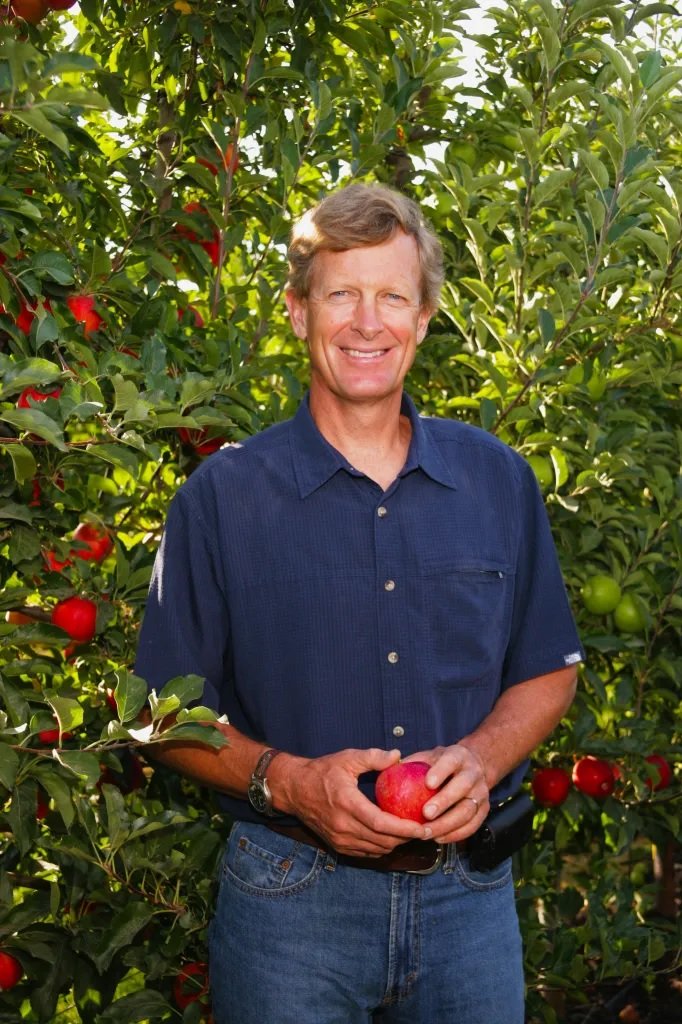
Photo credit: Okanagan Specialty Fruits
Also see: Sheikh Hasina News: Delhi Press Conference Fuels Row
Also see: Russian Ballistic Missile Strike on Kyiv Kills Two as Attacks Intensify Across Ukraine
Also see: Zuckerberg Faces India Apology Demand Over PM Modi Video
THE MONEY QUESTION: WHO ACTUALLY BENEFITS?
The economic case for Genetically Modified Apples is built around one simple idea: if less fruit is wasted, more fruit can potentially be sold.
Imagine a restaurant cutting 100 apples in the morning. If many of those slices turn brown before lunch, some may be thrown away. With a non-browning apple, the restaurant may be able to prepare the fruit earlier and keep it looking fresh for longer. A supermarket could also sell packages of sliced apples over a longer period.
For farmers, processors and retailers, that could mean less wasted product. For consumers, it could mean more convenient ready-to-eat fruit.

The commercial numbers show that Arctic apples did grow after approval. Okanagan Specialty Fruits reported production of about 1.7 million pounds in 2018 and expected around 8.5 million pounds in 2019. The company also reported about 1,235 acres planted at the time.
Those numbers sound impressive, but they need context. Arctic apples remain a small part of the global apple industry. Growth in production does not automatically mean the technology has transformed the economy.
There are also costs. Developing a genetically modified crop takes years of laboratory research, testing and regulatory work. Apple trees are another complication because orchards take years to establish. A farmer cannot simply plant an apple tree today and expect a full commercial harvest tomorrow.
Consumers are another unknown. Some people actively avoid genetically modified foods. Others care more about price, convenience and appearance. That means the economic success of GM apples depends not only on whether the technology works, but also on whether people are willing to buy the product.
Recent research provides an interesting clue. A 2026 study of 413 U.S. consumers found that participants were, on average, willing to pay more for gene-edited apples than for untreated apples. But there is an important warning: gene-edited apples are not exactly the same as the genetically modified Arctic apples already on the market. The study therefore shows that some consumers may accept new apple technologies, but it does not prove that Arctic apples have created a large consumer market.
Neal Carter once summed up his company’s goal this way: “Our goal is to ensure that less apples get wasted, and more apples get tasted.”
That is a reasonable business strategy. It is not proof of a global economic revolution.
Also see: Scholarships in India 2026: Complete List, Eligibility & How to Apply
Also see: NEET Paper Leak Protest: Rahul Gandhi Detained
Also see: ITR Filing 2026: Step-by-Step Guide to File Your Income Tax Return Online
ARE THESE APPLES SAFE AND WHY IS INDIA DIFFERENT?
The health question is probably the one consumers care about most: if scientists changed the apple’s genes, could eating it change our bodies?
For the approved Arctic apples studied by regulators, there is currently no evidence showing that they are more dangerous than conventional apples. Health Canada examined their nutritional composition, possible toxicity and allergenicity. Its assessment concluded that the approved Arctic varieties were as safe and nutritious as conventional apples.
The genetic change is also very specific. Scientists are not replacing the entire apple with something completely different. They are reducing the activity of genes connected to PPO, the enzyme involved in browning.
That does not mean scientists can prove that every genetically modified food ever created will be safe. Each product has to be assessed on its own characteristics. But for the Arctic apples that have undergone regulatory review, authorities have not found evidence of a greater health risk.

India provides a very different story.
There is no evidence that Arctic apples have become a normal part of India’s commercial apple market. India has strict rules around genetically modified food. Since March 1, 2021, imported apple shipments have been required to carry certification showing that they are non-GM and GM-free.
This means the same technology that has entered the U.S. and Canadian markets has not become a mainstream product in India.
And that tells us something important about the economics of biotechnology. Creating a product is only the first step. A genetically modified food also needs regulatory approval, willing farmers, retailers prepared to sell it and consumers prepared to eat it.
So, after more than a decade of commercial development, where does that leave Genetically Modified Apples?
The evidence supports a fairly simple conclusion.
They can reduce browning. They can make sliced apples easier to store and serve. They may reduce some food waste. They have created a commercial business and their production has grown since regulatory approval.
But there is no strong evidence that Genetically Modified Apples have made a meaningful contribution to solving world hunger.
They were never really designed to do that.
Their real purpose was much narrower: make an apple that does not brown so quickly.
That may still be valuable. Food waste is a serious problem, and even small reductions can have economic benefits when applied across large supply chains.
But the future of these apples will depend on a bigger question: are they worth the cost and controversy when other technologies can also slow browning and reduce waste?
Consumers already have refrigeration, packaging and anti-browning treatments. Scientists are also developing newer gene-editing technologies such as CRISPR. If those alternatives become cheaper, easier to regulate and more widely accepted, genetically modified apples may face stronger competition.

For now, the evidence does not show a miracle crop that is feeding the world’s hungry population.
It shows something more specific and perhaps more useful.
A genetically modified apple that stays white longer may help prevent some good food from becoming waste. Whether that benefit is large enough to justify the technology is the real economic question.
Also see: DOLLY PARTON’s Final Curtain: The Woman Who Became an Icon
Also see: From Sexual Harassment Allegations to Anti-Feminism Remarks: Elon Musk Faces Fresh Scrutiny
Also see: ISRO Launches EOS-05, Expanding India’s Space Reach
Also see: The $48.8 Billion Enterprise AI Boom Is Here. Most Businesses Aren’t Ready