

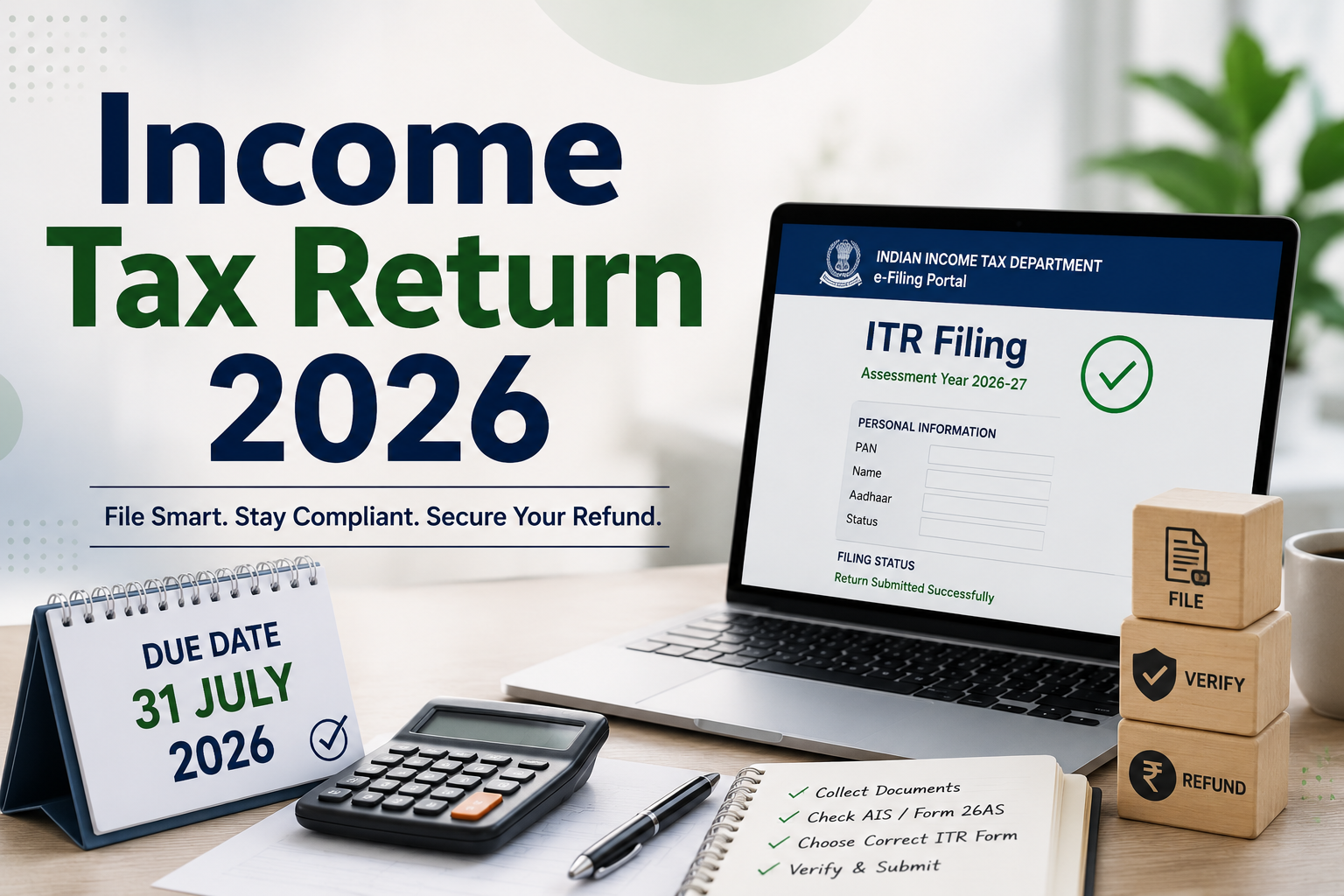
The countdown to the Income Tax Return (ITR) filing deadline has begun, and millions of taxpayers are logging into the Income Tax Department’s e-Filing portal to submit returns for Assessment Year (AY) 2026–27. While the government has continued to simplify the filing process with pre-filled data, online verification, and updated utilities, tax experts say the biggest mistakes now happen before a taxpayer even clicks “Submit.”
The Central Board of Direct Taxes (CBDT) has rolled out updated ITR forms, expanded eligibility for simplified returns, and introduced new reporting requirements for the current filing season. At the same time, the Income Tax Department has strengthened its Annual Information Statement (AIS), making it easier for taxpayers to reconcile their financial records, but also harder to overlook discrepancies.
The official portal guides taxpayers through the filing process with prompts such as “Download Pre-filled Data” and “Verify your return.” Those steps may appear straightforward, but filing an accurate return now requires more than simply entering income details.
Also see: The History of Bitcoin: A Timeline of Innovation and Disruption From 2008-2024
Also see: $300 Million Boost for India’s Tyres: Bridgestone
Three Ways to File Your ITR Online
The Income Tax Department offers taxpayers three official methods to file returns for AY 2026–27.
The first is Online Filing, where users complete the entire return directly on the e-Filing portal without downloading additional software. This option is primarily intended for salaried individuals, pensioners, and taxpayers with relatively straightforward financial profiles.
The second option is the Common Offline Utility, which allows taxpayers to download a JSON-based utility, import pre-filled information, complete the return offline, validate the data, generate a JSON file, and upload it to the portal.
A third option remains available through the Excel Utility, which requires Microsoft Excel with macros enabled. After entering and validating financial information, taxpayers generate a JSON file for submission through the portal.
Regardless of the filing method, every return must be verified before it is treated as successfully filed. Taxpayers can complete verification using Aadhaar OTP, Net Banking, Bank Account Electronic Verification Code (EVC), Demat Account EVC, Digital Signature Certificate (DSC), or by sending a signed ITR-V to the Centralized Processing Centre (CPC) in Bengaluru.
Also see: Amazon Layoffs 2026: 16,000 Corporate Jobs Cut Globally
Also see: Are You a Leader or a Follower?
Also see: Income Tax Return Filing for AY 2025-26: What We Know So Far
Choosing the Correct ITR Form Matters More Than Ever
One of the least explained, but most important parts of filing an Income Tax Return is selecting the correct ITR form.
The department currently provides seven ITR forms, each designed for different categories of taxpayers. Filing the wrong form can result in a defective return, delayed processing, or the need to submit a revised return.
For AY 2026–27, eligible individuals earning up to ₹50 lakh can continue using ITR-1, and this year brings an important change. Eligible taxpayers may now report up to two house properties while remaining within ITR-1, expanding access to the simplified form.
The updated forms also permit eligible taxpayers to report certain long-term capital gains under Section 112A up to ₹1.25 lakh, subject to prescribed conditions. Tax professionals say these changes reduce unnecessary migration to more complex forms while simplifying compliance for many salaried individuals.
The filing portal itself does not explain which form should be selected. Instead, taxpayers are expected to determine eligibility before beginning the filing process, making form selection one of the most critical decisions during return preparation.
Also see: Diploma vs Degree – Which is Right for You? | Gd Topic
Also see: Diversity in the Workplace is Overstated
Also see: Flexi Timings or Fixed Timings – Which is better at Work?
Why AIS Has Become Just as Important as Form 16
For years, salaried employees relied almost entirely on Form 16 while filing returns.
That approach is changing.
The Income Tax Department now encourages taxpayers to compare information available in the Annual Information Statement (AIS), Taxpayer Information Summary (TIS), Form 26AS, bank statements, and investment records before submitting returns.
AIS has evolved into one of the department’s most comprehensive reporting tools. It can include salary information, bank interest, dividends, securities transactions, mutual fund investments, specified financial transactions, tax deducted at source, and, in eligible cases, foreign financial information received under international information-sharing arrangements.
This means taxpayers should not assume that pre-filled information is automatically complete or accurate. The legal responsibility for reporting correct income remains with the taxpayer, even when much of the return is pre-populated by the portal.
Recent reports have also highlighted technical issues during the current filing season, including temporary utility-related problems affecting home loan interest reporting, reinforcing the importance of reviewing every section carefully before submission.
Also see: Gen Z Work-Life Balance
Also see: IB ACIO Recruitment 2025: 3,700+ Officer Vacancies Announced
Also see: Job Hoppers or Change Makers?
A Digital Tax System That Is Becoming More Data-Driven
India’s income tax system has undergone a significant transformation over the past decade.
Paper returns have largely been replaced by online filing, Aadhaar-based verification, electronic verification codes, pre-filled returns, and integrated financial reporting. The latest filing season continues that trend.
From 1 April 2026, the Income-tax Act, 2025 came into force, replacing the previous legislation. The Income Tax Department has clarified that taxpayers filing returns for income earned during FY 2025–26 are required to submit only one return for AY 2026–27 under the notified filing framework.
Another major development is the department’s growing use of international financial information. Recent CBDT initiatives have expanded AIS to include foreign financial information received under international exchange agreements, making overseas bank accounts, investments, and certain foreign income more visible to eligible taxpayers.
For taxpayers with foreign assets, this means reviewing Schedule FA and reconciling overseas financial information has become increasingly important before filing.
Also see: What Is More Important in a Job: Money or Job Satisfaction?
Also see: Moonlighting in India: Pros and Cons | 2025 | GD Topic
Also see: UK TECH TAX: A Critical Crossroad for the UK and Global Tech Giants
Common Mistakes That Can Delay Refunds
Tax experts say today’s filing errors are less about mathematical mistakes and more about reporting inaccuracies.
Common issues include selecting the wrong ITR form, relying only on Form 16 without checking AIS, incorrectly reporting capital gains, entering incorrect bank account details for refunds, and forgetting to complete e-verification after submission.
Another common misconception is that filing ends after clicking the submit button. It does not.
Unless the return is verified using one of the approved methods, the filing process remains incomplete.
For most individual taxpayers who are not subject to audit requirements, the due date for filing returns for AY 2026–27 is 31 July 2026. Waiting until the last few days increases the risk of portal congestion and leaves little time to correct validation errors or missing information.
As the filing season gathers pace, the government’s message is clear: digital filing is easier than ever, but accuracy matters more than speed. Reviewing documents, selecting the correct ITR form, reconciling AIS with financial records, and completing verification remain the steps that determine whether a return is processed smoothly or becomes another case requiring corrections after submission.
Also see: Novo Nordisk Ends Remote Work, Cuts 9,000 Jobs
Also see: Skills vs Exams: Why Practical Abilities Matter More in Today’s Job Market
FAQs
1. What is ITR filing?
ITR filing is the process of submitting your income and tax details to the Income Tax Department.
2. Who should file an Income Tax Return?
Individuals meeting prescribed income or filing conditions under the Income Tax Act should file an ITR.
3. What is the last date for ITR filing in AY 2026–27?
For most non-audit taxpayers, the due date is 31 July 2026.
4. Which website should I use to file my ITR?
Use the official Income Tax e-Filing portal at incometax.gov.in.
5. What documents are required for ITR filing?
Keep PAN, Aadhaar, Form 16, AIS, Form 26AS, TIS, and bank statements ready.
6. How do I choose the correct ITR form?
Choose the form based on your income source, taxpayer category, and eligibility.
7. Can I file my ITR online?
Yes, the Income Tax Department offers a complete online filing facility.
8. What is AIS in income tax?
AIS is a statement showing your reported financial transactions and income details.
9. Is e-verification mandatory after filing?
Yes, your return is incomplete until it is successfully verified.
10. What are the ways to verify an ITR?
You can verify using Aadhaar OTP, Net Banking, EVC, DSC, or ITR-V.
11. What happens if I choose the wrong ITR form?
Your return may become defective or require revision.
12. Can I edit my ITR after submitting it?
Yes, eligible taxpayers can file a revised return if corrections are needed.
13. What is pre-filled data in ITR filing?
It is taxpayer information automatically populated from available tax records.
14. Can I file my ITR offline?
Yes, you can use the Common Offline Utility or Excel Utility.
15. Why should I check AIS before filing?
It helps identify mismatches and ensures accurate income reporting.
16. How can I track my ITR refund?
You can track your refund status through the Income Tax e-Filing portal.
17. What happens if I miss the ITR filing deadline?
You may have to pay penalties and lose certain tax benefits.
18. Is Form 16 enough for ITR filing?
No, also verify your details using AIS, TIS, and Form 26AS.
19. Can I file an ITR without Form 16?
Yes, if you have all the necessary income and tax information.
20. Why is ITR filing important?
It ensures tax compliance and helps with refunds, loans, visas, and financial documentation.