
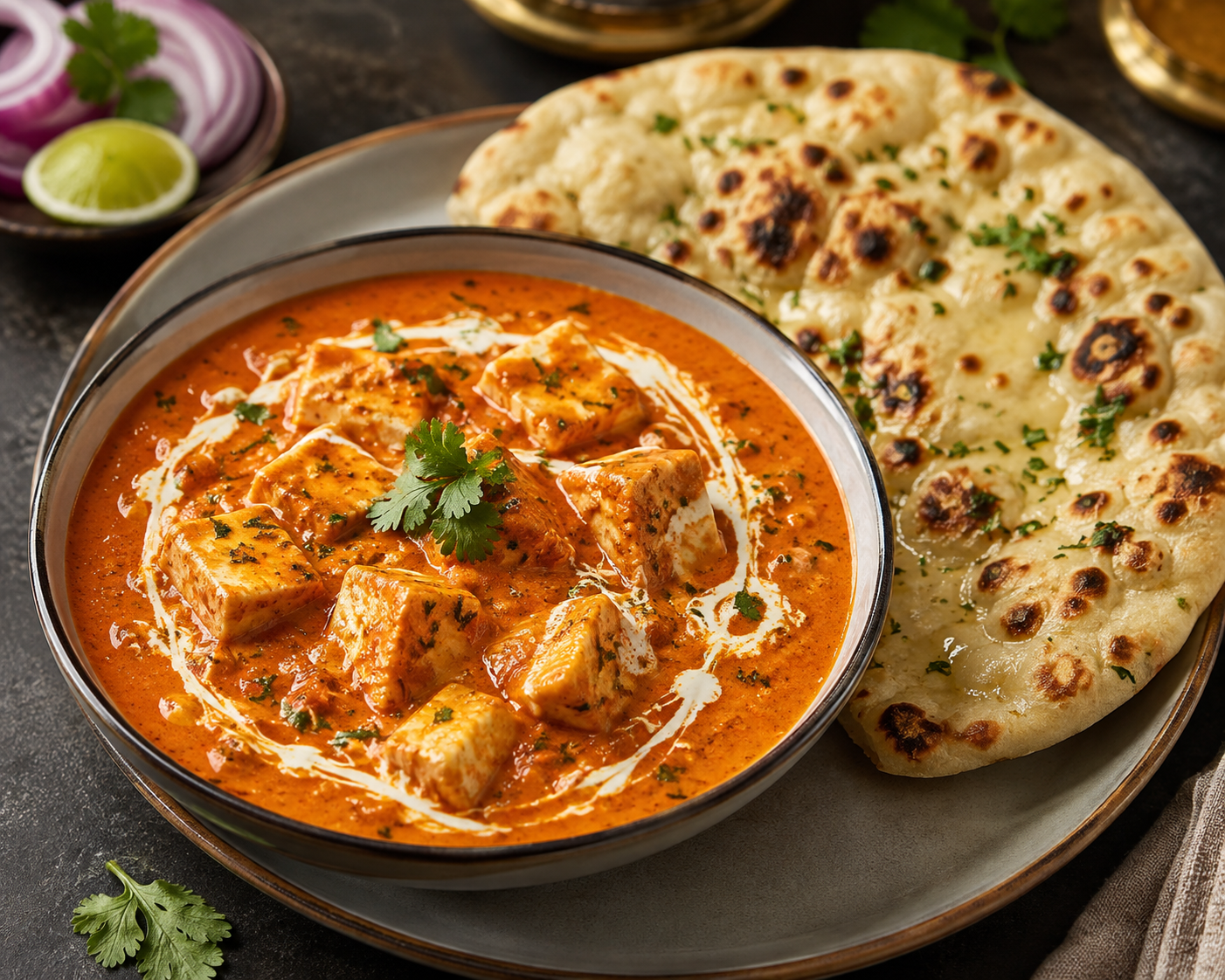
SHAHI PANEER & NAAN: Michelin-Star Indian Fine Dining × Traditional Punjabi
Serves: 2 people
Difficulty: Beginner, with professional techniques
Total time: Approximately 1 hour 35 minutes
Preparation: 30 minutes
Cooking: 45 minutes
Resting: 20 minutes
The three techniques that matter most:
- Cooking the onion-tomato base slowly so it becomes sweet rather than harsh.
- Blending and straining the sauce until it becomes exceptionally smooth.
- Controlling heat when adding dairy so the shahi sauce stays glossy and does not split.
1. EQUIPMENT
| Equipment | Size | Purpose | Substitute |
| Heavy saucepan | 2–3 L | Cooking curry | Deep frying pan |
| Frying pan/skillet | 24–26 cm | Searing paneer | Non-stick pan |
| Mixing bowls | 3–4 medium | Ingredients | Plates |
| Kitchen scale | — | Accurate weighing | Measuring cups |
| Measuring spoons | — | Spices/salt | Small spoons, carefully measured |
| Blender | 700 ml+ | Making smooth sauce | Food processor |
| Fine-mesh strainer | 16–20 cm | Removing fibres/seeds | Clean sieve |
| Wooden spoon | — | Stirring | Heatproof spatula |
| Silicone spatula | — | Scraping blender/pan | Spoon |
| Tongs | — | Turning paneer/naan | Spatula |
| Rolling pin | 30–40 cm | Rolling naan | Clean glass bottle |
| Pastry brush | — | Buttering naan | Back of spoon |
| Knife | Chef’s knife | Cutting ingredients | Small sharp knife |
| Cutting board | Medium | Chopping | Clean flat board |
| Kitchen thermometer | — | Checking dairy/paneer | Sensory cues below |
| Kitchen towel | — | Handling hot naan | Thick oven mitt |
| Cast-iron/tawa | 26–28 cm | Cooking naan | Heavy skillet |
| Ladle | — | Serving curry | Large spoon |
| Two warm serving plates | 25–28 cm | Plating | Any clean plates |
Important: Keep a clean, dry kitchen towel away from open flames. Never touch hot cookware with a wet towel because steam can burn you.
2. INGREDIENTS
Shahi Paneer
- Paneer, 250 g, preferably fresh, full-fat, cut into 2.5 cm cubes. Soft paneer gives the best texture.
- Neutral oil, 15 ml.
- Ghee, 20 g.
- Unsalted butter, 15 g.
- Yellow onion, 120 g after peeling, roughly chopped.
- Ripe red tomato, 180 g, roughly chopped.
- Raw cashews, 35 g.
- Ginger, 12 g, peeled and chopped.
- Garlic, 10 g, peeled.
- Green chilli, 5 g, optional.
- Water, 250 ml, plus approximately 100 ml extra if required.
- Kashmiri chilli powder, 2 g, about 1 teaspoon.
- Coriander powder, 3 g, about 1½ teaspoons.
- Turmeric, 0.5 g, about ¼ teaspoon.
- Garam masala, 1 g, about ½ teaspoon.
- Ground cardamom, 0.5 g, about ¼ teaspoon.
- Salt, 5 g initially, then adjust carefully.
- Sugar, 4 g, approximately 1 teaspoon.
- Double cream/heavy cream, 60 ml, chilled.
- Kasuri methi, 1 g, approximately 1 teaspoon, crushed between your fingers.
- Lemon juice, 5 ml.
- Fresh coriander, 10 g, finely chopped.
- Optional saffron: 0.1 g, soaked in 15 ml warm water for 10 minutes.
Naan
- Plain flour/maida, 250 g.
- Plain full-fat yogurt, 60 g, room temperature.
- Warm water, 90–110 ml, approximately 38–40°C.
- Sugar, 5 g.
- Salt, 4 g.
- Baking powder, 3 g.
- Baking soda, 1 g.
- Neutral oil, 10 ml.
- Melted butter or ghee, 25 g, for finishing.
- Fresh coriander, 5 g, finely chopped.
- Optional nigella seeds, 2 g.
3. MISE EN PLACE
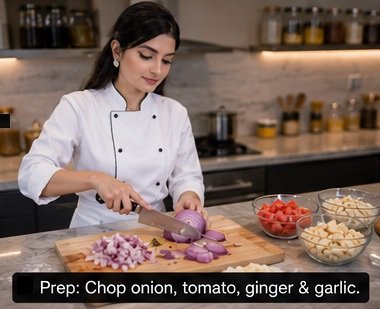
“Mise en place” means preparing and organizing everything before cooking.
Wash your coriander, tomatoes and green chilli. Peel the onion, ginger and garlic. Chop the onion and tomatoes into pieces roughly 2–3 cm wide. They do not need to be beautiful because they will be blended.
Measure every spice into one small bowl. Measure the cream separately. Keep the butter and ghee beside the stove.
Put the cashews into a bowl.
Cut paneer into equal cubes. Place them on a plate.
For the naan, combine flour, sugar, salt, baking powder and baking soda in a large bowl.
Warm the water to approximately 38–40°C / 100–104°F. It should feel comfortably warm, never hot.
Also see: Fast Food Culture: Pros & Cons | Gd Topic
Also see: Russia Kyiv Strike 2026: 27 Killed in Deadliest Russian Attack
Also see: Quad Ministers Meeting Held in New Delhi Amid China Tensions
Also see: Trump and Xi Strike Tone in Beijing as US-China Tensions Simmer
4. MAKE THE NAAN DOUGH FIRST

Add yogurt and oil to the flour mixture. Add 90 ml warm water gradually while mixing with your fingers.
When the mixture becomes shaggy and no dry flour remains, knead it.
Kneading means repeatedly pushing, folding and turning dough to develop its structure.
Knead for 7–8 minutes.
What you should feel
At first the dough feels rough. After kneading, it should become soft, smooth and slightly tacky but should not leave a thick layer on your fingers.
If extremely sticky, add flour 5 g at a time. If dry or cracking, add water 5 ml at a time.
Form a smooth ball. Lightly oil it. Cover the bowl with a damp kitchen towel.
Rest for 30 minutes at room temperature.
WHY?
Resting allows the flour to absorb water and lets the dough relax. Relaxed dough stretches rather than fighting the rolling pin.
5. BUILD THE SHAHI SAUCE
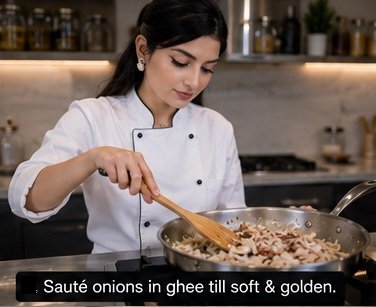
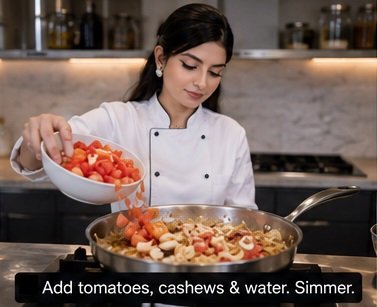
Place the saucepan over medium heat, approximately 150–170°C / 300–340°F pan surface temperature.
Add ghee and oil.
You want the fat hot but not smoking. Drop one tiny piece of onion into the pan. It should immediately make a gentle sizzling sound. If the oil smokes, remove the pan from heat for 30 seconds.
Add onion.
Cook for 5–7 minutes, stirring every 30–45 seconds.
LOOK
The onion should become soft and translucent with pale golden edges.
SMELL
It should smell sweet and savoury, not burnt.
SOUND
Gentle sizzling is correct. Violent crackling means the heat is too high.
Add ginger, garlic and green chilli.
Cook 60–90 seconds.
Do not brown the garlic heavily. Dark brown garlic tastes bitter.
Add tomatoes and cashews.
Add 150 ml water.
Increase to medium-high until the liquid reaches a gentle boil, approximately 95–100°C / 203–212°F at normal sea-level conditions.
A gentle boil has steady bubbles but is not violently splashing.
Immediately reduce to medium-low, approximately 110–130°C / 230–266°F pan temperature.
Cover partially and cook 15 minutes.
Stir every 3–4 minutes.
Also see: Indian Army Uniform 2026 Introduces Major Dress Reforms
Also see: France Economic Slowdown: Job Market Concerns & Reform Urgency
CHECKPOINT 1 — SAUCE BASE
Correct:
- Tomatoes completely soft.
- Onion soft enough to crush with a spoon.
- Cashews swollen and tender.
- No raw tomato smell.
- Sweet, rounded aroma.
Incorrect:
- Hard vegetables: continue cooking 3–5 minutes.
- Burnt bottom: immediately transfer the unburnt mixture to another pan. Do not scrape the black layer.
6. BLEND AND STRAIN
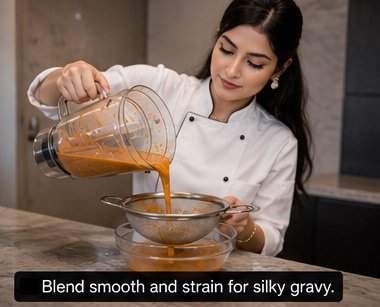
Turn off the heat.
Let the mixture cool for 5 minutes.
This matters because extremely hot liquid can expand violently inside a blender.
Transfer carefully to the blender. Add approximately 50 ml water.
Secure the lid firmly. Start at low speed, then increase gradually.
Blend for 60–90 seconds.
The mixture should look completely smooth, glossy and creamy.
Pour through the fine-mesh strainer into a clean saucepan.
Use the back of a ladle to push the sauce through.
Discard the dry fibrous material left in the strainer.
WHY?
Straining removes tomato seeds, onion fibres and cashew particles. This is one of the biggest differences between ordinary home-style gravy and an exceptionally refined restaurant sauce.
7. SEASON THE SAUCE
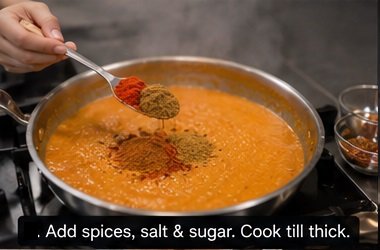
Place the strained sauce over medium-low heat.
Add:
- Kashmiri chilli powder
- Coriander powder
- Turmeric
- Salt: 5 g
- Sugar: 4 g
Stir continuously for the first minute.
Cook for 7–10 minutes.
The sauce should reach approximately 85–95°C / 185–203°F, with occasional small bubbles.
Do not allow aggressive boiling.
CHECKPOINT 2 — REDUCTION
Correct:
- Sauce coats the back of a spoon.
- Colour is deep orange-red.
- Texture is silky.
- Raw spice smell has disappeared.
- Aroma is sweet, nutty and warmly spiced.
If watery, continue cooking uncovered for 2–3 minutes at a time.
If excessively thick, add water 15 ml at a time.
8. TASTE LIKE A CHEF
Turn the heat to low.
Taste a small spoonful after allowing it to cool for several seconds.
Ask:
Is it salty enough?
If bland, add 0.5 g salt, stir, wait 30 seconds and taste again.
Is it too sweet?
Do not immediately add lemon. First add a tiny pinch of salt and taste again.
Does it taste flat?
Add 1–2 ml lemon juice, stir and taste.
Is it too acidic?
Add 1 g sugar, stir and taste.
Is the spice too aggressive?
Add 10–15 ml cream later.
The goal is not maximum spice. The goal is balance: savoury, mildly sweet, aromatic, creamy and gently acidic.
9. FINISH THE SHAHI SAUCE
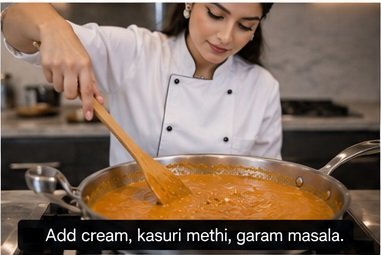
Add crushed kasuri methi, garam masala and cardamom.
Cook for 60 seconds on low heat.
Add cream gradually while stirring.
Keep the sauce around 75–85°C / 167–185°F.
Do not boil the cream aggressively.
Add saffron water if using.
Stir in butter.
Turn the heat to the lowest possible setting.
WHY?
Cream contains milk proteins and fat. Aggressive boiling can destabilize the mixture, producing a grainy or oily sauce. Gentle heat keeps the emulsion smooth.
10. PREPARE THE PANEER

For particularly soft paneer, soak the cubes in hot water at approximately 60–70°C / 140–158°F for 10 minutes, then drain and pat dry.
Heat the frying pan over medium heat, approximately 170–190°C / 338–374°F.
Add 5 ml oil.
Place paneer cubes into the pan without overcrowding.
Sear for approximately 45–60 seconds per side.
You are not trying to cook the paneer through. You are creating light golden surfaces.
LOOK
Golden edges, white centre.
FEEL
Soft and springy.
WARNING
Do not fry paneer until dark brown. It becomes rubbery.
Transfer paneer directly into the sauce.
Simmer gently for 3 minutes at approximately 80–90°C / 176–194°F.
Turn off the heat.
Rest the curry for 5 minutes.
11. SHAPE THE NAAN
Divide the rested dough into 4 equal pieces, approximately 100–105 g each.
Roll each piece into a ball.
Flatten one ball.
Dust lightly with flour.
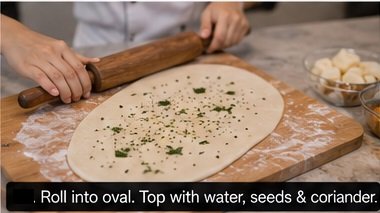
Roll into an oval approximately 18–20 cm long and 3–4 mm thick.
Do not make it perfectly thin. A slightly thicker centre creates a soft interior.
Brush one side lightly with water.
Sprinkle optional nigella seeds and coriander.
12. COOK THE NAAN


Heat a heavy tawa or skillet over medium-high heat for approximately 4–5 minutes.
Target pan surface temperature: 220–260°C / 428–500°F.
The pan must be hot enough that the dough bubbles quickly.
Place the wet side onto the hot pan.
Cook 30–45 seconds.
You should see bubbles forming.
Flip.
Cook another 30–60 seconds until brown spots appear.
If using a suitable cast-iron tawa, you may briefly hold it upside down over a gas flame to blister the upper surface. Do this only if your cookware is designed for it and you are comfortable controlling an open flame.
Otherwise, simply continue cooking in the pan.
Brush immediately with melted butter or ghee.
Repeat with remaining dough.
CHECKPOINT 3 — NAAN
Correct:
- Brown blistered spots.
- Soft centre.
- Slightly crisp edges.
- Pleasant roasted flour aroma.
Incorrect:
- Pale and chewy: pan was insufficiently hot.
- Black and bitter: pan was too hot.
- Hard: naan was overcooked or dough was too dry.
Also see: World Cup 2026 Roundup: Six Matches Produce Historic Milestones
Also see: Ambedkar Jayanti 2026: A Nation Marks Equality
13. FINAL SEASONING

Return the curry to very low heat for approximately 30–45 seconds if necessary.
Add lemon juice.
Taste once more.
The final sauce should be rich but not heavy, sweet but not sugary, spicy but not aggressive.
The paneer should remain tender.
14. PLATING

Fine-Dining Version
Warm two wide white plates.
Spoon approximately 220–250 g curry into the centre of each plate.
Use the back of the spoon to create a smooth circular pool.
Place approximately 125 g paneer across the centre, leaving visible sauce around it.
Add a tiny drizzle of cream.
Add 2–3 drops of ghee or melted butter.
Scatter a few pieces of coriander and a tiny pinch of crushed kasuri methi.
Do not cover the entire surface with garnish. Negative space—the empty area around the food—is part of elegant plating.
Place one folded naan beside the curry and one behind it.
Home Version
Use a warm shallow bowl. Spoon curry into the centre. Place paneer visibly on top. Add coriander, cream and butter. Put naan on a separate warm plate.
The food should look abundant, not crowded.
15. SERVING TEMPERATURE

Serve the curry at approximately 65–75°C / 149–167°F.
It should be hot enough to steam gently but cool enough to taste comfortably after a short pause.
Serve within 5–10 minutes of finishing.
If extremely hot, flavours become harder to perceive and the creaminess can seem less pronounced.
Warm plates help prevent rapid cooling.

16. COMPLETE TIMELINE
| Time | Action |
| 00:00 | Gather equipment and ingredients |
| 00:05 | Chop vegetables and measure spices |
| 00:15 | Mix and knead naan dough |
| 00:25 | Begin curry base |
| 00:40 | Simmer vegetables and cashews |
| 00:45 | Cool and blend |
| 00:50 | Strain sauce |
| 00:55 | Reduce and season |
| 01:05 | Rest and shape naan |
| 01:10 | Sear paneer |
| 01:15 | Finish curry |
| 01:20 | Cook naan |
| 01:30 | Taste and adjust |
| 01:35 | Plate and serve |
17. TEN BEGINNER MISTAKES
1. Burning onions: Heat is too high. Lower it and stir frequently.
2. Burning garlic: Garlic needs only 60–90 seconds. Add tomatoes quickly.
3. Boiling cream: Keep below an aggressive boil.
4. Over-frying paneer: Golden is enough; dark brown becomes chewy.
5. Skipping straining: This produces a less refined sauce.
6. Adding all water immediately: Reduction becomes harder to control.
7. Oversalting: Add salt in measured increments rather than handfuls.
8. Making naan too thin: Keep it approximately 3–4 mm.
9. Using a cold pan: Naan will become dry before blistering.
10. Serving immediately after extreme heat: Give the curry several minutes to settle.
18. TROUBLESHOOTING
| Problem | Likely cause | Fix |
| Too salty | Excess salt | Add unsalted cream/water gradually; balance with tiny sugar addition |
| Too watery | Insufficient reduction | Simmer uncovered 2–3 minutes at a time |
| Too thick | Excess reduction | Add water 15 ml at a time |
| Burnt | Excessive heat | Transfer immediately without scraping bottom |
| Bland | Insufficient seasoning | Add salt 0.5 g at a time; then acidity |
| Too spicy | Excess chilli | Add 10–15 ml cream and 1–2 g butter |
| Too acidic | Sharp tomatoes | Add 1 g sugar and 10 ml cream |
| Sauce split | Excessive heat | Remove from heat and whisk in 15 ml warm cream |
| Paneer rubbery | Over-frying | Next time soak first and sear briefly |
| Naan hard | Overcooking/dry dough | Reduce cooking time and increase dough hydration slightly |
19. PROFESSIONAL RESTAURANT TECHNIQUES
The sauce should be silky rather than merely thick. Thickness alone is not quality.
The onion provides sweetness and body. Tomatoes provide acidity. Cashews provide natural richness and help create a luxurious mouthfeel. Butter and cream provide finishing richness rather than replacing proper cooking.
The sauce is blended because mechanical breakdown releases flavour and creates uniform texture. Straining removes particles that would otherwise interrupt that texture.
Season in layers. Salt the base, taste after reduction, then make the final adjustment. This is more controllable than adding a large quantity at the end.
Acidity should be added carefully at the finish. Lemon juice brightens a rich sauce, but too much makes the curry taste sour.
Temperature is equally important. The final sauce should be warm and fluid, not violently boiling.
Also see: Global Trade Turbulence: How Tariffs are Reformulating Economic Growth by 2025
Also see: The Global Economy Faces a 2025 Slowdown, But India’s Growth Remains Strong
Also see: Indian Women in Blue-Collar Jobs: Breaking Barriers, Filling the Salary Gap
20. STORAGE AND REHEATING
Refrigerate leftovers within 2 hours of cooking.
Store in a sealed container at 4°C / 40°F or colder.
For conservative food safety, consume refrigerated leftovers within 3 days.
The curry freezes reasonably well, although paneer may become slightly firmer after freezing. Naan is better frozen separately.
Reheat curry gently in a saucepan over low-medium heat until steaming throughout, approximately 74°C / 165°F internally.
Stir frequently.
Do not repeatedly boil it.
Add 15–30 ml water or cream if the sauce becomes too thick.
Reheat naan in a hot dry pan for approximately 30–60 seconds per side, then brush with butter.
21. MAKE-AHEAD PLAN
1 day before
Prepare the curry base, blend and strain it. Refrigerate promptly.
4 hours before
Prepare naan dough and refrigerate covered if necessary. Bring it toward room temperature before shaping.
1 hour before
Finish seasoning the sauce and prepare paneer.
Immediately before serving
Cook naan, warm curry gently, add paneer, finish with butter, cream, lemon and herbs.
Do not cook naan hours in advance. Fresh naan is dramatically better.
CHEF’S NOTES
1. Fresh paneer matters. Soft paneer gives a delicate centre that contrasts with the silky sauce.
2. Do not chase darkness. Deeply browned onions are not automatically better for shahi paneer. The goal is sweetness and depth without bitterness.
3. Strain twice if necessary. If your blender is weak, pass the sauce through the sieve twice.
4. Taste after cooling slightly. Extremely hot food can make seasoning difficult to judge.
5. Use butter as a finishing ingredient. Stirring it in at the end gives the sauce a glossy appearance and richer mouthfeel.
6. Lemon is the final adjustment. Add it only after the sauce has reached its desired richness.
7. Keep paneer treatment gentle. Shahi paneer should contain soft cubes, not fried cheese nuggets.
8. Make the naan last. The aroma, blistering and softness are at their peak immediately after cooking.
9. Serve contrast. Silky hot curry beside soft, blistered naan creates a much more exciting eating experience than making every component equally rich.
10. The final test: Close your eyes and taste the curry. You should first notice butter and cream, then tomato sweetness, followed by warm spices, cashew richness and finally a small lift of acidity. Nothing should dominate.
FINAL RECIPE CARD
SHAHI PANEER
250 g paneer; 120 g onion; 180 g tomato; 35 g cashews; 12 g ginger; 10 g garlic; 5 g chilli; 20 g ghee; 15 g oil; 15 g butter; 60 ml cream; 250–350 ml water; 2 g Kashmiri chilli; 3 g coriander powder; 0.5 g turmeric; 1 g garam masala; 0.5 g cardamom; 1 g kasuri methi; 4 g sugar; 5 g initial salt; 5 ml lemon juice.
NAAN
250 g flour; 60 g yogurt; 90–110 ml warm water; 5 g sugar; 4 g salt; 3 g baking powder; 1 g baking soda; 10 ml oil; 25 g melted butter/ghee.
ESSENTIAL TEMPERATURES
Dough water: 38–40°C / 100–104°F.
Curry simmer: 85–95°C / 185–203°F.
Cream finishing: 75–85°C / 167–185°F.
Paneer searing pan: 170–190°C / 338–374°F.
Naan pan: 220–260°C / 428–500°F.
Serving curry: 65–75°C / 149–167°F.
ESSENTIAL ORDER
Knead dough → rest 30 minutes → cook onion → add ginger/garlic → add tomato/cashew/water → simmer 15 minutes → cool → blend → strain → reduce → season → add dairy → sear paneer → simmer paneer 3 minutes → rest → cook naan → finish with butter, lemon and herbs → plate immediately.
Your goal is not simply to make a curry. Your goal is to create a sauce that is silky, balanced and deeply aromatic, tender paneer that remains delicate, and naan that arrives blistered, buttery and steaming. Control the heat, trust your senses, and never rush the sauce.
Also see: World Cup 2026 Roundup: Six Matches Produce Historic Milestones
Also see: Ronaldo World Cup Record: Portugal 5-0 Uzbekistan
Also see: USA 2-0 Australia: Pulisic Out, Knockout Spot Secured