
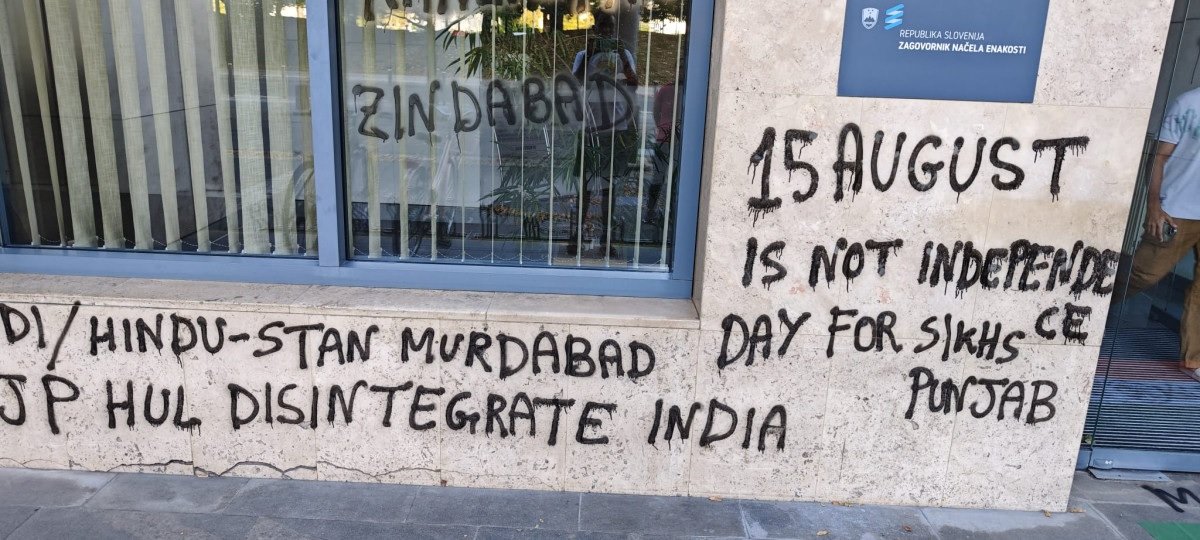
“The Indian Embassy Slovenia in Ljubljana was defaced with pro-Khalistan graffiti, prompting India to demand action against those responsible and stronger security for its diplomatic mission.”
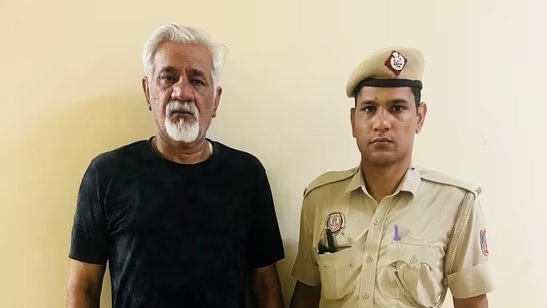
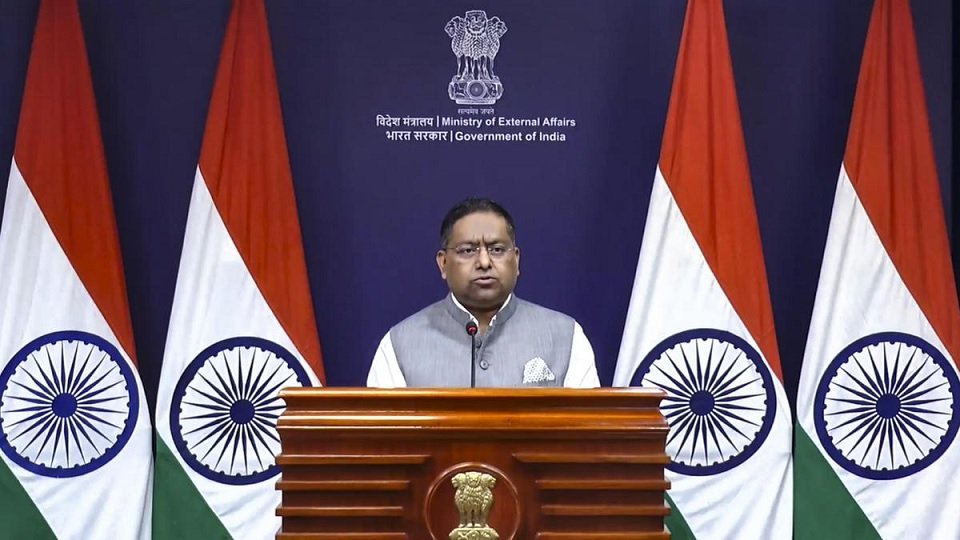
India has demanded that Slovenian authorities identify and prosecute those responsible for defacing the Indian Embassy in Ljubljana, after the Ministry of External Affairs said the diplomatic premises had been targeted by “anti-India elements.” The incident was condemned by New Delhi on August 10, with the MEA saying it had taken up the matter “strongly” with authorities in both New Delhi and Ljubljana. The ministry did not publicly identify suspects, disclose the damage, or say whether arrests had been made.
Indian Embassy Slovenia: What India has officially said
The embassy is located at Železna Cesta 16 in Ljubljana. India’s official embassy website lists Amit Narang as ambassador. The embassy opened in Ljubljana in February 2007, while India and Slovenia established diplomatic relations on May 18, 1992. Slovenia’s government describes the relationship as good and friendly.
The legal issue behind India’s protest is specific. Article 22 of the 1961 Vienna Convention on Diplomatic Relations says mission premises are inviolable and requires the receiving state to take “all appropriate steps” to protect them against intrusion or damage and prevent disturbance of the mission’s peace or impairment of its dignity. India’s statement directly invoked that obligation. The convention does not make an embassy foreign territory, but it creates a special protection regime for diplomatic premises.
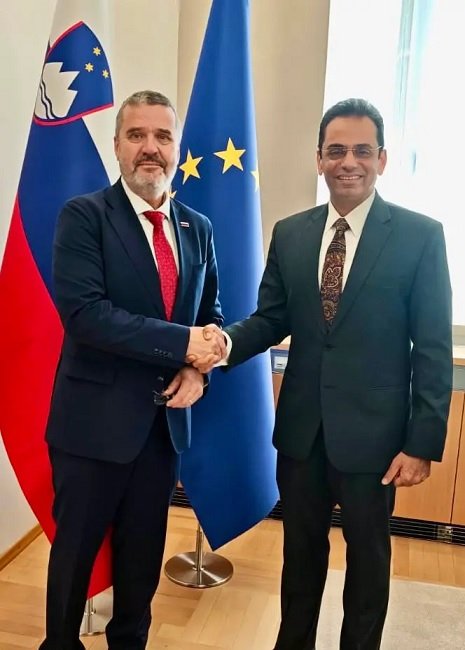
The incident comes as India and Slovenia have been publicly deepening ties. On July 2, Indian Ambassador Amit Narang met Slovenia’s Foreign and European Affairs Minister Tone Kajzer in Ljubljana. Narang delivered a personal letter from External Affairs Minister S. Jaishankar, and the Indian Embassy said the discussions covered steps to elevate bilateral relations into a “mutually beneficial partnership.” On June 24, MEA Secretary (West) Sibi George represented India at Slovenia’s National Day celebrations in New Delhi and praised Slovenia’s support for India’s fight against cross-border terrorism.
Also see: Russia Kyiv Strike 2026: 27 Killed in Deadliest Russian Attack
Also see: Quad Ministers Meeting Held in New Delhi Amid China Tensions
Also see: Trump and Xi Strike Tone in Beijing as US-China Tensions Simmer
The Khalistan link and what is not yet proven!
The relationship also has an economic dimension. Indian government data published by the Embassy of India shows bilateral trade at $848.13 million in 2024-25, comprising $586.04 million of Indian exports and $262.09 million of imports. In the first eight months of 2025-26, through November 2025, bilateral trade stood at $706.18 million. In November 2025, the two governments held the 10th session of their Joint Committee on Trade and Economic Cooperation, covering agriculture, pharmaceuticals, health, transport, energy, tourism, MSMEs and other sectors.
The wider European context matters too. Slovenia’s government said in January 2026 that the European Union and India had concluded negotiations on a free trade agreement. The EU said goods and services trade between the bloc and India was already worth more than €180 billion annually, while the agreement was expected to reduce tariffs on 96.6% of EU exports to India. For Ljubljana, India is not simply a diplomatic partner; it is part of a larger EU economic relationship.
New Delhi has also connected the Ljubljana incident to a wider concern about separatist propaganda. The MEA urged law-enforcement authorities elsewhere to take note of “hateful propaganda and disinformation” being circulated by such groups. Indian reporting has described the suspects as pro-Khalistan elements, but the public MEA statement itself used the broader phrase “anti-India elements.” That distinction matters because the ministry has not publicly released evidence linking named individuals or a specific organization to the Ljubljana incident.
India has a documented record of treating overseas attacks on its diplomatic missions as a security and diplomatic issue. In January 2026, New Delhi condemned trespassing and vandalism at its embassy in Zagreb, Croatia, where reporting said members of “Sikhs For Justice” attempted to replace the Indian flag with a Khalistan flag. India’s Home Ministry has designated Sikhs For Justice as an unlawful association under the Unlawful Activities (Prevention) Act and extended that designation for another five years in 2024. That legal status is Indian domestic law and does not itself establish responsibility for the Ljubljana incident.
Also see: US-Iran Deal or Diplomatic Mirage? Secretive Switzerland Talks Produce Surprise Breakthrough
Also see: G7 Summit 2026: Modi Calls for Trust and Cooperation as Global Leaders Meet in France
Also see: India Slovakia Comprehensive Partnership Unveiled
Indian Embassy Slovenia: Why the timing matters
The chronology makes the timing notable. Slovenia’s new government under Prime Minister Janez Janša took office after the March 2026 parliamentary election, and Prime Minister Narendra Modi congratulated Janša on May 28. In June, Slovenian Foreign Minister Tone Kajzer invited Jaishankar to visit Slovenia. In July, Narang and Kajzer held bilateral talks. The embassy defacement therefore occurred during an active period of diplomatic engagement, not after a prolonged breakdown in relations. Janša was elected with 51 votes in Slovenia’s 90-member parliament, while his government formally took office on June 4.
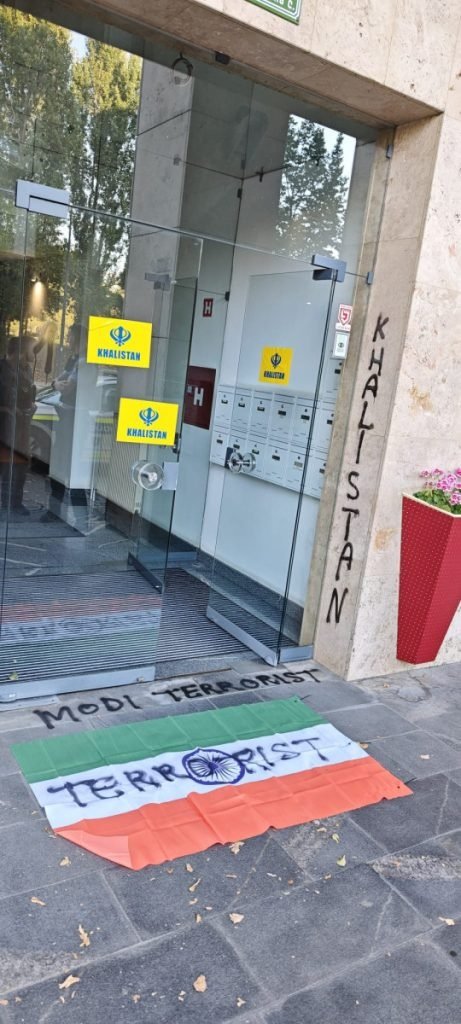
But several central facts remain unresolved. Neither the Indian statement nor the reporting reviewed for this dossier identifies when the defacement occurred, what was written or damaged, how many people were involved, whether surveillance footage exists, whether Slovenian police have made arrests, or what criminal provisions are being applied. There is also no public Slovenian police or Foreign Ministry account in the material reviewed confirming the alleged perpetrators’ identity or motive. There is also no publicly identified Slovenian court filing, charging document, police bulletin, or forensic assessment in the sources reviewed so far. Those records would clarify the investigation and the alleged motive.
That missing evidence is crucial. The Indian government has clearly made a diplomatic demand: protect the mission and hold the perpetrators accountable. The next meaningful development will be whether Slovenian authorities publicly establish who carried out the act, how it was executed, whether it was organized, and whether the evidence supports the pro-Khalistan attribution reported in India. Until then, the safest factual description is an embassy defacement attributed by India to anti-India elements, with a pro-Khalistan link reported but not publicly substantiated in the official statement.
Also see: Xi Jinping North Korea Visit: China Seeks Greater Influence
Also see: India Rebukes Pakistan at UN, Reasserts Kashmir Claim Amid Fresh Row Over Gilgit-Baltistan Elections
Also see: Trump-Netanyahu Rift Explodes Over Lebanon Strikes as Iran Talks Stall