
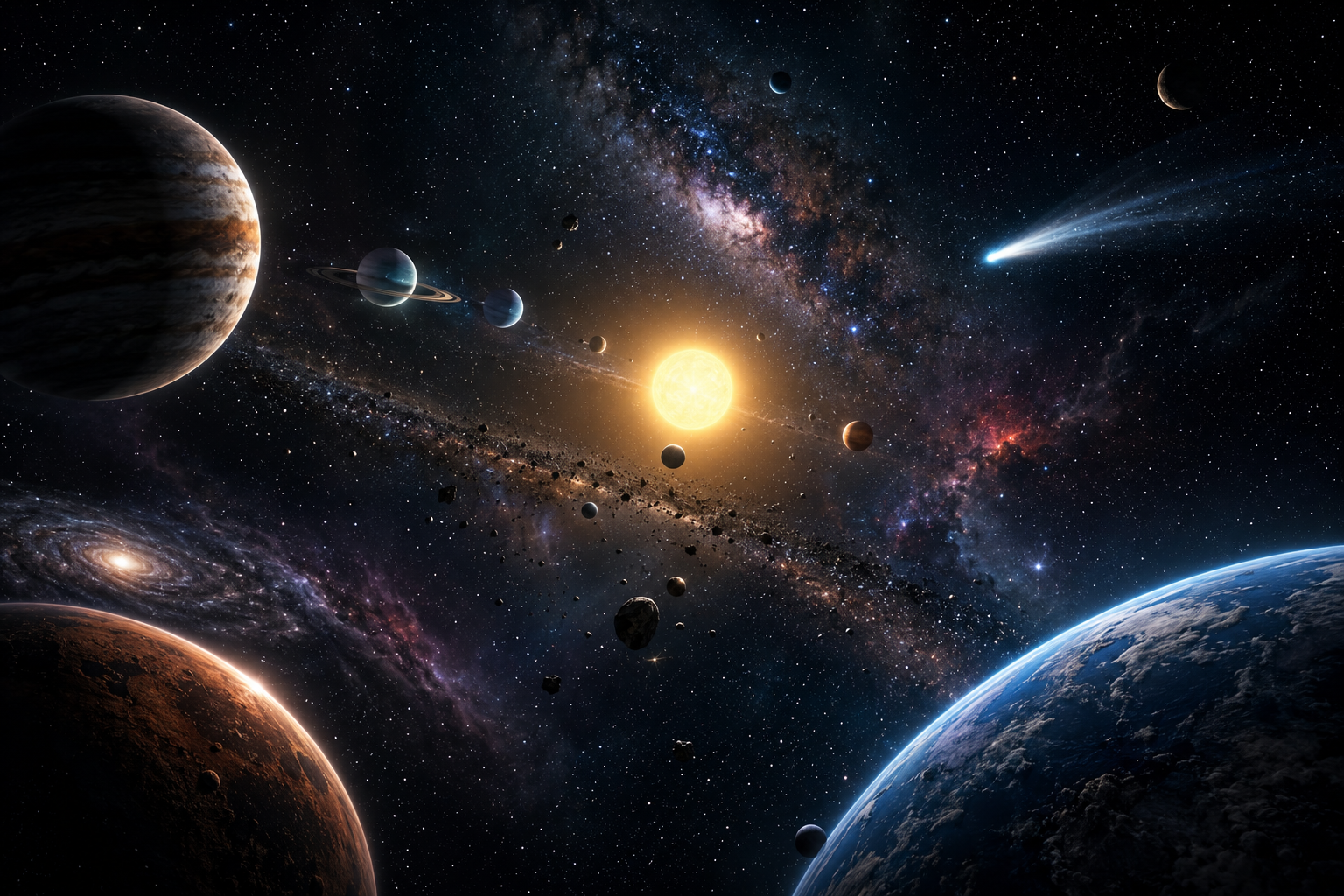
“August 2026 astronomical events are turning the night sky into a busy calendar of eclipses, meteor showers, planetary alignments and other rare celestial sights.“
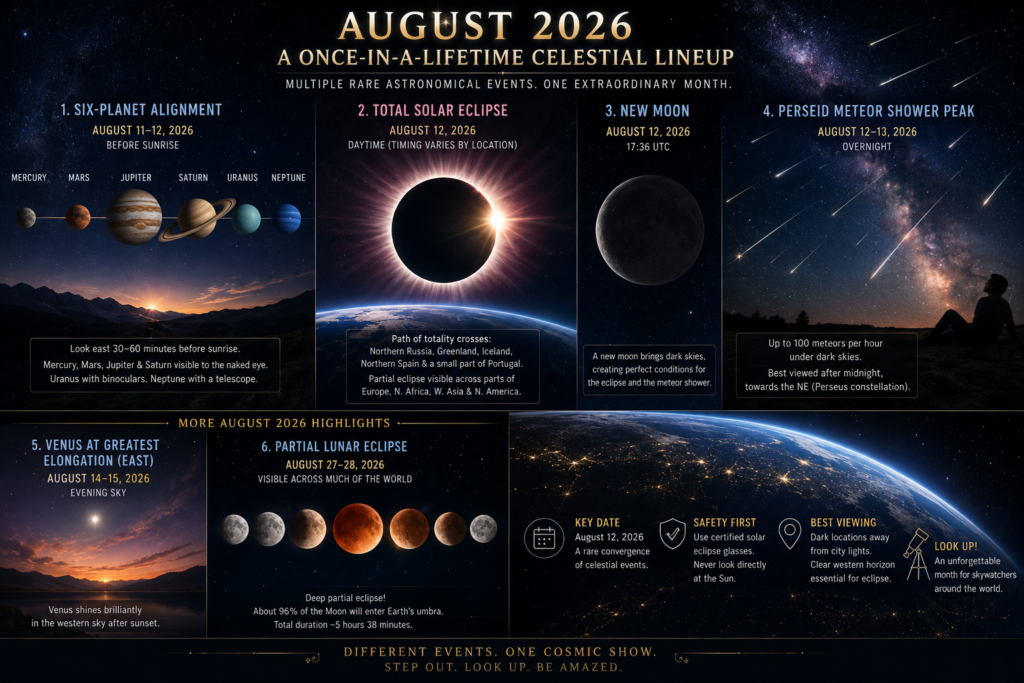
The sky stacks events: a total solar eclipse will sweep through northern Russia, Greenland, Iceland, Spain and a small corner of Portugal; six planets will be strung across the pre-dawn sky and the Perseid meteor shower will reach its annual maximum under a New Moon. NASA still sees the eclipse as a scientific opportunity, while Spain prepares for a visitor surge.
Headline event: a sunset eclipse
The eclipse is the most geographically restrictive event. NASA’s path of totality crosses far northern Russia, Greenland, western Iceland, the Atlantic and northern Spain, with a small area of northeastern Portugal inside the path. In Spain, the timing is awkward and spectacular: totality arrives late in the day, close to sunset, so a clear western horizon matters as much as being inside the path.
The maximum duration of totality is 2 minutes 18 seconds, according to Spain’s National Geographic Institute. Timeanddate calls it the first total solar eclipse across mainland Europe since 1999; ESA uses a broader definition and dates the last mainland-Europe totality to 2006.
Spain itself has not had a total solar eclipse since 1905.
Also see: Strawberry Moon 2026: When to See June’s Rare Full Moon
Also see: AI Debt Panic Wipes $600 Billion Off SpaceX
Also see: 50-Year Search Ends as Scientists Confirm Wind Blowing From Milky Way’s Central Black Hole
The “four events” claim needs a correction
A lot of articles describe the four rare events converging: eclipse, planetary alignment, New Moon and Perseids. The first problem is conceptual. A total solar eclipse occurs only at New Moon.
The planetary parade is real, but it is easy to oversell. Jupiter, Mercury, Mars, Uranus, Saturn and Neptune will appear spread along the morning sky before sunrise. Only Mercury, Mars, Jupiter and Saturn are expected to be visible without optical aid under good conditions; Uranus and Neptune require binoculars or a telescope. They are not physically forming a neat line in space. The apparent alignment is a line-of-sight effect because the planets orbit roughly in the same plane.
Then comes the Perseids. The International Meteor Organization gives a 2026 maximum around August 13 at 02:00–04:00 UTC, with a broader maximum spanning August 12–13. Its nominal zenithal hourly rate is 100, but normal rural observing rates are closer to 50–75 meteors per hour.
The shower comes from Comet 109P/Swift-Tuttle debris. The meteoroids hit Earth’s atmosphere at about 59 kilometres per second. “100 meteors an hour” is a theoretical rate under ideal conditions, not a promise that every observer will see 100 shooting stars.
The eclipse is already changing plans on the ground
Spain has now turned the eclipse into a planning exercise for 2026. On July 21, the Spanish government said an economic-impact study estimated 446,700 additional tourists during August 10–16 across 36 provinces affected by totality and nearby attraction zones. The study projected €342.19 million in additional tourist spending and €347.60 million in net economic contribution. It found that 8.4% of people planning to watch the eclipse would travel outside their home province, while scheduled air seats for the eclipse week were up 7.9% year on year and hotel bookings for August were up 17.8%.
In Somosierra, the population is 93, while the council expects as many as 2,000 visitors. It has 400 official registration slots. Volunteers are being trained with astrotourism specialists.
The government is preparing for a less glamorous consequence: electricity. Some channels reported that EU grid operators are preparing for the eclipse’s effect on solar generation. European Commission spokesperson Anna-Kaisa Itkonen said, “Given the fact that it should be taking place towards the afternoon, its impact is not expected to be huge.” A Financial Times report published August 9 said grid operators expect nearly 10 gigawatts of solar power to disappear across Europe around the eclipse peak, with Britain alone potentially losing up to 1.3 GW.
NASA is treating the event as a research opportunity, not just a spectacle. A NASA-funded WB-57 aircraft will chase the Moon’s shadow while the Nationwide Eclipse Ballooning Project is sending student teams to Iceland and Spain. In Iceland, two teams plan to launch 80 balloons from 18 hours before the eclipse until eight hours afterward. NASA eclipse program manager Kelly Korreck said, “From our unique perspective on Earth during a total solar eclipse, scientists can study the Sun’s corona in a way we can’t from anywhere else in the solar system.”
Also see: Total Solar Eclipse 2026 Set for Europe
Also see: India vs Afghanistan ODI: Gill, Kishan Tons Seal Series Win
Also see: The Global Economy Faces a 2025 Slowdown, But India’s Growth Remains Strong
For India, there is an important correction to the excitement. The total solar eclipse will not be visible from Indian ground locations because the eclipse occurs after sunset there. The Perseids, however, are a night-sky event and can be observed from India under dark, clear skies. India’s Meteorological Department independently confirms the August 12 eclipse is not visible from India.
Timing matters for viewers. In Spain, the Sun will be low in the western sky during totality, making terrain, buildings and cloud near the horizon deal-breakers. Spain’s National Geographic Institute advises observers to choose locations with an unobstructed western horizon. In the Balearic Islands, totality will occur even closer to sunset.
The eclipse is part of a Spanish “trio of eclipses”. The government is preparing for another total eclipse on August 2, 2027 and an annular eclipse on January 26, 2028. Officials are building infrastructure and public-safety planning around three consecutive eclipse seasons.
NASA says parts of the northern United States, Canada, most of Europe and northwestern Africa will see the Moon cover part of the Sun. In the United States, visibility stretches from Alaska to North Carolina, but the amount of coverage varies sharply by location.
The safety issue is simple but easy to miss. NASA says eclipse glasses or a safe handheld solar viewer are required whenever any part of the Sun is visible. Only during totality, when the bright solar face is completely covered, is direct viewing safe.
So the August 12 story is not that the universe has scheduled four miracles for one date. It is that several predictable astronomical cycles happen to stack within 24 hours, while Spain and Europe have built a tourism, science and energy-management operation around them. The sky will provide the spectacle. The complicated part is underneath it.
Also see: Artemis II Moon Mission: NASA Sends Humans Back After 50 Years
Also see: Hormuz Oil Crisis: Trump Says “Buy US Oil or Take It Yourself”
Also see: I Couldn’t Stay Silent’: UN Diplomat Quits Over Iran Nuclear Claims
Also see: Total Solar Eclipse on August 12, 2026 – NASA Science