
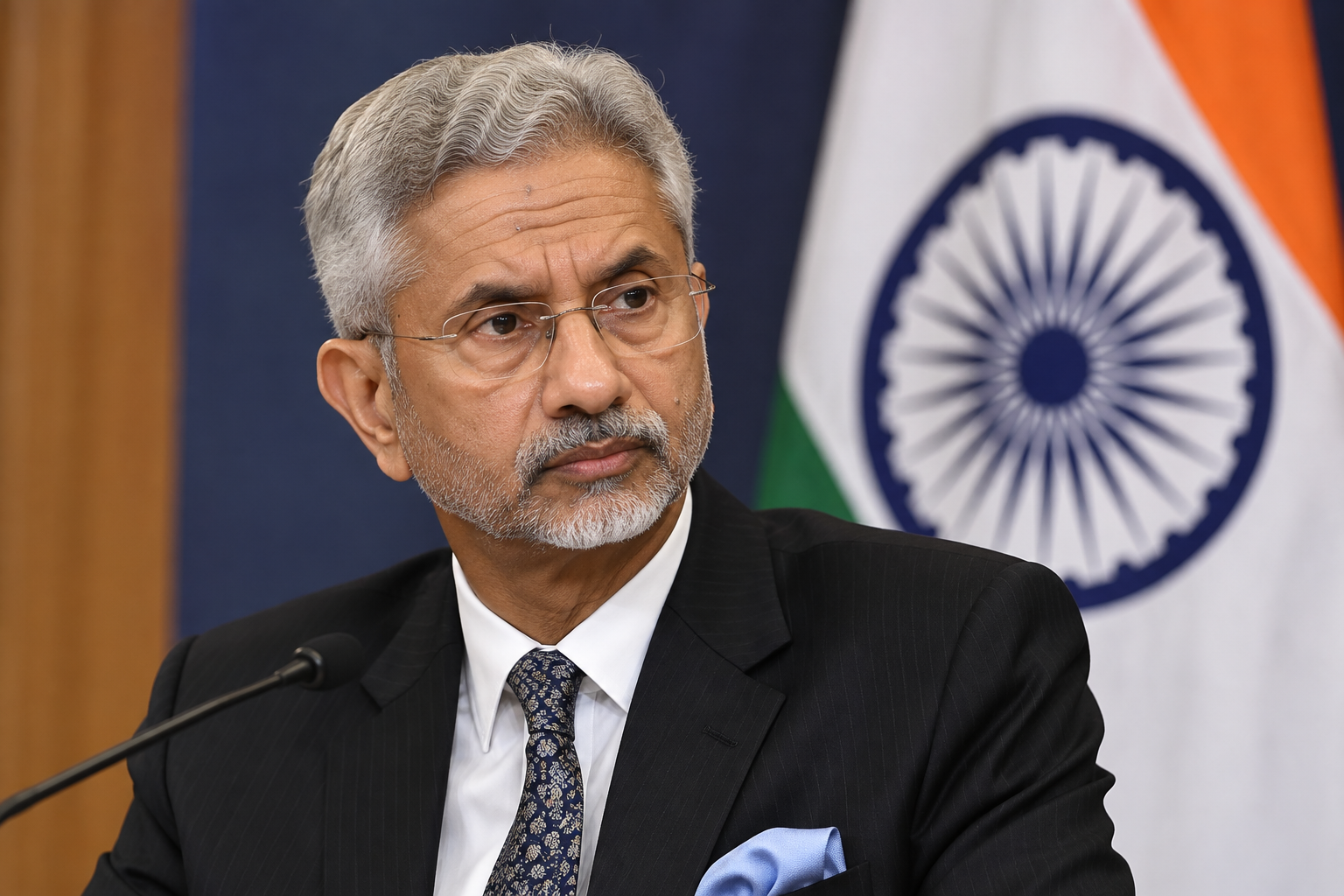
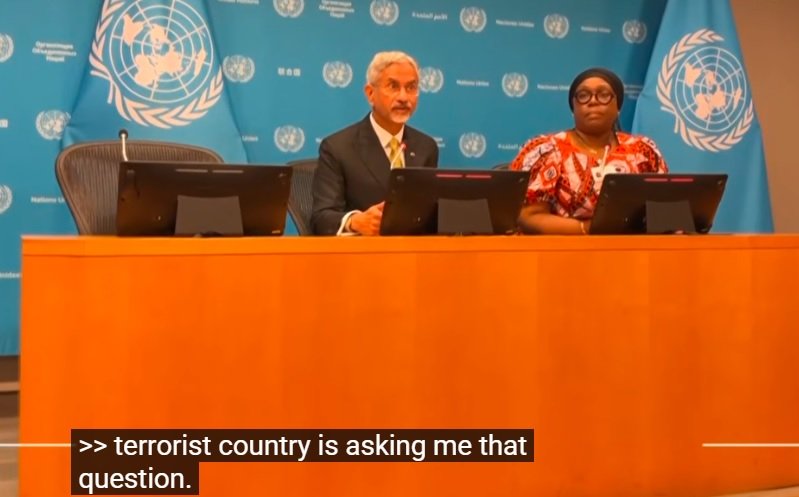
Jaishankar answered a Pakistani journalist’s terrorism allegation with one sentence on Friday at the United Nations in New York: “A terrorist country is asking me that question. Come on.” The exchange occurred after Jaishankar and Liberia’s Foreign Minister Sara Beysolow Nyanti addressed reporters about maritime security during the 81st UN General Assembly.
The journalist asked: “When will your government stop sponsoring terrorism in Pakistan?” Jaishankar responded immediately. India’s Permanent Representative to the UN, Harish Parvathaneni, then told the journalist: “You have heard your reply. You have heard your response, loud and clear.”
Jaishankar’s confrontation came during a different security briefing
The confrontation was not the scheduled subject of the meeting. The UN’s September 25 media alert listed a 9 a.m. in-person briefing by Jaishankar and Nyanti on the “Group of Friends” on Safety and Security of Shipping and Seafarers. The initiative was launched by India and Liberia amid concerns over attacks affecting commercial vessels and crews.
Jaishankar said India, as a major source of seafarers and Liberia, as the largest shipping registry, had joined to focus international attention on the safety of shipping and seafarers. He cited repeated attacks in the Gulf, Red Sea and surrounding waters, saying such attacks disrupt maritime commerce and cost lives.
The timing gave the exchange a wider diplomatic setting. The question was about alleged Indian support for terrorism in Pakistan; the briefing itself concerned maritime security. The two issues were not presented by the UN as a single agenda item.
Also see: Terrorism in Pakistan Hits a New Peak as Masood Azhar Case Exposes a Deeper Security Crisis
Also see: Saudi Arabia, Pakistan, Türkiye Defence Alliance Explained
Also see: Pakistan Launches Cross-Border Operation After Karachi Attack, Says 29 Militants Killed
The evidence behind the terrorism dispute is contested
The strongest documentary complication comes from a UN Security Council Monitoring Team report issued in 2025. It records that five terrorists attacked a tourist site in Pahalgam, Jammu and Kashmir, on April 22, killing 26 civilians. The Resistance Front, or TRF, claimed responsibility that day and repeated the claim the following day. On April 26, however, TRF retracted its claim.
Read now: Reports | Security Council
Also see: India Crush Pakistan by 64 Runs as Deepti Sharma Rewrites T20 History
Also see: India Rebukes Pakistan at UN, Reasserts Kashmir Claim Amid Fresh Row Over Gilgit-Baltistan Elections
The UN report does not resolve responsibility in a single uncontested finding. It records that one member state said the attack could not have happened without support from Lashkar-e-Tayyiba and that LeT had a relationship with TRF. Another member state said the attack was carried out by TRF and that TRF was synonymous with LeT. A third member state rejected those views and said LeT was defunct.
India subsequently launched Operation Sindoor on May 7, 2025, saying its armed forces had targeted nine sites described as terrorist infrastructure in Pakistan and Pakistan-occupied Jammu and Kashmir. The Defence Ministry said the strikes followed the Pahalgam attack and that Pakistani military facilities were not targeted.
On July 18, 2025, the United States designated TRF as a Foreign Terrorist Organization and Specially Designated Global Terrorist. The US State Department described TRF as a LeT front and proxy and said it had claimed responsibility for Pahalgam. The Federal Register subsequently recorded TRF and related names as aliases added to LeT’s designation.
Pakistan rejected the alleged TRF-LeT connection. Its position, reported after the US designation, was that the Pahalgam investigation remained inconclusive and that the alleged linkage was not established. Those are competing government positions, not equivalent to an independent judicial finding.
FATF record adds another layer
The background to Jaishankar’s response also includes the long-running international scrutiny of Pakistan’s systems for combating terrorist financing. The Financial Action Task Force removed Pakistan from increased monitoring on October 21, 2022, after concluding that Pakistan had strengthened its anti-money-laundering and counter-terrorist-financing regime and addressed deficiencies across action plans containing 34 items.
India has interpreted that process differently. In 2022, the Ministry of External Affairs said FATF scrutiny had forced Pakistan to take action against well-known terrorists, including people linked to the 2008 Mumbai attacks. FATF’s own statement, however, described progress against technical and strategic deficiencies rather than endorsing India’s characterization of causation.
Also see: Pakistan $3 Billion Saudi Loan: Survival or Debt Trap
Also see: Pakistan Israel War of Words: “Burn in Hell” Amid Lebanon Strikes
What the exchange establishes and what it does not
The September 25 encounter is well corroborated. Multiple reports carry the same question, Jaishankar’s response and Parvathaneni’s intervention. The identity of the Pakistani journalist was not established in the sources reviewed.
The exchange also sits one day after Pakistan Prime Minister Shehbaz Sharif was questioned by an Indian journalist outside the UN building. The journalist asked Sharif, “When will you stop harbouring terrorists?” Sharif did not answer, according to reporting on the encounter.
The broader dispute remains anchored in competing claims about terrorism, responsibility and state support. The public documentary record is stronger on some points than others: the Pahalgam death toll and TRF’s initial and retracted claim are recorded by the UN; the US designation is an established government action; Pakistan disputes the attribution; and FATF confirms its own compliance assessment.
What happened in the UN room is therefore clear. Jaishankar was asked to answer an allegation that India sponsors terrorism in Pakistan and he chose a direct political response rather than engaging the premise. The underlying terrorism dispute is considerably less simple than the exchange itself.
Also see: Sri Lanka Had the Warnings. So Who the Hell Let Easter Sunday Happen?