
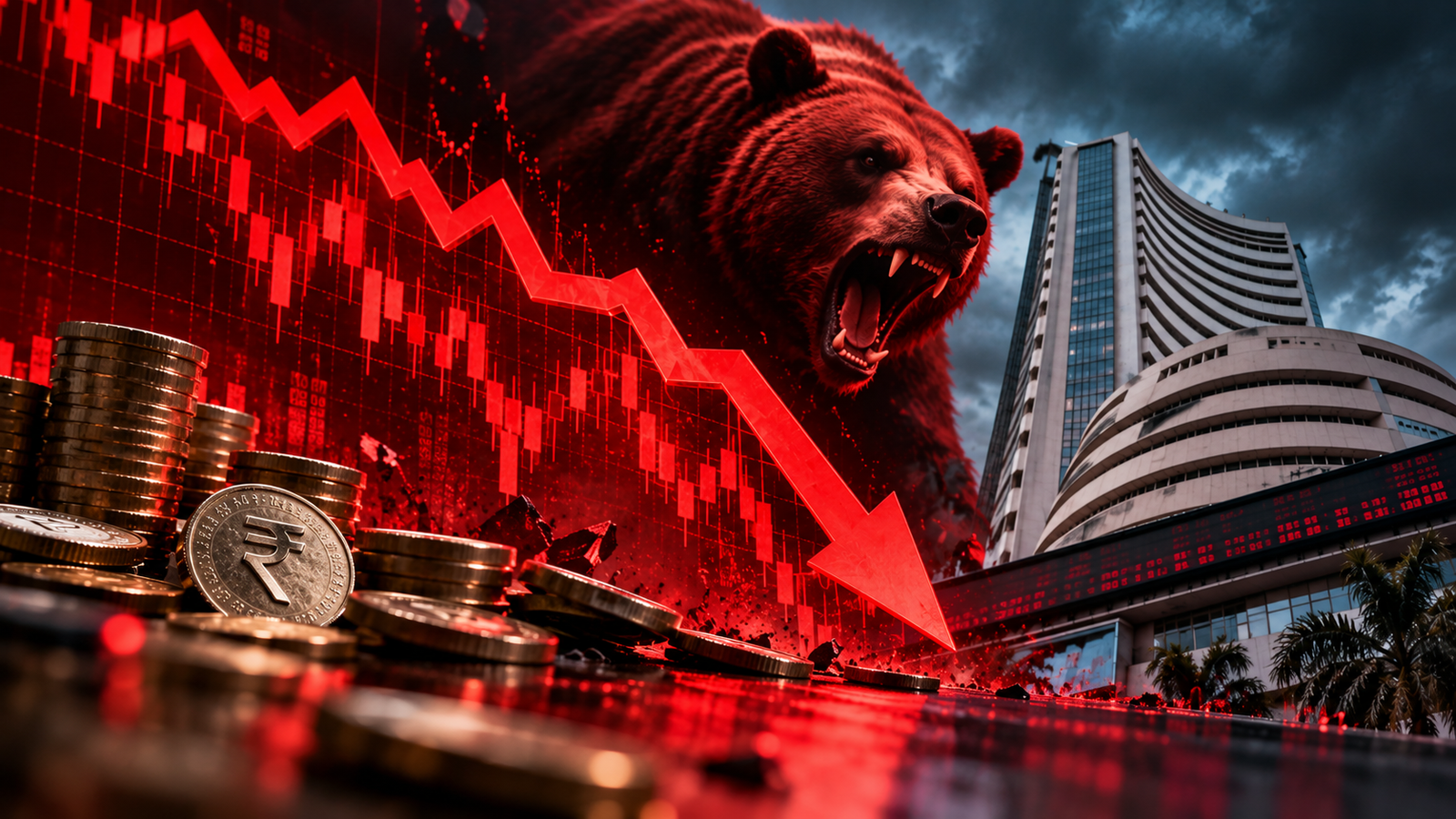
The September 24 share market crash was driven by several pressures hitting Indian equities at once, but the sharpest damage came from a new insurance-regulation proposal that sent some financial stocks into a tailspin.
The Sensex fell 1,247.71 points, or 1.67%, to 73,580.54, while the Nifty 50 dropped 383.70 points, or 1.64%, to 23,063.10. The Nifty touched 23,046.15 during the session. The decline was broad: all 16 major sectoral indices ended lower, while the India VIX, a measure of expected market volatility, jumped sharply.
The sell-off followed a combination of rising oil prices, higher US Treasury yields, stronger expectations of another Federal Reserve rate increase and continuing uncertainty around the US-Iran conflict. But a domestic regulatory development added a separate shock for banks, insurers and insurance distributors.
Insurance reform becomes the biggest stock-specific trigger
On September 23, the Insurance Regulatory and Development Authority of India released a two-part consultation paper titled “Recalibrating Economics of Insurance Distribution”. The proposal covers insurance distribution, expenses, commissions, market conduct, transparency and digital infrastructure. It is a consultation, not a final regulation.
Read now: Recalibrating Economics of Insurance Distribution Press Release
Read now: Recalibrating Economics of Insurance Distribution Part 1 and 2
Also see: The $48.8 Billion Enterprise AI Boom Is Here. Most Businesses Aren’t Ready
The proposed framework includes tighter commission limits and a glide path for lowering insurers’ Expense of Management limits. It also proposes stronger disclosure requirements and restrictions intended to address mis-selling. Stakeholder feedback is open until October 25.
The market reaction was immediate. PB Fintech, the parent of Policybazaar, fell 36% on September 24, its worst single-day decline since listing, according to the market reports. Turtlemint fell 20%, while several listed insurers and financial companies also declined.
The reaction was particularly severe because commission income is important to insurance-distribution businesses. PB Fintech management said after the fall that it expected slower growth and planned to moderate hiring and marketing spending while adapting to the proposed framework.
The proposed rules do not establish that PB Fintech’s earnings will fall by any particular amount. Analysts have offered estimates, but those are forecasts rather than established outcomes.
Also see: Merchant Discount Rate on Select UPI Payments Explained
Also see: Travis Kelce Named Victim in $35 Million Fraud Case
Oil and US yields added pressure
Crude oil was another major factor. Brent rose above $100 a barrel and was reported around $105.60 during the September 24 market session. For India, which imports a large share of its crude requirements, higher oil prices can increase the import bill and add pressure to inflation, the rupee and corporate costs.
US Treasury yields added another layer of pressure. The 10-year Treasury yield had closed around 5.11% on September 23, its highest level since 2007 and remained elevated during the Indian trading session.
The move followed stronger US economic data. The September flash US Composite PMI reached 58.4, its strongest reading since July 2021. Stronger business activity, alongside higher input-price pressures, increased concern that US interest rates could remain high for longer.
The Federal Reserve had already raised its federal-funds target range by 25 basis points on September 16, taking it to 3.75%-4%. Market pricing then put the probability of another 25-basis-point increase at about 75% overnight, according to the CME FedWatch measure cited in market reporting. That probability is a market expectation, not a Federal Reserve decision.
Higher US yields can affect Indian equities by making dollar-denominated assets more attractive and increasing the cost of capital. They can also contribute to pressure on emerging-market currencies and foreign investment flows.
The geopolitical risk was tied to oil
The US-Iran conflict added another source of uncertainty because developments in the region can affect oil supplies and shipping routes. On September 23, Iranian President Masoud Pezeshkian addressed the United Nations, while US and Iranian officials remained engaged in difficult negotiations.
The key market issue was not simply the existence of tensions. Oil traders were also assessing the possibility of disruptions around the Strait of Hormuz, a critical route for global energy shipments. On September 24, oil prices remained elevated even as reports pointed to continuing diplomatic contacts.
That combination made the oil shock particularly important for Indian markets. Higher energy costs can affect inflation expectations and corporate expenses, while a weaker rupee can make dollar-priced commodities more expensive for Indian buyers.
Also see: What Is Reliance Intelligence? Ambani’s AI Plan Explained
Also see: Spiritual Tech Is Turning Faith Into a Global Digital Market
Foreign selling made the fall broader
Foreign institutional investors were net sellers of Indian equities worth ₹5,027.36 crore on September 24, while domestic institutional investors bought about ₹4,301.18 crore, according to exchange data reported after the session.
The figures show that domestic institutions absorbed part of the foreign selling, but not enough to prevent a broad market decline. Financial stocks were among the weakest parts of the market, linking the global macro pressures with the separate insurance-regulation shock.
There is also an important data discrepancy around the reported loss in market value. One report put the day’s decline in investor wealth at ₹3.54 lakh crore, while other calculations published around the same session produced substantially different figures. Those numbers may reflect different market universes or timestamps. They should not be treated as interchangeable.
What is established is the size of the index move and the breadth of the decline. What remains less certain is how much of the fall can be assigned to oil, US yields, foreign selling, geopolitics or the insurance proposals individually.
For the insurance sector, the next concrete step is the consultation process. The proposals remain open for stakeholder feedback until October 25, meaning the rules that triggered Thursday’s sharp repricing are not yet legally final or enforceable. The market reaction, however, has already exposed which listed businesses investors believe are most sensitive to changes in insurance-distribution economics.
Also see: India Trade Deficit Falls to $9.41 Billion in August
Also see: Appellate Body Members: BRICS Pushes for WTO Revival