

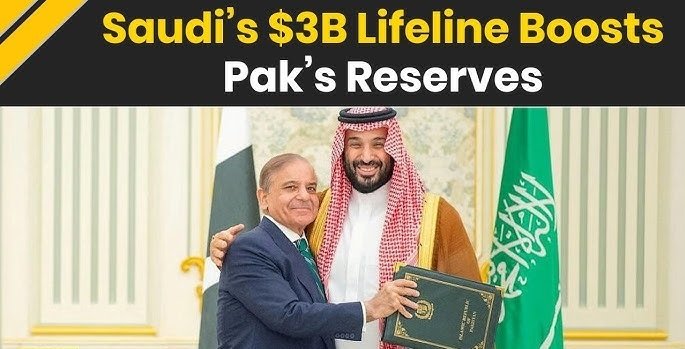
“Pakistan $3 Billion Saudi Loan Crisis Amid Rising Debt and Economic Pressure“
A Bailout to Repay a Bailout
Pakistan has secured a fresh $3 billion deposit from Saudi Arabia, but the purpose is to repay the $3-3.5 billion loan to the United Arab Emirates (UAE), which is due this month. In simple terms, Islamabad is borrowing from one ally to pay another. A Saudi finance ministry spokesperson confirmed, “Saudi Arabia has agreed to a $3 billion deposit… to support their balance of payments”.
The funding comes alongside an extension of an already existing $5 billion Saudi deposit. This highlights how critical Riyadh’s backing has become.
A Dangerous Numbers Game
The severity of the problem becomes clear when you take a look at Pakistan’s reserves:
1. $16.4 billion total reserves
2. $3.5 billion UAE repayment (18%)
3. Barely 3 months of import cover
Under its $7 billion IMF programme, Pakistan must push reserves above $18 billion by June. A target that now heavily depends on external bailouts. Finance Minister Muhammad Aurangzeb admitted the urgency, saying the Saudi support comes at a “critical time for Pakistan’s external financing needs”.
What’s happening around the globe: Trump vs Pope Clash Explodes After AI Jesus Image
UAE’s Refusal Signals a Shift
But the real shock isn’t Saudi’s support, it’s the UAE stepping back!
For the first time in nearly 7 years, Abu Dhabi refused to roll over Pakistan’s debt. Literally forcing immediate repayment! This decision has raised some uncomfortable questions like: Is the Gulf’s financial patience running out? Or is geopolitics reshaping the alliances?
More than Money: It’s Geopolitics at Play!
All of this isn’t just economics. Saudi Arabia and Pakistan have signed a mutual defense pact. In which “any aggression against either…. shall be considered an aggression against both”. In recent developments, the Pakistani military has been deployed to Saudi bases. This underlines the fact that the $3 billion is just as strategic as it is financial”.
Meanwhile, the regional tensions, including the conflict involving Iran, have pushed oil prices even higher, worsening Pakistan’s import bill and inflation risks.
The Bigger Picture is Survival Not Stability
Aurangzeb said, “all options are on the table”, while Pakistan is exploring Eurobonds, Sukuk and even Panda bonds to plug funding gaps. The reality of Pakistan is stark, the evidence suggests that this is not economic recovery but financial firefighting.
For now, Saudi Arabia has bought Pakistan time! But unless exports rise and debt dependence falls, the cycle of borrowing to repay could end up becoming a permanent feature and not a temporary fix.
For more updates follow: First Report News