

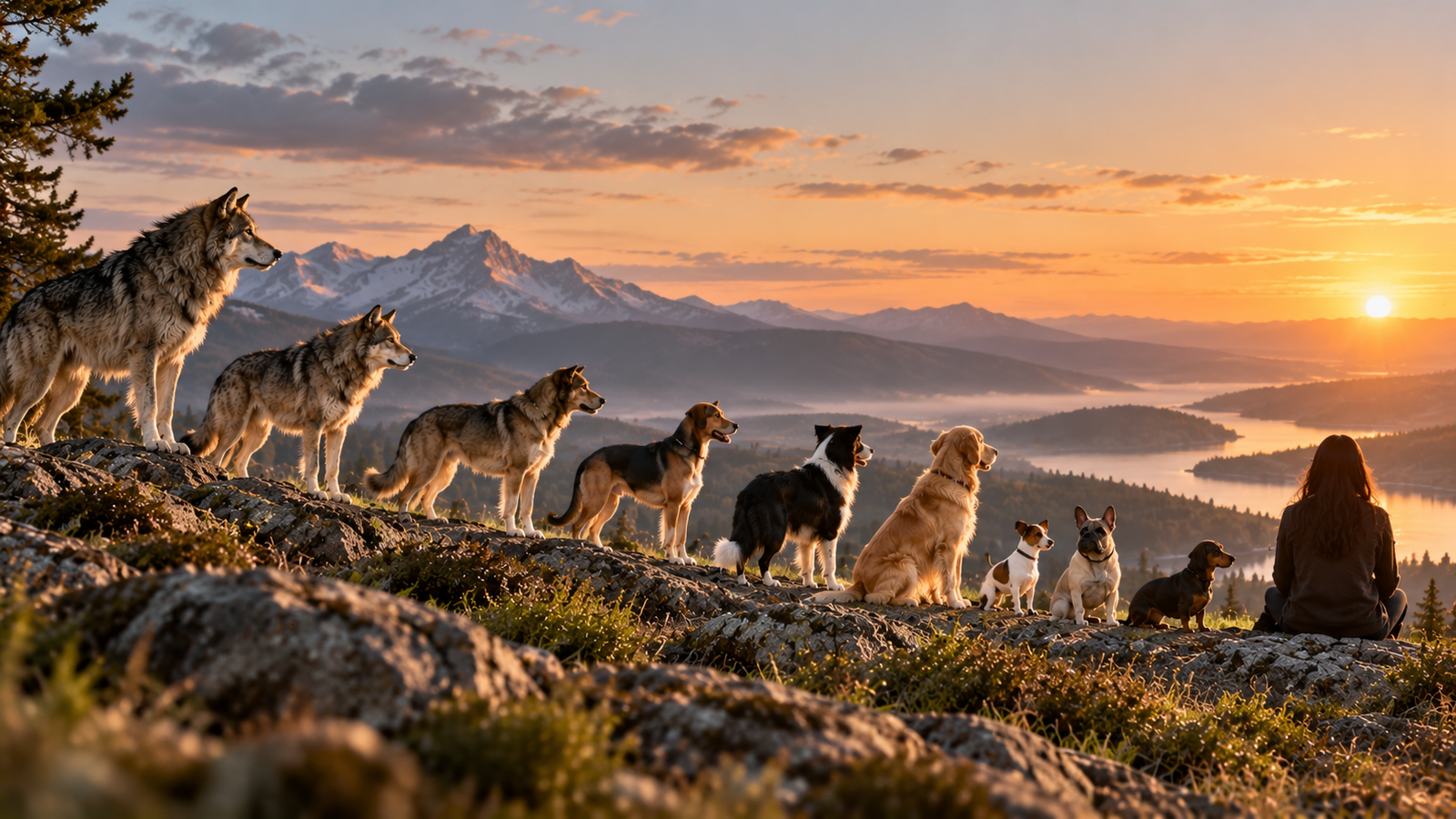
The modern dog did not emerge from a laboratory. No scientist assembled a Labrador, Pug or Border Collie by rewriting its DNA. Yet humans have spent thousands of years influencing which dogs survive, reproduce and pass their genes to the next generation. The result is one of the most extraordinary examples of human-directed evolution on Earth: a single domestic species containing animals that range from tiny Chihuahuas to enormous Great Danes, with radically different bodies, behaviors and abilities.
That makes the phrase “genetically modified” both tempting and misleading. Conventional dog breeds are not genetically modified organisms in the modern laboratory sense. They are overwhelmingly products of selective breeding and artificial selection, humans repeatedly choosing animals with preferred characteristics and allowing those animals to contribute disproportionately to future generations. The deeper question, then, is not whether humans have edited dogs’ DNA, but how extensively we have genetically shaped dogs for ourselves.
From Wolves to Dogs: The First Selection
The story begins long before modern breeds existed.
Dogs descend from grey wolves, but scientists still cannot identify the precise wolf population, or populations, that gave rise to domestic dogs. A 2022 Nature study analyzed 72 ancient wolf genomes spanning 100,000 years and found that dogs have strongest overall genetic affinities with ancient wolves from eastern Eurasia. The researchers also found evidence of a second wolf-related ancestry in dogs from Southwest Asia and Africa. None of the ancient wolves examined, however, was a direct genetic match for the dog progenitors.
The archaeological record provides another piece of the puzzle. A 2026 Nature study analyzing 216 ancient canid remains identified a 14,200-year-old dog from Kesslerloch in Switzerland through genome-wide DNA. The researchers found that this dog already shared ancestry with later European and worldwide dogs, showing that substantial genetic diversification among dogs had begun by at least that time.
Exactly when domestication began remains unresolved. But the basic evolutionary process is clearer: once some wolf populations began living around humans, dogs and people entered a relationship that gradually changed both species. Dogs gained access to food and protection; humans gained animals capable of helping with hunting, guarding and other tasks. Over generations, characteristics that improved life alongside humans could become more common.
This was selection before anyone understood genetics.
Read about the study: Grey wolf genomic history reveals a dual ancestry of dogs | Nature
Also see: Genetically Modified Apples: Have They Helped the World or Just Reduced Waste?
Also see: World Map Distortion: Why Country Sizes Look Wrong
Also see: India Fast Breeder Reactor at Kalpakkam Achieves Criticality
We Didn’t Rewrite Their DNA. We Chose Who Reproduced.
Selective breeding works by exploiting genetic variation that already exists.
Imagine a population of working dogs. One retrieves exceptionally well. Another swims efficiently. A third is unusually responsive to human commands. If people repeatedly breed the dogs with the most desirable combination of these traits, their offspring are more likely to inherit those characteristics. Continue the process for generations and the population’s genetic composition changes.
The Labrador Retriever provides a useful example.
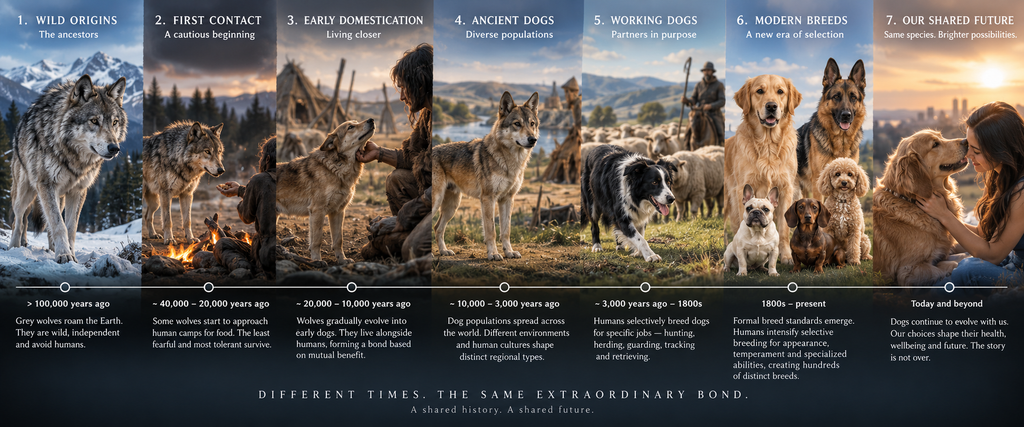
The breed’s history traces through Newfoundland’s St. John’s Dogs, working water dogs associated with fishermen. These dogs were valued for their abilities in water and retrieving. Later, dogs taken to Britain became increasingly associated with sporting estates and retrieving game. British breeders selected for qualities that made the dogs effective working companions, including retrieving ability, temperament and physical characteristics suited to the job. The modern Labrador emerged through this extended process rather than through one single breeding event.
The mechanism is deceptively simple:
Natural genetic variation → human preference → selection of breeding animals → offspring → repeated selection → increasingly predictable traits.
The important point is that humans did not need to know which DNA variants controlled those traits. They only needed to recognize the dogs they preferred and breed them.
Over time, selection can become so intense that breeds acquire distinctive genetic signatures.
Modern dog breeds are therefore not simply different-looking versions of the same animal. Their genomes have been shaped by different histories of selection, population bottlenecks and breeding practices.
There Was Never Just One “Original Dog”
The idea that today’s breeds descended from one identifiable “original dog breed” is also misleading.
Most modern standardized breeds are surprisingly recent compared with the history of domestication. Research on village dogs has shown that many dogs around the world are not purebred animals at all, but free-breeding populations shaped by a mixture of human association, natural selection and gene flow. One genomic study noted that the majority of modern breeds are less than 200 years old, while most dogs globally are not members of standardized breeds.
The 2026 Nature study adds another complication. Researchers found that a 14,200-year-old European dog already possessed ancestry related to later European dogs, while also finding evidence that dog populations changed as humans and animals moved across Europe.
In other words, there is no single living breed that can honestly be labeled “the original dog.” Some modern populations may preserve portions of ancient genetic histories, but every surviving population has its own evolutionary story.
Also see: ISRO Launches EOS-05, Expanding India’s Space Reach
Also see: The $48.8 Billion Enterprise AI Boom Is Here. Most Businesses Aren’t Ready
Also see: Astronomers Say Six Red Dwarf Stars May Have Consumed Rocky Planets
Also see: Artemis II Moon Mission: NASA Sends Humans Back After 50 Years
We Bred Dogs for What We Wanted
Human selection initially had obvious practical value.
Dogs could hunt. They could retrieve. They could herd livestock, guard settlements, track scents and pull loads. Different environments and jobs rewarded different characteristics.
But breeding eventually moved beyond simple usefulness.
Humans also began selecting dogs because they liked particular temperaments and appearances. Dogs that were friendly, cooperative and easier to manage made better companions. Physical characteristics increasingly became part of the selection process too.
That is where the relationship becomes ethically complicated.
A Labrador’s retrieving ability can benefit both human and dog when the animal is healthy and capable of performing the behavior comfortably. But selecting extreme physical traits can produce a very different outcome.
Brachycephalic breeds, including Pugs and Bulldogs, illustrate the problem. Their shortened skulls are associated with respiratory and thermoregulation difficulties, as well as gastrointestinal, eye, skin, reproductive and dental problems. The traits humans often find visually appealing can therefore carry biological costs for the animals themselves.
The science does not support the claim that all selective breeding is harmful. It does, however, show that breeding decisions can have consequences extending far beyond appearance or behavior.
So, Did We Design the Dog?
In the laboratory sense, no! not historically. The Labrador was not genetically engineered. The Pug was not assembled through gene editing. Modern breeds arose primarily through domestication, artificial selection, selective breeding, population movement and genetic change over generations.
But in another sense, the answer is much closer to yes.
Humans have repeatedly decided which canine traits are valuable and which animals should reproduce. We selected dogs for jobs, for cooperation, for companionship and, increasingly, for appearance. Those decisions changed the genes carried by dog populations and helped produce the extraordinary diversity visible today.
The boundary becomes harder to define as genetic technology advances. Selective breeding changes populations indirectly, over generations.
That means humanity may be approaching a new version of an old question. For thousands of years, we have been choosing which dogs reproduce. Modern genetics raises the possibility of choosing which genetic traits exist in the first place.
The history of the dog therefore is not simply a story of domestication. It is a record of how human preferences became an evolutionary force and a warning that the ability to shape an animal does not automatically tell us whether we should.
Also see: Nepal Floods: 933 Hydropower Workers Unaccounted
Also see: Rahul Gandhi seeks toughest action after police rescue 12 bonded labourers from UP factory
Also see: DOLLY PARTON’s Final Curtain: The Woman Who Became an Icon
Also see: PM Kisan Status Check 2026: 23rd Installment & Eligibility
Also see: Ali Khamenei Funeral: Granddaughter’s Coffin Draws Attention
Also see: Asha Bhosle Dies at 92: Voice That Defined Generations
Also see: September Full Moon 2026: Saturn, Neptune and More