


A spiritual app can collect thousands of searches and still miss what users want. The difference is whether it treats each query as a keyword or as evidence of an evolving need. Research on web search shows that users often reformulate queries across multiple rounds, changing specificity, concepts or wording as they pursue useful information. That makes Search Behavior a potential product signal, not simply an SEO metric.
For spiritual apps, the question is whether those signals can help attract users, improve discovery and keep them returning. The evidence supports these as product goals.
Searches can reveal the job users are trying to complete
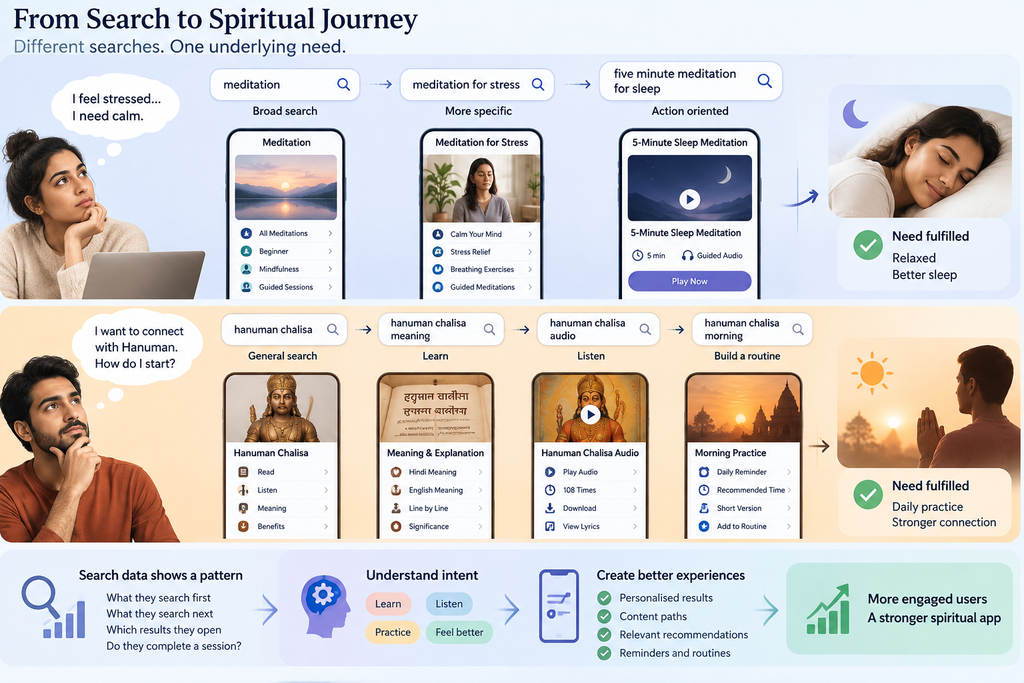
Consider a sequence such as “meditation,” followed by “meditation for stress,” then “five minute meditation for sleep.” The terms are different, but the sequence can represent a narrowing information need. Research on query reformulation has found that users change searches in different ways, including making them more specific, switching concepts and rephrasing queries. Researchers have linked these patterns to predicting intent and improving assistance.
A spiritual app can apply the same logic to internal search data. It can examine search sessions: what users searched first, what came next, which result they opened, whether they completed an audio session, and whether they searched again.
Also see: Spiritual Tech Is Turning Faith Into a Global Digital Market
Also see: UAE Iran BRICS Meeting Opens a New Diplomatic Channel in New Delhi
Also see: Ram Temple Trust Gets First CEO: Jeetendra Mishra Appointed
Also see: September Full Moon 2026: Saturn, Neptune and More
That creates a map of demand. It makes the search box a useful discovery channel and a behavioral feedback loop for internal product teams. A cluster around “Hanuman Chalisa,” “Hanuman Chalisa meaning,” “Hanuman Chalisa audio” and “Hanuman Chalisa morning” could signal distinct needs: listening, learning and routine-building. The app could respond with a dedicated content path rather than four disconnected results based on observed user behavior.
The bigger problem is not discovery but abandonment
Recent research on a meditation app shows why relevance matters. In a 2026 longitudinal study of 668 new users across 30 countries, usage data showed that 50% of the 655 users included in the engagement analysis accumulated 16 minutes or less of use during their first month. Fewer than 20% continued using the app after 14 days. Actual use was also substantially below what users initially intended.
The same study found that engagement was associated with how well the app matched users’ expectations, including expectations around anxiety and focus. These findings do not prove that search personalization will fix retention, but they provide a reason to test whether better matching between a query and the next experience changes behavior.
Turn search data into product decisions
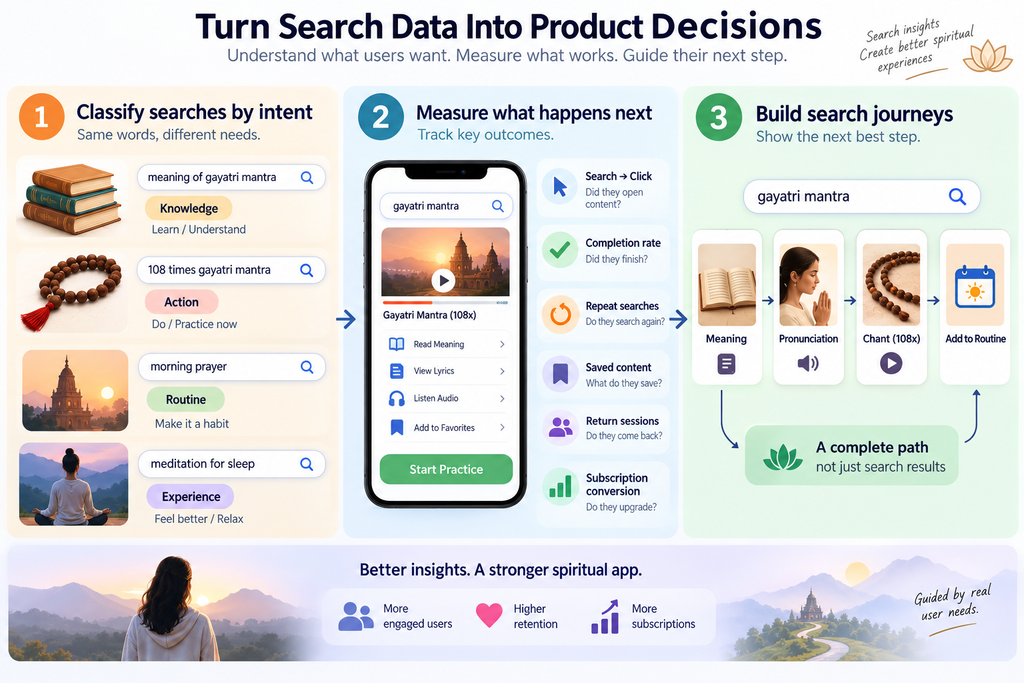
The first step is to classify searches by intent rather than only by words. A spiritual app might distinguish knowledge searches such as “meaning of Gayatri mantra,” action searches such as “108 times Gayatri mantra,” routine searches such as “morning prayer,” and experience searches such as “meditation for sleep.”
The second step is to connect those searches to outcomes. Teams can measure search-to-content click-through, completion rate, repeat searches, saved content, return sessions and subscription conversion. These metrics let teams test whether a better answer produces better engagement.
The third step is to build search journeys. If users repeatedly move from a broad spiritual question to a specific practice, the app can surface the next logical step. A user searching for a mantra’s meaning might see the explanation, pronunciation, audio and practice options together.
India’s market makes the experiment commercially relevant
A 2025 market study of India’s spiritual-wellness-app sector segments the market by personalized programs, guided sessions, stress management, downloads, retention, daily active users, session duration and subscription models. Those categories place acquisition, monetization and engagement in the same market framework.
But Search Behavior should not become a shortcut to assuming what a user feels or believes. Search data can show what someone typed and what they did afterward. It cannot, by itself, establish their emotional state, religious commitment or personal circumstances.
The strongest commercial test is experimental. Compare a generic search experience with one that uses recent search sequences and observed actions to improve the next recommendation. Measure whether users find content faster, complete more sessions, return more often and convert at higher rates. If those changes occur consistently, Search Behavior becomes more than an SEO concept. It becomes a measurable product input.
Also see: Indian Festival Calendar 2026-2027: Dates & Holidays
Also see: Full Moon on July 29, 2026: Horoscope, Meaning & Rituals
Also see: Ram Temple donation theft: VHP to await SIT probe on Rai
Also see: Muharram 2026 Set to Begin as Muslims Mark Islamic New Year