
France is not actually cutting its national education budget for 2027! It is doing something more complicated: increasing the headline allocation while reducing some permanent teaching posts and forcing the education system to absorb a wider government squeeze.
That contradiction sits at the centre of the France education dispute spilling into school protests. The government’s 2027 budget proposal, presented on October 1, allocates roughly €65.5 billion to education. But the increase is only about 1.7%, a rise that comes while the government forecasts 1.8% inflation and financing costs are climbing sharply. The proposal is not yet law.
The budget is rising while the state is cutting
France’s government says the wider fiscal problem leaves little room for expansion. Its 2027 budget plan seeks €54 billion in total fiscal adjustment, including €43 billion of measures in the budget and social-security bills. The government forecasts a public deficit of 5.4% of GDP in 2026 and wants to bring it down to 5% in 2027. It also expects interest costs on public debt to reach €91.2 billion next year, up from €79.2 billion in 2026.
Also see: G7 Summit 2026: Modi Calls for Trust and Cooperation as Global Leaders Meet in France
That makes education a protected priority, but not an untouched one. The government says the Education Ministry will continue receiving resources and that the plan will reduce pupils per class, strengthen student protection and complete teacher-training reforms. Yet protecting a nominal budget does not mean protecting every job, classroom or service. If prices, wages and other operating costs rise faster than the allocation, the same number of euros buys less.
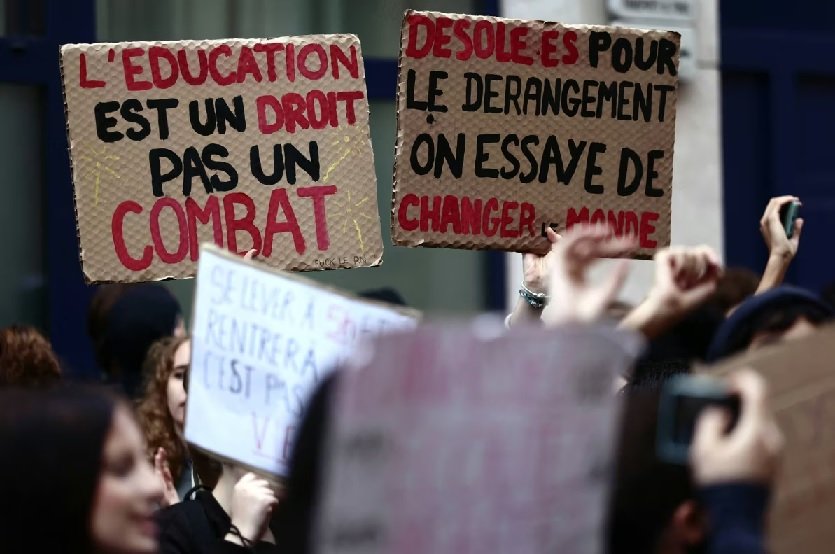
The staffing numbers expose the tension because the 2027 proposal removes 1,588 permanent teaching posts. The government’s justification is demographic rather than a simple decision to abandon schools: France is running out of children.
France education and the shrinking school population
Official projections published in April forecast 1,676,800 fewer pupils by 2035, a 14.2% decline from current levels across public and publicly contracted private schools. The decline is already visible. At the 2026 rentrée, the system had about 161,000 fewer pupils.
The government argues that staffing must eventually follow those demographic changes. It has begun an experiment in 18 departments to build five-year forecasts for school capacity and employment, with the stated goal of matching staffing decisions to local population trends. The Education Ministry says the approach is designed to prevent schools from being reorganized only after demographic changes have already hit.
But demographic decline does not automatically translate into a painless reduction in teachers. Closing classes, merging schools or removing posts can produce different outcomes in different territories. A national fall in pupil numbers can coexist with overcrowding in particular schools, difficult recruitment in particular subjects and shortages in particular regions.
That last problem is already documented. In the 2026 public external teacher competitions, 25,043 posts were offered and 24,351 candidates were admitted. The result represents a major improvement over the previous year, but it still leaves a gap between posts offered and posts filled in those competitions. The figures also do not prove that every vacancy in French schools is caused by insufficient recruitment.

The squeeze is about more than teachers
The political dispute is therefore not simply about whether France is spending “more” or “less” on education. It is about what the government can actually buy with that money.
The education budget proposal lists priorities including smaller classes, recruitment and training, student protection and digital modernization. At the same time, the broader budget is designed to restrain state expenditure by more than €9 billion. Defense is receiving additional money, while debt costs are consuming a growing share of the state’s financial capacity
That pressure is particularly important because education is one of France’s largest public services. Even a protected budget competes with debt service, defense, social spending and other government commitments. The result is a political choice: preserve education as a priority while accepting slower growth and targeted reductions in staffing.
Also see: France Pulls Gold From US, Locks in 13 Billion Profit
Also see: UAE Iran BRICS Meeting Opens a New Diplomatic Channel
The government’s demographic argument also has a hard limit. Fewer pupils can justify fewer posts where fewer classes are genuinely required. It does not, by itself, establish that every proposed reduction will leave educational provision unchanged. Nor does it resolve complaints about teacher shortages, absenteeism, school buildings or unequal conditions between territories.
For critics, that is the central weakness in the government’s case. A smaller school population is being used to redesign staffing just as schools in some places are still struggling to recruit and retain teachers. For the government, refusing to adjust staffing to a sustained demographic collapse would mean paying for capacity the system increasingly does not need while the state is under severe fiscal pressure.
The immediate consequence is a budget that can be described as increasing in euros and tightening in real terms and staffing. Calling it simply a “school budget cut” misses the evidence. Calling it an expansion misses it too.
The more revealing fact is the 1,588-post reduction inside a nominally protected education budget. France is trying to make its schools cheaper to run without making education a lower priority. Whether that produces leaner schools or weaker ones will depend on what happens after the budget is debated and whether the promised demographic savings actually translate into better resources per pupil. The parliamentary process will determine whether those reductions survive, while local implementation will determine who feels them first in practice, particularly locally.
Also see: BRICS New Delhi Declaration 2026: Key Points & Impact
Also see: ISRO Launches EOS-05, Expanding India’s Space Reach