
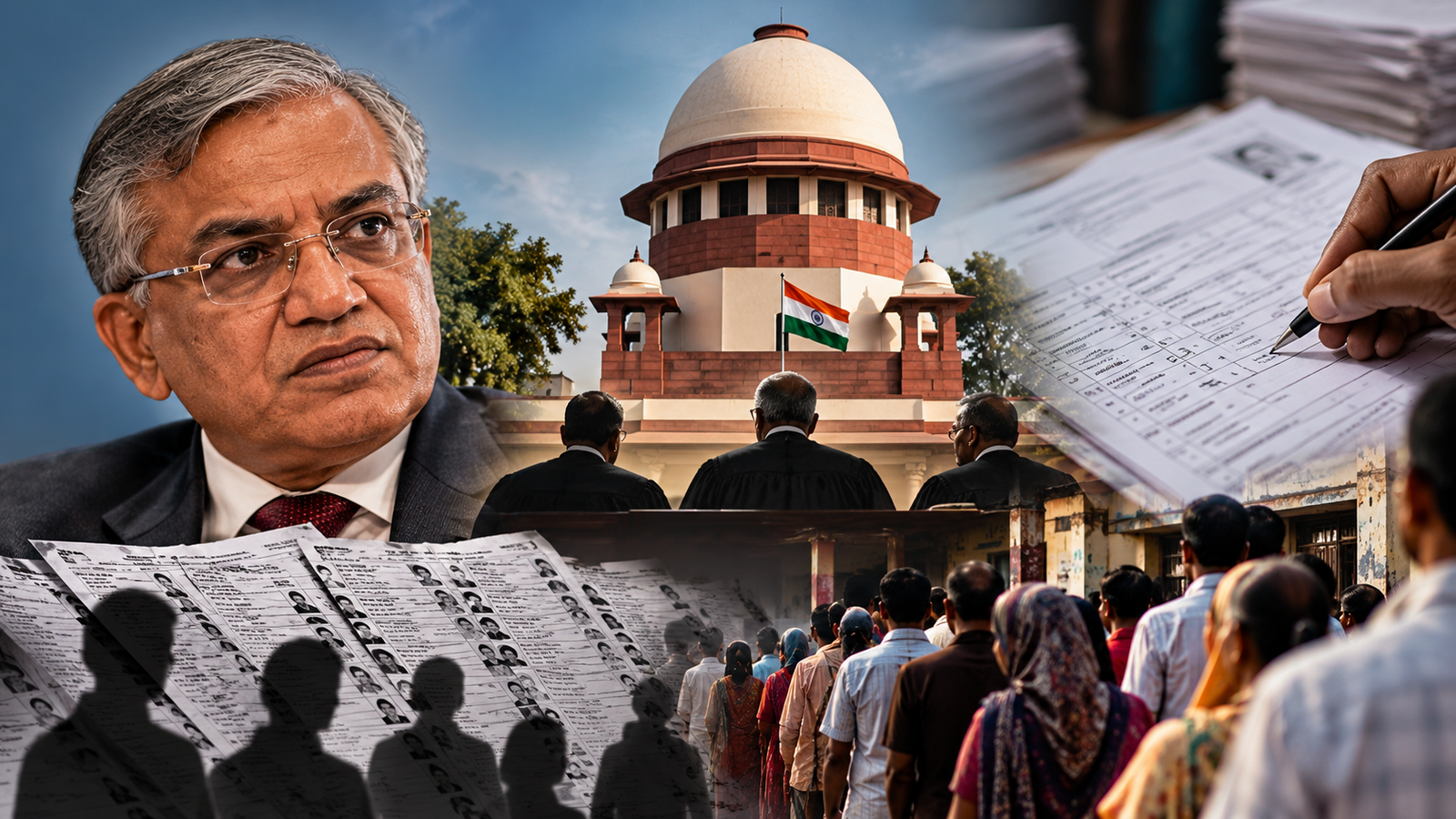
The Supreme Court on October 5 refused to suspend Chief Election Commissioner Gyanesh Kumar, but the hearing produced a consequential question: who authorized the disputed changes to Form 6, the statutory application used by people seeking inclusion in electoral rolls?
Chief Justice Surya Kant, heading a bench with Justices Joymalya Bagchi and V. Mohana, said the court had not approved the modified form. “Any modified Form 6 has not been approved by us. Let’s be clear,” he said. The court wants the Election Commission’s records before deciding who changed the form and whether the decisions challenged by petitioners complied with law.
The court issued notice to the Union government, the Election Commission and other respondents. It rejected an ex-parte request to suspend Kumar, stressing that it could not decide the allegations solely from newspaper reports. Justice Bagchi said the court needed a clear response before deciding whether the challenged decisions were unilateral.
Also see: 13.37 Crore Names Missing From Draft Rolls, So Why Are Protesters Calling It Vote Theft?
Also see: BAPS No Contact Request Preceded Women Being Removed at Eiffel Tower
Why Gyanesh Kumar’s Form 6 became the flashpoint
Form 6 is the statutory application for a new elector’s registration. The controversy concerns an additional declaration that appeared on the online version during the Special Intensive Revision, or SIR, of electoral rolls.
The additional declaration sought information connecting an applicant or relatives to an earlier intensive revision. That included historical electoral-roll details not part of the ordinary statutory Form 6. The disputed declaration therefore sits between a statutory form, an SIR-specific administrative measure and an unresolved question of legal authority.
The Election Commission disputes the characterization that it changed Form 6. Its position is that the statutory form remained intact and an additional SIR declaration was attached to it. On September 26, the Commission said the “declaration attached to Form 6 for SIR” had been upheld by the Supreme Court.
The October 5 hearing exposed a narrower legal problem with that explanation. The Supreme Court’s May 27 judgment had upheld the Bihar SIR, including the Commission’s authority to devise documentation for the exercise, but it did not amount to blanket approval of every later modification made to the online voter-registration system.
The May judgment said the Commission had residual authority to create documentation for SIR, while stressing that this authority was not unlimited. Any departure from the statutory framework had to maintain a rational connection with the purpose of the revision.
Also see: Modi Tells Putin Enough With the ‘Endless War’
Also see: 51 Indians died after joining the Russian army. New Delhi is still warning people away
The internal dispute
The Form 6 controversy is also tied to an alleged split inside the three-member Commission. Two Election Commissioners, Sukhbir Singh Sandhu and Vivek Joshi, were reported to have objected to the changes. Their objections is important because Section 18 of the Chief Election Commissioner and Other Election Commissioners Act, 2023 says Commission business should, as far as possible, be conducted unanimously; where commissioners differ, the matter is decided by majority.
The reported record says Joshi objected in May that Form 6 could not be altered without changes to the Registration of Electors Rules, 1960, while Sandhu later described the alteration as “unauthorised and illegal.” Those claims have not been judicially established. The Election Commission has maintained that its decisions, including those related to SIR, were unanimous.
The court has not ruled that Kumar personally altered Form 6, that the alteration was unlawful, or that it was intended to benefit any political party.
What the court actually decided
The October 5 order was procedural, not a verdict on Kumar’s conduct. The court did not exonerate the CEC, but neither did it find him guilty of unilateral decision-making. It ordered the respondents to respond and indicated that decisions could be annulled if the court ultimately finds they were not taken according to law.
The court’s intervention also separates two claims repeatedly merged in political debate. First, the Supreme Court upheld the Bihar SIR in May. Second, the court has now expressly said it did not approve the later modified Form 6 at issue.
That leaves the documentary question unresolved: what exactly changed on the Election Commission’s digital system, when was it changed and under whose written authority?
There is already one immediate development. The additional SIR declaration was removed from the online Form 6 in states where the SIR had concluded, with the Commission saying that outside the SIR period the forms prescribed by the 1960 rules would apply. The declaration remains relevant where SIR is underway.
For Gyanesh Kumar, the immediate issue is therefore not whether the Supreme Court has ordered his removal. It has not! The next test is the record. The Commission must explain the authorization chain behind the disputed form, the legal basis for the declaration and the relationship between the 2026 version and the documentation considered in the Bihar case.
Until those records are examined, claims that the court has established an illegal Form 6 alteration remain premature. But the court has made one point unambiguous: it did not approve the modified form.
Also see: UPI’s Free Ride Ends October 15 & Merchants Get the Bill
Also see: Spiritual Tech Is Turning Faith Into a Global Digital Market