

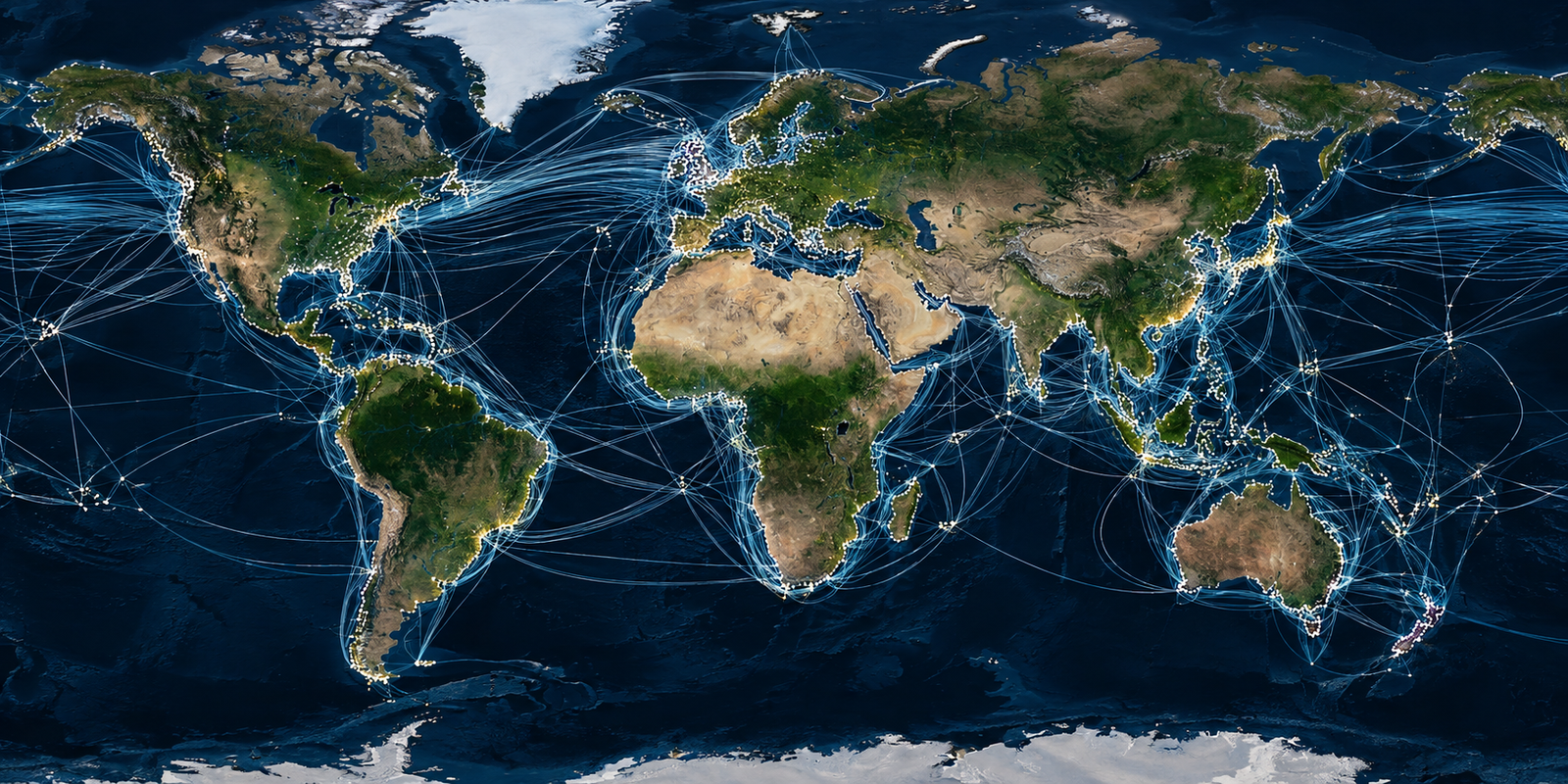
694 Undersea Lines Are Mapped Worldwide But That Is Not The Total…
The internet’s physical backbone is sitting on the ocean floor. Undersea lines made from optical fibre connect continents in a network that carries more than 99% of international data traffic. TeleGeography’s 2026 Submarine Cable Map lists 694 cable systems and 1,893 landing stations, counting systems that are active or under construction. That figure is not the same as 694 individual strands of cable, and it is not a permanent world total.
What sits beneath the sea
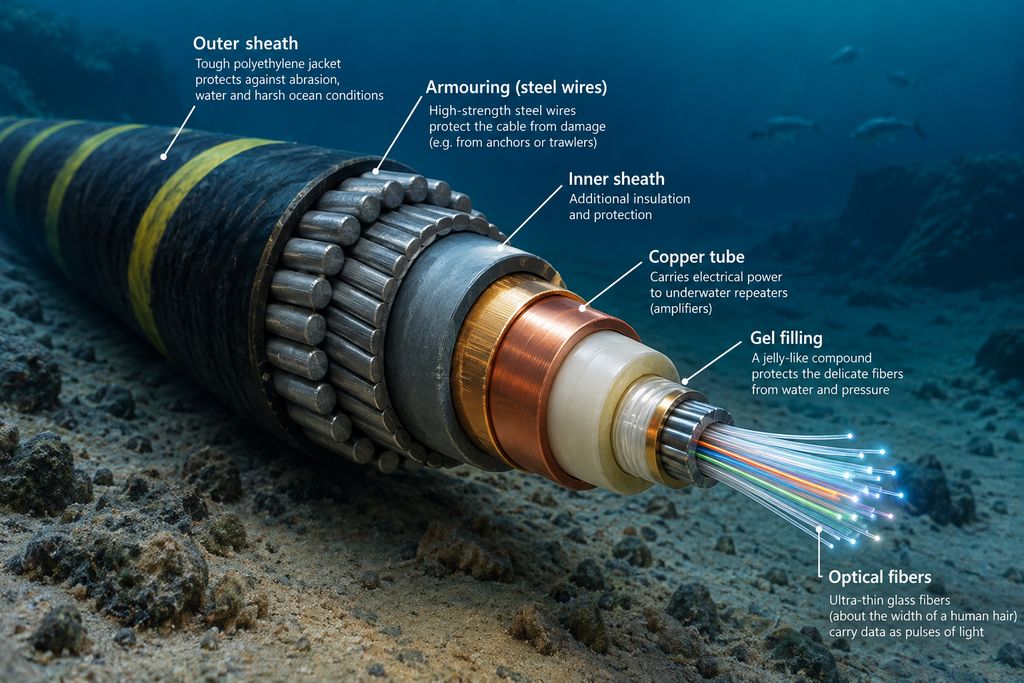
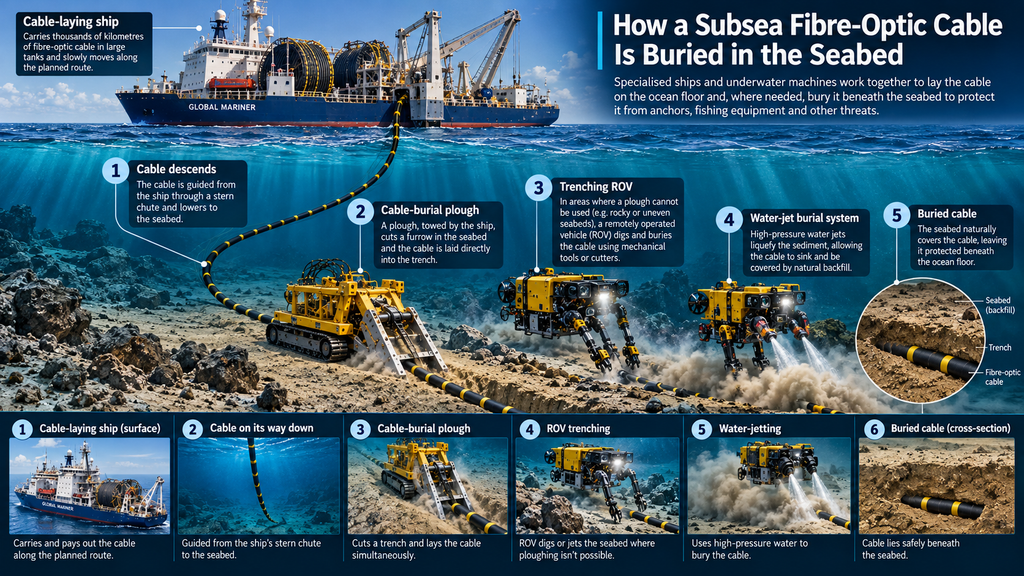
A subsea fibre-optic cable is a communications system designed to move digital information through pulses of light. The glass fibres sit inside protective layers built to withstand pressure, corrosion and seabed movement. Near shore, where fishing gear and anchors pose greater risks, cables are commonly buried beneath the seabed.
A complete system is more than the cable itself. Each fibre pair can carry traffic in both directions, and modern systems use dense wavelength division multiplexing to send many channels through the same fibres, greatly increasing capacity without laying another route simultaneously. Terminal stations on land send and receive optical signals. Long-distance systems can contain repeaters, which amplify optical signals along the route, while branching units can divide traffic toward different destinations. Technical guidance from the International Telecommunication Union describes optical submarine systems as combinations of submarine cable, repeaters or optical amplification, terminal equipment and branching equipment.
The distances are substantial. A submarine system can run less than 100 kilometres on a regional route or exceed 10,000 kilometres on an intercontinental route, according to technical documentation hosted by the U.S. National Oceanic and Atmospheric Administration.
Also see: Merchant Discount Rate on Select UPI Payments Explained
Also see: Ed Sheeran Cut Macklemore Over Palestine: Tour Fallout
Also see: Travis Kelce Named Victim in $35 Million Fraud Case
How many undersea lines are there?
The answer depends on what is being counted and when. TeleGeography’s 2026 map records 694 cable systems and 1,893 landing stations, with in-service and planned cables identified separately. Its 2025 map contained 597 systems. The company’s figures include cables under construction, so 694 should not be read as the number of systems already carrying traffic.
The ITU uses a different snapshot. Its 2025 Global Connectivity Report says the global submarine network comprised more than 500 operational systems stretching over about 1.4 million kilometres. In February 2026, the ITU and International Cable Protection Committee described the worldwide network as about 500 cables extending more than 1.7 million kilometres. The difference reflects different datasets, definitions and reporting dates rather than a simple contradiction.
There is no single live counter for every submarine fibre-optic cable ever installed, because systems enter service, are planned, retired or left inactive on the seabed. Some maps count cable systems; other sources use cables or kilometres of infrastructure. A headline claiming that exactly 694 physical cables exist worldwide would therefore overstate what the data proves.
The hidden network carries almost everything
Despite their physical invisibility, submarine cables dominate international connectivity. The ITU says they carry more than 99% of international data flows. Satellites remain important for remote connectivity, resilience and specialized uses, but they do not replace the capacity provided by the fibre network linking national systems across oceans.
The network is also becoming more valuable as data demand rises. The ITU’s 2025 report says international bandwidth grew by an average of 22% a year from 2021 through 2024. Investment followed: the report puts submarine cable investment at $9.7 billion in 2025, compared with $0.8 billion in 2015. New systems are increasingly financed by major cloud and content companies as well as traditional telecommunications operators.
That expansion is changing cable design. TeleGeography’s 2026 map notes that cables deployed since 2020 are increasingly being designed with more than eight fibre pairs, increasing potential capacity and reducing the unit cost of transmission.
Also see: Tariff: India Chose Russian Oil. Now America Can Hit Its Exports
Also see: Genetically Modified Apples: Have They Helped the World or Just Reduced Waste?
Also see: Selective Breeding in Dogs: Did We Design Them?
The weak point is still the seabed
More infrastructure does not mean zero risk. The ITU’s 2025 data says 86% of submarine cable faults result from human activities such as fishing and anchoring. The ICPC says roughly 150 to 200 submarine telecommunications cable faults occur globally each year, with about 70% to 80% attributed to accidental human activity. These figures describe different datasets and methodologies, so they should not be treated as identical measurements.
Natural hazards can also disrupt routes. Earthquakes, submarine landslides, sediment movement and other seabed processes can damage cables, while component failures affect individual systems. Repairing a break is a specialized marine operation: a repair vessel must locate the fault, recover the cable, splice damaged fibres and return the repaired section to the seabed. Permits, customs procedures, weather and repair-vessel availability can add delays.
Age adds another pressure. Submarine cables are generally engineered around a minimum 25-year design life, but that does not mean every cable is automatically retired at 25 years. TeleGeography notes that economic factors, including competition from newer systems, capacity requirements and operating costs, can make a cable obsolete earlier, while some systems continue operating longer.
So the world does not have one final number of undersea lines. The clearest current measure is a network of hundreds of submarine cable systems spanning well over a million kilometres, with hundreds more systems mapped as active, planned or under construction. As of 2026, TeleGeography’s count reaches 694 systems. The more important fact is what those numbers represent: a mostly invisible infrastructure layer on which international internet traffic depends, with landing stations on shore and fibre running across the seabed between them. Every new cable adds capacity, but it also adds another physical asset that must be protected, monitored and repaired.
Also see: Curiosity Rover: NASA Gave It 2 Years. Mars Kept It for 14
Also see: ISRO Launches EOS-05, Expanding India’s Space Reach