

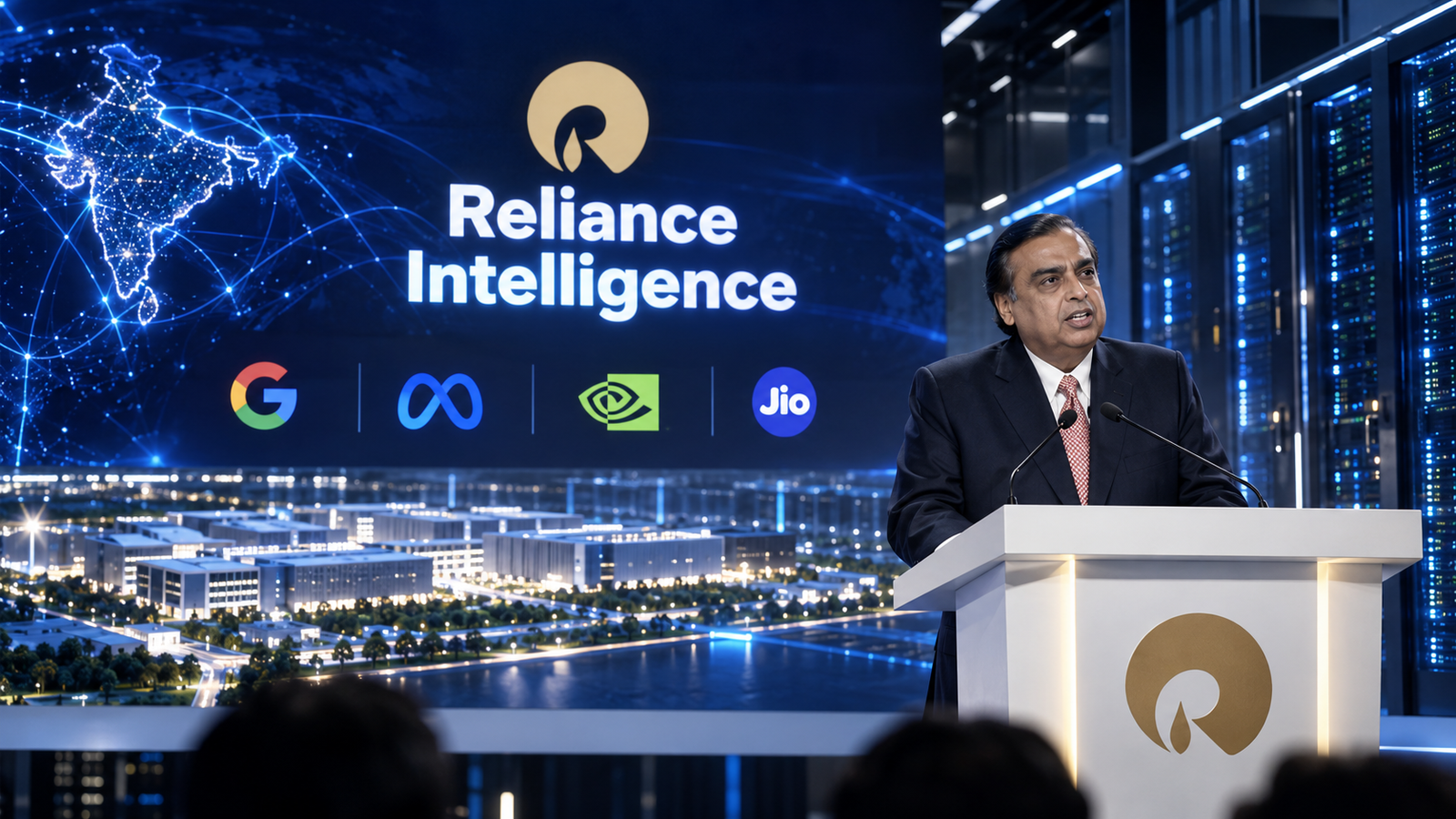
Reliance Intelligence is not another consumer app or a standalone chatbot. It is the company Reliance Industries created to build the infrastructure, partnerships and services behind its AI strategy. Announced by Mukesh Ambani on August 29, 2025 and incorporated on September 9, the wholly owned subsidiary has been given responsibility for AI infrastructure, global partnerships, AI services and talent. Its first major build is planned in Jamnagar, Gujarat, where Reliance says it is creating a sovereign AI backbone.
That makes Reliance Intelligence less like a single product business and more of a corporate hub around which Reliance is assembling an AI stack. NVIDIA supplies accelerator technology. Google provides cloud and enterprise AI capabilities. Meta is involved through technology, equity and data-centre capacity. Reliance’s own businesses, particularly Jio, provide distribution and connectivity.
Check out: Reliance Enterprise Intelligence Limited Financial Statements
Check out: Meta Partners With Reliance on AI-Enabled Data Center in India
Check out: Reliance and NVIDIA Partner to Advance AI in India, for India
What Reliance Intelligence actually does
Reliance’s 2026 annual report describes the company’s role alongside the broader push for sovereign AI infrastructure. The group says it plans to invest ₹10 lakh crore in multi-gigawatt AI-ready data centres and related infrastructure. Reliance Intelligence is the company tasked with building part of that compute backbone and turning partnerships into services.
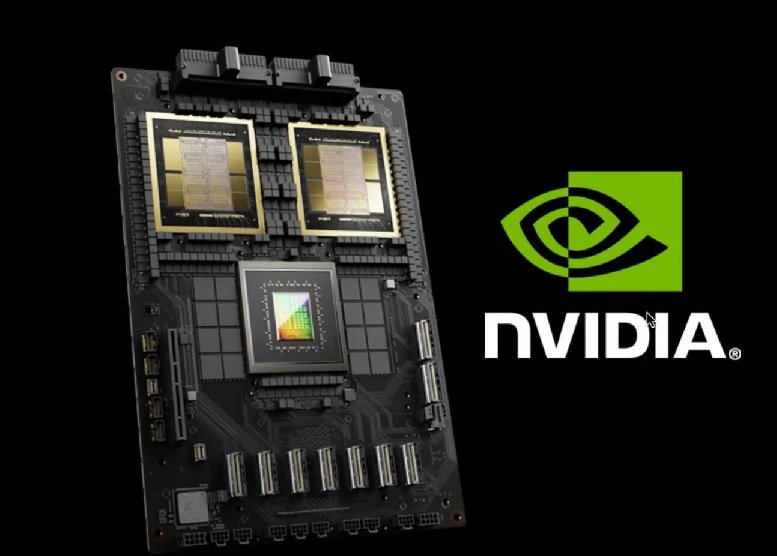
Photo credit: NVIDIA
The Jamnagar project is the clearest example. At the 2026 AGM, Reliance said the first 120 MW would be commissioned by the end of 2026. It said an initial fleet of NVIDIA GB300 GPUs would provide capacity equivalent to more than 75,000 H100 GPUs on an AI-inference basis, with the potential to scale beyond 200,000 H100-equivalent GPUs when the first 120 MW is fully operational.
Those numbers come from Reliance and describe its own capacity comparison. They are not an independent audit of installed GPUs.
The company’s role also extends into enterprise AI. Reliance Intelligence owns 70% of Reliance Enterprise Intelligence Limited, while Facebook Overseas, a Meta subsidiary, owns 30%. In February 2026, Reliance disclosed that the two shareholders had been allotted shares worth ₹596.6 crore and ₹256.6 crore respectively, taking the combined investment to ₹853.2 crore.
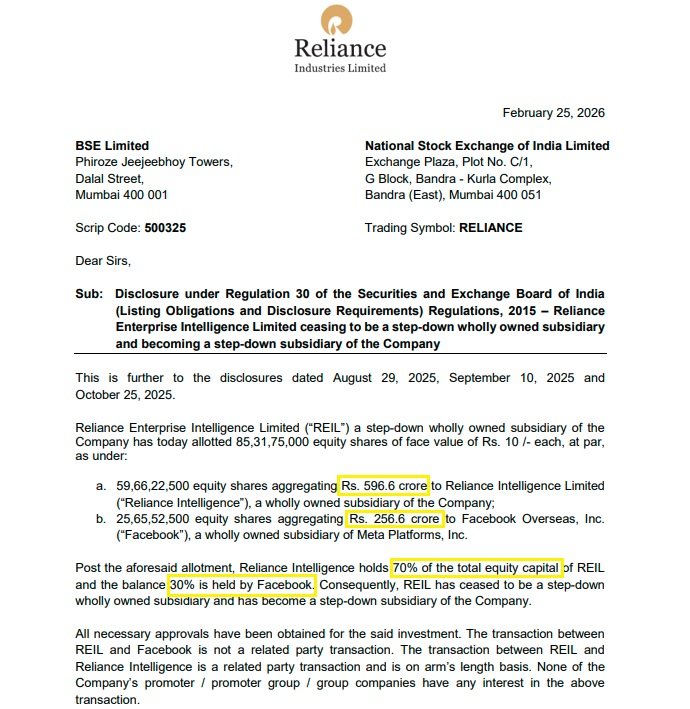
Photo credit: Reliance Industries Ltd.
REIL was created to develop, market and distribute enterprise AI services. In April 2026, it appointed Parminder Singh as chief executive officer. Reliance said the joint venture would combine Meta’s AI capabilities with Reliance’s enterprise reach, compute infrastructure and Jio connectivity.
That gives Reliance Intelligence a direct bridge from infrastructure to customers. The company is not simply building computing capacity and leaving other businesses to figure out what to do with it. Through REIL, it is also helping package AI for Indian enterprises.
Also see: Spiritual Tech Is Turning Faith Into a Global Digital Market
Also see: UAE Iran BRICS Meeting Opens a New Diplomatic Channel in New Delhi
Also see: BRICS New Delhi Declaration 2026: Key Points & Impact
Google, Meta and NVIDIA are different pieces
The partnerships around Reliance Intelligence are not interchangeable.
Google’s relationship centres on cloud infrastructure and enterprise AI. Reliance and Google announced a dedicated Jamnagar cloud region in August 2025. By October, Reliance Intelligence had become a strategic go-to-market partner for Google Cloud’s Gemini Enterprise and was expected to develop pre-built enterprise AI agents for the platform.
Meta’s relationship is broader. Its Llama models are being brought into the enterprise joint venture, while Meta also owns 30% of REIL. Then, in June 2026, Reliance and Meta announced a separate 168 MW AI-enabled data centre in Jamnagar. Reliance will design, construct and manage utilities, renewable power, connectivity and managed services. Meta will lease the capacity.
Meta described the facility as its first AI-enabled data centre in India. Mark Zuckerberg said, “We’re proud to be working with Reliance to build our first AI-enabled data center in India.” The company said the facility would be powered by renewable energy and cooled with desalinated seawater.
NVIDIA’s relationship with Reliance began before Reliance Intelligence existed. In September 2023, NVIDIA and Reliance announced an AI infrastructure partnership centred on Jio. The plan called for AI-ready data centres that could eventually expand to 2,000 MW. In 2026, Reliance said Reliance Intelligence was operationalising NVIDIA GB300 GPUs in Jamnagar.
Mukesh Ambani has described the broader objective in sovereign terms. In his 2026 chairman’s statement, he said Reliance had initiated Reliance Intelligence so that AI’s power was “not concentrated, but democratised.” The statement describes Reliance’s intended objective, not an independently measured outcome.
Also see: Genetically Modified Apples: Have They Helped the World or Just Reduced Waste?
Also see: Curiosity Rover: NASA Gave It 2 Years. Mars Kept It for 14
The balance sheet shows how new the company is
Reliance Intelligence’s first audited accounts make the structure more revealing. For the period from September 9, 2025 to March 31, 2026, the company reported zero operating revenue, expenses of ₹3.04 crore and total assets of ₹623.01 crore.

It also recorded ₹620 crore of short-term borrowings through zero-coupon, unsecured, optionally fully convertible debentures. At the same time, it held a ₹598.62 crore investment in Reliance Enterprise Intelligence.
Most strikingly, the audited accounts reported no property, plant and equipment.
That does not mean Reliance had no AI infrastructure under construction. The accounts belong to Reliance Intelligence, not the entire Reliance group. Management has also said physical infrastructure could sit directly with Reliance Industries rather than the subsidiary.
The ownership trail is therefore still important. Reliance has created the corporate vehicle, committed partners and announced the compute. But the legal entity that ultimately records the physical Jamnagar assets is not fully established by the first accounts.
The 120 MW sovereign backbone and the separate 168 MW Meta facility should also not be added together. Public documents do not establish whether they are separate facilities, capacity blocks within one campus or overlapping parts of a larger development.
Its consumer reach is also part of the plan. Reliance says Google AI Pro, powered by Gemini, has been made available to millions of Jio users for 18 months, while its wider AI strategy is intended to serve consumers, businesses, developers and public-sector organisations. That puts Reliance Intelligence between the infrastructure layer and the customer layer, rather than at only one point in the chain. The company therefore sits between machines producing AI and businesses and users expected to consume it directly.
For now, Reliance Intelligence is best understood as the coordinating company in Reliance’s AI buildout: the entity connecting compute, global technology partners and enterprise AI services. Its next test is physical. Reliance has promised that the first 120 MW in Jamnagar will be commissioned by the end of 2026.
Also see: ISRO Launches EOS-05, Expanding India’s Space Reach
Also see: Aule Space: India’s ‘Power Bank’ for Satellites
Also see: Best AI Tools for Students in 2026: 10 Free AI Apps That Actually Make Studying Smarter