
Merchant Discount Rate will return to select UPI payments from October 15
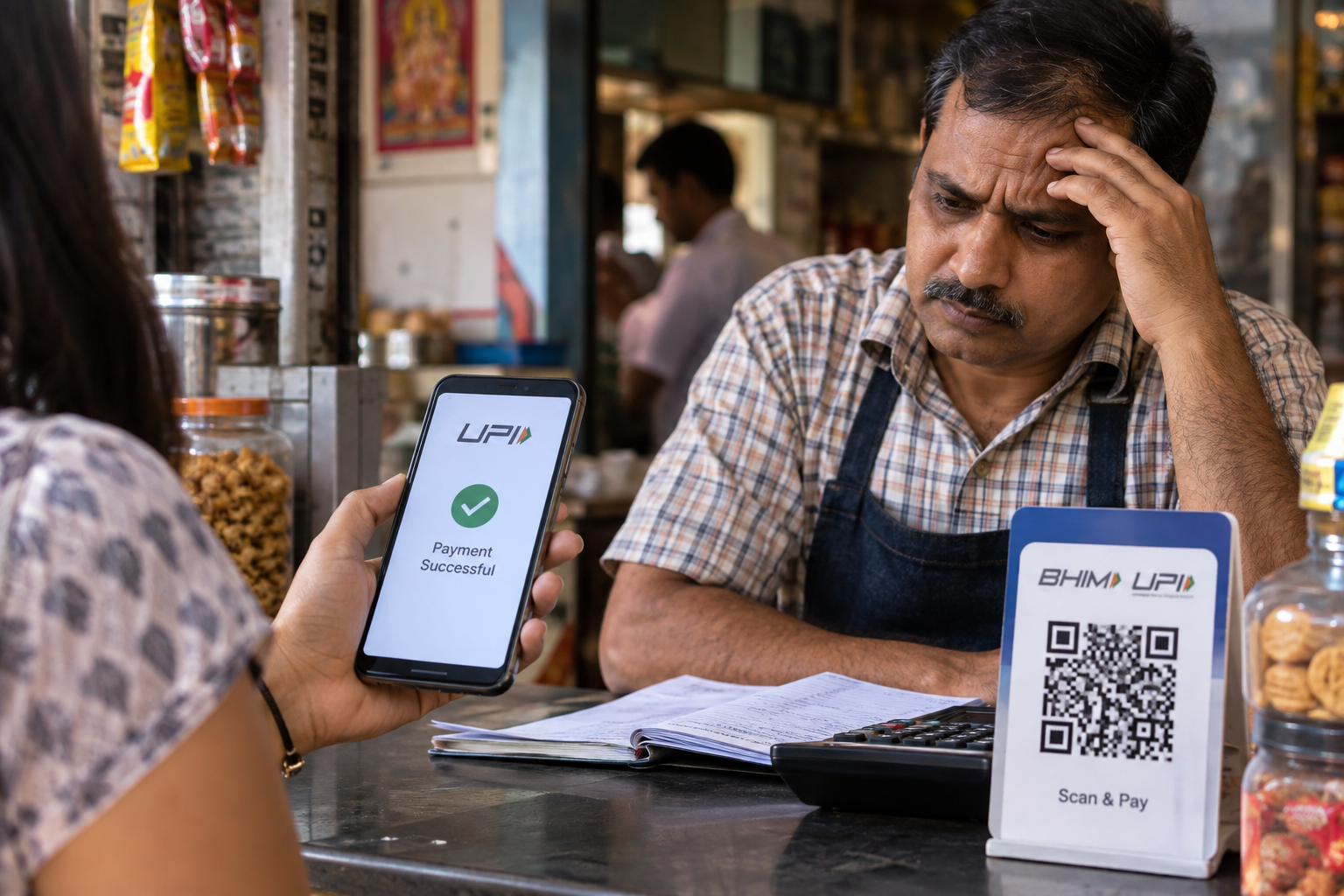
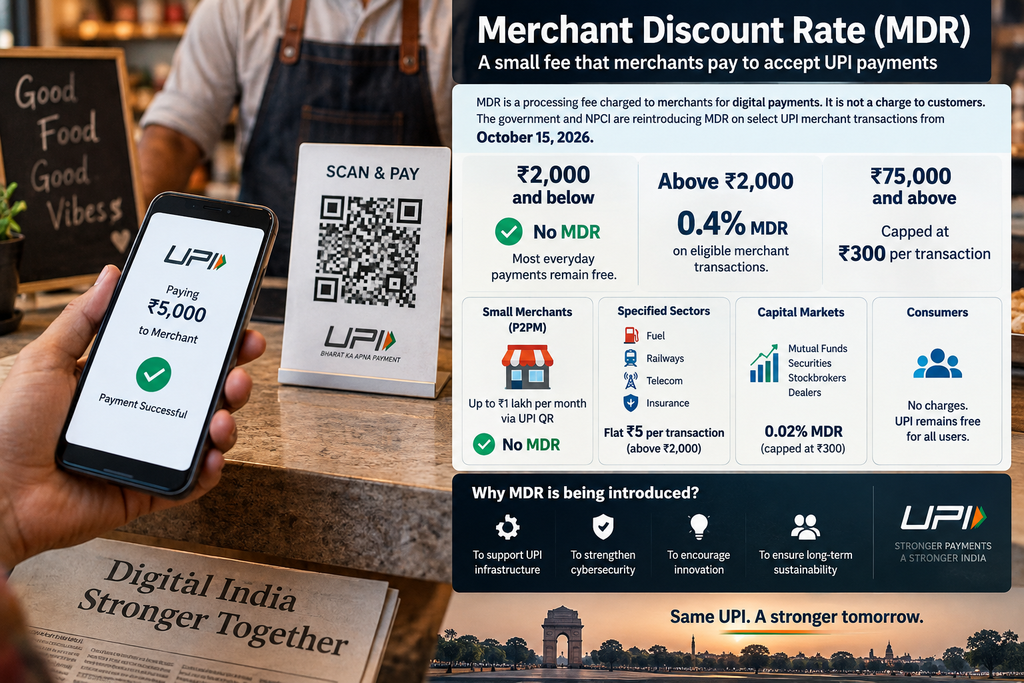
The Merchant Discount Rate, or MDR, will change how India’s digital payment system handles certain merchant transactions. From October 15, 2026, specified person-to-merchant, or P2M, UPI payments above ₹2,000 will attract a 0.4% MDR, subject to a maximum charge of ₹300 per transaction. The fee is paid within the merchant ecosystem, not by the person making the payment.
What the new Merchant Discount Rate actually covers
MDR is a processing fee charged to the merchant side of a digital transaction. It is different from a consumer transaction fee and different from a tax collected by the government. Under the new UPI framework, the money is distributed among participants in the payment chain, including banks and payment application providers.
Read: Merchant Discount Rate (MDR) on Select UPI (P2M) Transactions
Also see: Travis Kelce Named Victim in $35 Million Fraud Case
Also see: What Is Reliance Intelligence? Ambani’s AI Plan Explained
The change is narrower than a blanket UPI charge. Person-to-person payments remain free regardless of amount. P2M payments of ₹2,000 or less also remain free. The Finance Ministry said approximately 96% of P2M transactions will remain unaffected because they fall below the threshold or within the zero-MDR small-merchant framework. MDR therefore applies only to specified merchant payments above ₹2,000.
For standard eligible transactions, the percentage applies to the full transaction amount once the payment crosses the threshold. A ₹3,000 payment would therefore generate ₹12 in MDR, while a ₹50,000 payment would generate ₹200. At ₹75,000, the 0.4% calculation reaches ₹300, and the cap applies from that point. A ₹1 lakh transaction therefore carries ₹300 rather than ₹400.
The framework also creates separate treatment for certain categories. Payments above ₹2,000 in specified essential sectors, including railways, fuel, telecom services and insurance, carry a flat MDR of ₹5 per transaction. Capital-market payments, including mutual funds, securities, stockbrokers and dealers, carry a 0.02% MDR, capped at ₹300.
Small merchants get a separate exemption
The threshold is not determined only by an individual payment. Merchants receiving payments directly into their own bank accounts through UPI QR codes can remain exempt when their monthly UPI collections do not exceed ₹1 lakh, subject to classification rules.
A small merchant can therefore receive a payment above ₹2,000 without automatically becoming liable for the standard 0.4% MDR. The exemption is tied to the merchant category and monthly UPI collection level, rather than simply the amount printed on a single invoice.
The framework also keeps UPI AutoPay mandates outside the prescribed MDR charges and does not impose a customer-side platform fee for using a UPI application. Consumers are not permitted to be charged the MDR directly, and the government has said the cost is to remain within the merchant payment ecosystem.
Also see: Spiritual Tech Is Turning Faith Into a Global Digital Market
Also see: India Trade Deficit Falls to $9.41 Billion in August
Why India is changing the zero-MDR model
The shift follows years of government support. Section 10A of the Payment and Settlement Systems Act had provided statutory protection against charges on prescribed electronic payment modes. The government’s 2026 legislative change narrowed that protection, while preserving no-charge treatment for UPI payments up to ₹2,000 and for RuPay debit-card transactions.
The shift follows years of government support for digital payments. The Department of Financial Services said an incentive scheme was used to compensate payment-system participants and promote low-value digital payments. Its 2024 guidelines allocated ₹3,270 crore of a ₹3,637 crore scheme outlay to BHIM-UPI for financial year 2023-24. A later government answer said approximately ₹8,730 crore had been provided in incentives across four financial years through 2024-25.
The scale of UPI has also changed sharply. NPCI statistics show that in August 2026 the system processed 24,508.96 million transactions worth ₹29,82,355.95 crore, across 752 participating banks. In July, it processed 23,658.35 million transactions worth ₹29,87,880.49 crore. The new MDR is intended to create a revenue stream inside the payment infrastructure rather than relying entirely on public support.
Also see: The $48.8 Billion Enterprise AI Boom Is Here. Most Businesses Aren’t Ready
Also see: Japanese Yen Crisis: Inside the Rare US-Japan Intervention
What merchants and users face next
The government has stressed that MDR is not a charge collected by the state or NPCI. Its September 15 clarification said the fee would be distributed among ecosystem participants to support the operation and continued expansion of UPI. Statistics Secretary Saurabh Garg separately said, “More than 95% of transactions still fall out of MDR,” while saying investment is required to keep the system operating.
Merchant groups have challenged parts of the framework. Retail associations have argued that the ₹1 lakh monthly exemption threshold is too low for many small businesses and have sought broader protection. Fuel retailers have also sought exemption, citing high transaction volumes and tight margins. These are representations from industry groups, not findings that the policy will necessarily reduce digital-payment use.
There is also a legal challenge. A public interest litigation filed in the Supreme Court on September 16 seeks to challenge the framework and the government notifications behind it. The petitioner argues, among other things, that merchants could eventually pass the cost to customers despite the stated prohibition. The Supreme Court had not issued a ruling on the challenge as of September 21.
For consumers, the practical rule is straightforward: sending money to another person remains free and paying a merchant up to ₹2,000 remains free. For larger merchant payments, the overall checkout amount can remain unchanged while the merchant’s settlement economics change. The first operational test comes on October 15, when the new MDR schedule is due to take effect.
Also see: Appellate Body Members: BRICS Pushes for WTO Revival
Also see: PM Modi Uzbekistan Visit: $5 Billion Trade, Uranium Deal
Also see: Accenture Vacation Policy 2026: Unused Leave Carry Forward