

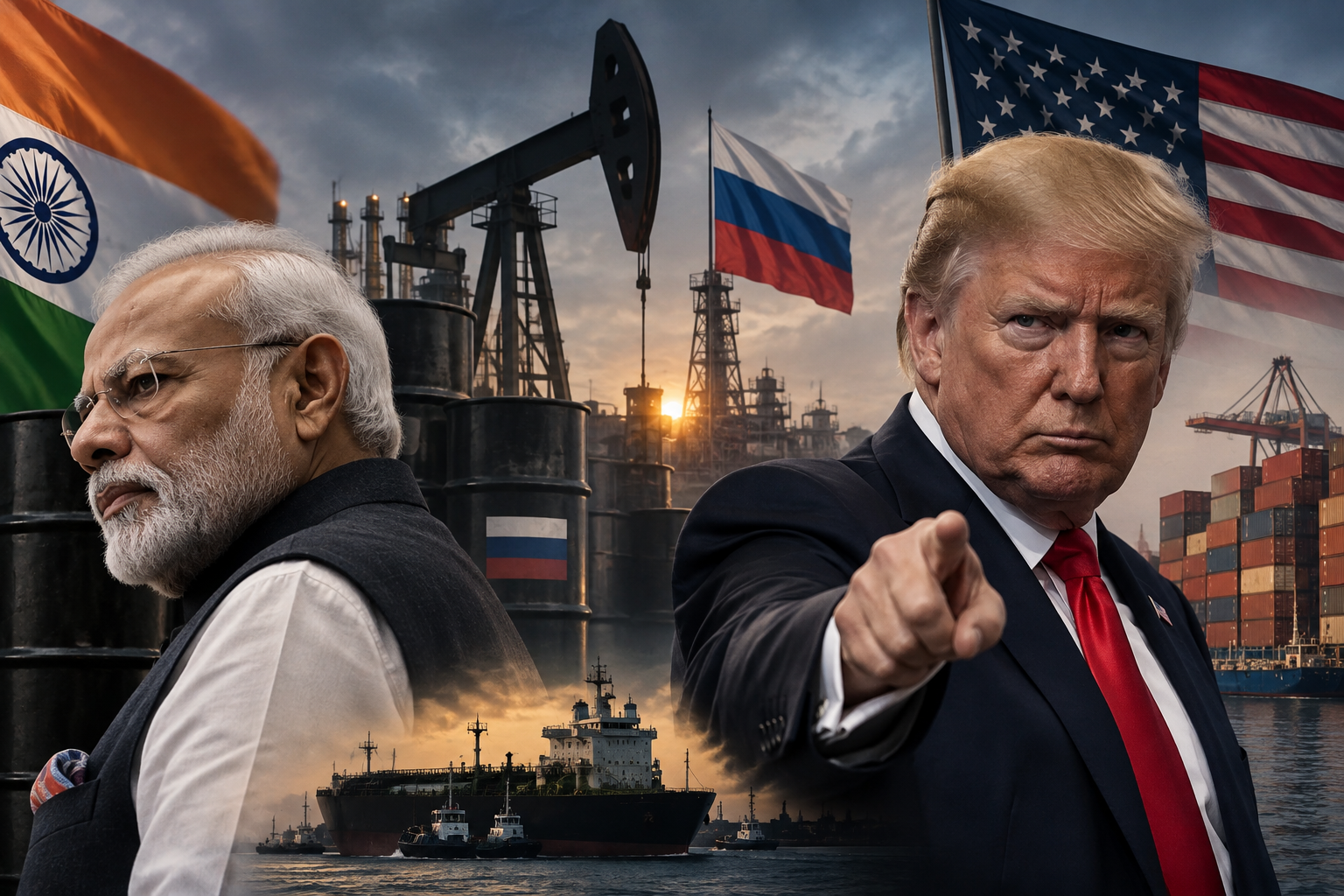
US signs Graham Act, putting India’s Russian oil trade under a new tariff test
The United States has signed the Lindsey O. Graham Sanctioning Russia and Iran Act of 2026 into law, creating a mechanism that can impose a Tariff of up to 100% on goods from countries that continue buying significant volumes of Russian crude or natural gas. For India, the measure is important because Russian oil has become a major part of its import basket, while the United States is a major Indian export market. President Donald Trump signed it on September 18, after large bipartisan votes in Congress.
What the Tariff law does
H.R. 5334 is broader than tariffs. Its Russia provisions target senior Russian officials, financial institutions, state-linked entities, people supporting Russia’s defense industry and vessels involved in sanctions evasion. It restricts new U.S. investment in Russia’s energy sector, bars U.S. persons from buying Russian sovereign debt and requires action on Russian uranium imports.
READ: USTR — 2026 National Trade Estimate Report on Foreign Trade Barriers
Also see: Strait of Hormuz: US Strikes Iran, Trump Warns Tehran
Also see: Trump-Netanyahu Rift Explodes Over Lebanon Strikes as Iran Talks Stall
Section 112 requires the president, within 30 days of enactment, to raise duties on all goods imported from Russia to a rate of up to 500%. Section 113 establishes duties of up to 100% on goods from qualifying third countries. The second measure matters to India because the duty applies to goods, not merely Russian oil.
A country can qualify if it makes new purchases of Russian crude or natural gas after 30 days from enactment and was among the five largest importers by volume during the preceding 12 months. It also covers the five countries identified as facilitating Russian oil sanctions evasion. Every 180 days, the U.S. Trade Representative, with the State and Energy departments, must reassess the five largest crude and gas importers and impose duties on qualifying countries.
The law does not name India in Section 113. Nor does it automatically set 100%. It establishes a ceiling of 100%, requires a duty for countries meeting the statutory conditions and allows the rate to be adjusted above zero and up to that ceiling. Before imposing or changing a duty, the administration must provide Congress with a written justification and explain how the country was identified.
Also see: Months After $6.25 Billion Trump-Linked Donation, Dell Lands $9.7 Billion Pentagon Deal
Also see: Trump Yet to Approve Proposed U.S.-Iran 60-Day Ceasefire Deal as Nuclear Talks Intensify
Also see: Trump Pauses Planned Iran Strike After Gulf Pressure as Oil, Security Fears Mount
Why India is exposed
India’s exposure comes from the scale of its Russian crude purchases. Trade data cited in August showed Russian oil accounted for 50.83% of India’s crude imports in July, equal to 2.47 million barrels per day. That was 62.4% higher than a year earlier, but below June’s 2.6 million barrels per day. From April through July, Russia supplied an average 43.25% of India’s crude imports, while Middle Eastern suppliers accounted for about 30%. India imports more than 90% of its crude.
A 100% U.S. duty on Indian goods would affect trade even though the trigger is India’s energy purchases from Russia. U.S. goods imports from India totalled $103.8 billion in 2025, according to the U.S. Trade Representative.
For Indian companies, the immediate issue is uncertainty over the rate and timing, not an already imposed 100% Tariff. The law was enacted on September 18, so the 30-day clock for the Russian-purchase condition begins from that date. An Indian exporter is not itself sanctioned simply because India buys Russian oil. Potential exposure comes through the country-level duty mechanism.
India’s response and the energy problem
India’s Ministry of External Affairs said on September 17, before the presidential signature, that New Delhi remained committed to energy security for its 1.4 billion people and would continue diversified sourcing based on evolving market conditions. The ministry said the issue had been discussed with U.S. interlocutors and that India had communicated potential effects on bilateral relations and energy markets. It also said the government would take necessary measures to protect trade and economic interests and work with Indian industry bodies.
India has already been changing its supply mix. During April-July, the Middle East’s share of crude imports fell from about 43% a year earlier to 30%, while Latin America’s share rose from 3.5% to 12.7%, according to trade-source data. The UAE became India’s second-largest supplier. Alternative suppliers exist, but they do not remove India’s dependence on imported crude or guarantee replacement barrels at the same cost.
The law allows waivers. The president may waive sanctions, restrictions or duties if the required national-interest certification is submitted to Congress. The act also provides humanitarian exceptions and preserves specified civilian nuclear cooperation and uranium exceptions. Most Russia provisions expire five years after enactment, while the extension of the Iran Sanctions Act runs through 2031.
Also see: Trump-Xi summit ends with modest trade signals as deeper US-China tensions persist
Also see: Trump and Xi Strike Tone in Beijing as US-China Tensions Simmer
Also see: Trump vs Pope Clash Explodes After AI Jesus Image
What changes now
The law connects energy sourcing to U.S. market access. India’s Russian oil purchases do not automatically trigger a 100% Tariff today, but continued purchases can place the country within the statutory framework for additional duties. The administration must identify qualifying countries, set the rate and follow Congress’s reporting requirements.
For New Delhi, the policy problem is split between two markets: Russian crude, which has supplied a large share of India’s refineries, and the United States, which bought $103.8 billion of Indian goods in 2025. The next step is identifying countries covered by Section 113. Until those decisions are made, the maximum Tariff is a legal ceiling, NOT a rate already being charged on Indian exports.
Also see: Hormuz Oil Crisis: Trump Says “Buy US Oil or Take It Yourself”
Also see: What Is Reliance Intelligence? Is Ambani Building India’s AI Future or His Own?