
Group Discussion: Complete Guide with Panel Discussion and Debate Comparison

group discussions panel discussions debates
Spread the love

Group discussion, panel discussion and debates are widely used in schools, colleges, interviews, conferences, and professional meetings. Although all three involve discussing a common topic, they differ significantly in their purpose, structure, and communication style.

A group discussion (GD) encourages participants to exchange ideas, solve problems, and work towards a common understanding. A panel discussion brings together experts who share their knowledge and perspectives under the guidance of a moderator. A debate, on the other hand, is a structured contest of ideas where opposing sides present arguments and evidence to support their position.

Understanding these differences helps students prepare for campus placements, MBA admissions, public speaking competitions, and professional discussions more effectively.

Group Discussion vs Panel Discussion vs Debate: A Quick Comparison

FeatureGroup DiscussionPanel DiscussionDebate
Primary PurposeGenerate ideas and solve problemsShare expert knowledgePresent opposing arguments
Communication StyleCollaborative and interactiveInformative and moderatedCompetitive and persuasive
ParticipantsGroup membersModerator and expertsIndividuals or opposing teams
ModeratorOptionalRequiredRequired
Audience ParticipationUsually limitedCommon through Q&ALimited depending on format
GoalReach a conclusion or consensusEducate and informConvince judges or audience
OutcomeShared understandingBetter awareness of the topicWinning argument
Best Used ForInterviews, classrooms, brainstormingConferences, seminars, webinarsCompetitions, policy discussions

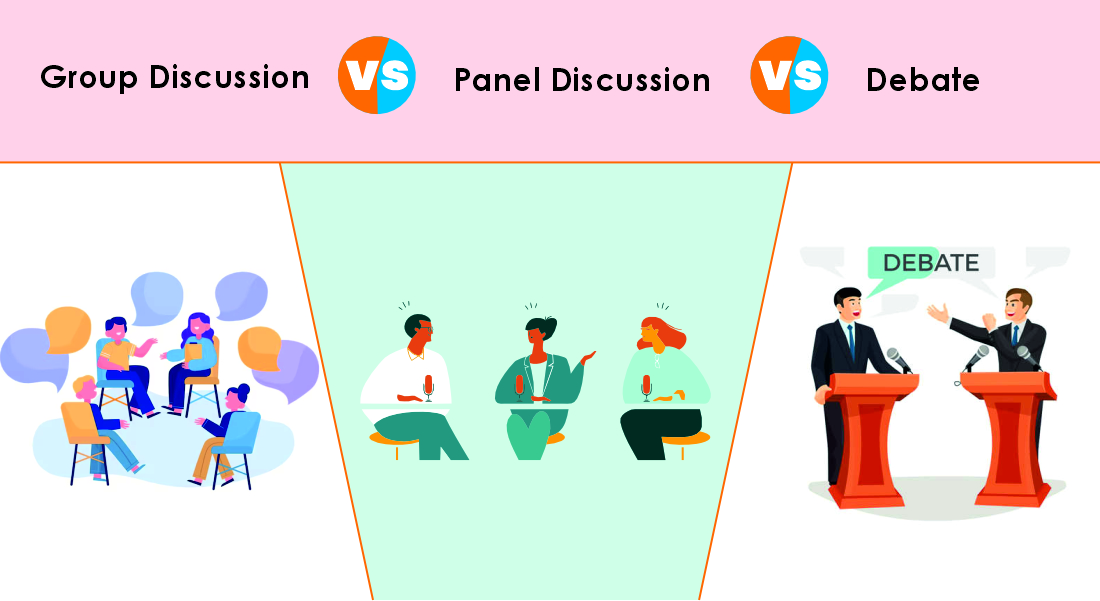
Visual Comparison

Key differences between group discussions, panel discussions, and debates at a glance.

Which Format Should You Choose?

Before selecting a discussion format, consider your objective.

If your goal is to…Best Choice
Brainstorm ideasGroup Discussion
Solve problems collaborativelyGroup Discussion
Learn from expertsPanel Discussion
Educate an audiencePanel Discussion
Defend a viewpointDebate
Improve persuasive speakingDebate
Evaluate teamworkGroup Discussion
Explore multiple expert opinionsPanel Discussion

What is Group Discussion?

A group discussion is a communication method where participants share ideas, opinions, and perspectives on a topic to reach a meaningful conclusion together. Unlike debates, where participants defend opposing positions, group discussions encourage collaboration, active listening, and collective problem-solving.

Group discussions are commonly conducted in educational institutions, corporate training programmes, recruitment processes, and team meetings because they evaluate how individuals communicate, think critically, and work with others.

Also Read: Co-Education- Pros and Cons 

Goals of Group Discussions

Group discussions offer a range of advantages for both participants and the overall objective of the discussion.

Generate New Ideas

People with different experiences often approach problems differently. Bringing those viewpoints together encourages creativity and produces innovative solutions.

Improve Knowledge

As participants exchange information and experiences, everyone develops a broader and more balanced understanding of the topic.

Better Decision-Making

Considering multiple viewpoints before reaching a conclusion helps groups make informed and practical decisions.

Develop Communication Skills

Regular participation improves speaking confidence, active listening, logical reasoning, and the ability to express ideas clearly.

Strengthen Teamwork

Because success depends on collaboration rather than competition, participants learn how to respect different opinions, encourage others, and contribute constructively.

Also Read: Creativity vs Knowledge – Which Is Better? 

Where Are Group Discussions Used?

Group discussions are widely used in:

  • MBA admissions
  • Campus placement interviews
  • Corporate recruitment
  • Business meetings
  • Classroom discussions
  • Employee training programmes
  • Leadership development workshops

Many organisations prefer group discussions because they allow evaluators to assess several interpersonal skills at the same time.

Skills Required for Effective Participation

Success in a group discussion depends on much more than speaking frequently.

SkillWhy It Matters
Active ListeningHelps understand others before responding.
Clear CommunicationEnsures ideas are presented logically and confidently.
Critical ThinkingEncourages thoughtful analysis instead of assumptions.
TeamworkBuilds collaboration and supports collective problem-solving.
Respectful BehaviourMaintains healthy discussion even during disagreements.
Subject KnowledgeAllows meaningful contributions backed by understanding.
Time ManagementPrevents overly long or repetitive responses.
AdaptabilityHelps participants respond to new ideas effectively.
Positive AttitudeEncourages constructive and professional interaction.
Confident Body LanguageReinforces verbal communication through eye contact and posture.

How Are Group Discussions Evaluated?

Recruiters and educators usually evaluate multiple competencies rather than simply counting how often someone speaks.

Evaluation CriterionImportance
Communication Skills⭐⭐⭐⭐⭐
Leadership⭐⭐⭐⭐⭐
Teamwork⭐⭐⭐⭐⭐
Critical Thinking⭐⭐⭐⭐
Problem Solving⭐⭐⭐⭐
Active Listening⭐⭐⭐⭐⭐
Confidence⭐⭐⭐⭐
Clarity of Thought⭐⭐⭐⭐
Consensus Building⭐⭐⭐⭐
Professional Behaviour⭐⭐⭐⭐⭐

Common Mistakes to Avoid

Many participants lose marks because of avoidable mistakes.

  • Interrupting other participants.
  • Speaking without adding meaningful information.
  • Dominating the conversation.
  • Remaining silent throughout the discussion.
  • Ignoring alternative viewpoints.
  • Making personal remarks instead of discussing ideas.
  • Going off-topic.
  • Rushing to conclusions without considering different perspectives.

Also Read: How to Fight Phone Addiction 

What is a Panel Discussion?

A panel discussion is a structured conversation in which a moderator leads a group of experts or experienced professionals through a discussion on a specific topic. Rather than trying to reach a common decision or prove one side right, the objective is to present multiple viewpoints, share practical knowledge, and help the audience understand an issue from different perspectives.

Panel discussions are common at academic conferences, business events, industry summits, webinars, and educational seminars because they allow audiences to hear informed opinions from people with different expertise.

Unlike a group discussion, not everyone in the room participates equally. The panelists lead the conversation while the audience typically listens and asks questions during a dedicated Q&A session.

Communication Structure of a Panel Discussion 

                    Moderator

                        │

        ┌───────────────┼───────────────┐

        │               │               │

   Panelist A      Panelist B      Panelist C

        │               │               │

        └───────────────┼───────────────┘

                        │

                  Audience Q&A

Unlike a group discussion where everyone participates equally, the moderator guides the discussion while panelists contribute their expertise. Audience participation generally takes place during the question-and-answer session. 

Objectives of Panel Discussions

The main objectives of a panel discussion extend beyond simply sharing opinions. A well-organised panel helps audiences understand a subject from multiple viewpoints while encouraging thoughtful discussion.

Share Expert Knowledge

Panel discussions bring together professionals with different backgrounds and experiences, allowing audiences to benefit from practical insights rather than a single perspective.

Explore Different Viewpoints

A moderator encourages panelists to discuss both agreements and disagreements, giving audiences a balanced understanding of the topic.

Encourage Audience Learning

Audience questions create opportunities to clarify concepts, challenge ideas, and explore subjects in greater depth.

Promote Meaningful Conversations

Unlike lectures, panel discussions allow ideas to evolve naturally through interaction between experts.

Connect Theory with Practice

Panelists often support their viewpoints with real-world experiences, making complex topics easier to understand.

Also Read: Online Vs Offline Shopping 

Where Are Panel Discussions Used?

Panel discussions are widely used across education, business, research, and public events.

Common examples include:

  • Academic conferences
  • University seminars
  • Industry conferences
  • Business leadership summits
  • Government policy discussions
  • Corporate town halls
  • Technology conferences
  • Healthcare events
  • Professional webinars
  • Television discussion programmes

Roles in a Panel Discussion

Every successful panel discussion depends on clearly defined responsibilities.

RolePrimary Responsibility
ModeratorGuides the discussion and manages time.
PanelistsShare expertise, experiences, and informed opinions.
AudienceListen actively and participate during Q&A sessions.

Moderator

The moderator keeps the discussion organised, balanced, and engaging.

Typical responsibilities include:

  • Introducing the topic and speakers.
  • Explaining the objectives of the discussion.
  • Asking relevant questions.
  • Managing speaking time fairly.
  • Encouraging balanced participation.
  • Preventing interruptions or domination by one speaker.
  • Keeping the discussion focused.
  • Facilitating audience questions.
  • Summarising the discussion before closing.

A skilled moderator often determines whether a panel discussion feels engaging or disorganised.

Also Read – Top MBA Colleges in India 

Panelists

Panelists are selected because of their knowledge, expertise, or professional experience.

They are expected to:

  • Prepare relevant insights.
  • Support opinions with practical examples.
  • Listen carefully to other panelists.
  • Respect differing viewpoints.
  • Respond clearly and concisely.
  • Build upon previous discussions instead of repeating ideas.

Audience

Although the audience usually does not participate throughout the discussion, it remains an essential part of the session.

Audience members should:

  • Listen attentively.
  • Take notes where appropriate.
  • Ask thoughtful questions during Q&A.
  • Respect discussion guidelines.
  • Contribute constructively.

Panel Discussion Skills Compared

SkillImportance
Subject Expertise⭐⭐⭐⭐⭐
Listening⭐⭐⭐⭐⭐
Public Speaking⭐⭐⭐⭐
Audience Engagement⭐⭐⭐⭐
Professionalism⭐⭐⭐⭐⭐
Communication⭐⭐⭐⭐⭐
Time Management⭐⭐⭐⭐
Adaptability⭐⭐⭐⭐

Also Read: Top Engineering Colleges In India 

Effective Panel Discussions: Tips for Organisers

The success of a panel discussion depends as much on planning as it does on the speakers.

Choose a Relevant Topic

Select a subject that encourages discussion rather than simple agreement.

Assemble a Diverse Panel

Invite speakers with different backgrounds and viewpoints to provide a richer discussion.

Select a Skilled Moderator

An experienced moderator keeps the conversation balanced and ensures everyone contributes.

Prepare Meaningful Questions

Questions should encourage discussion instead of producing simple yes-or-no answers.

Encourage Audience Participation

Reserve sufficient time for audience questions and interaction.

Tips for Panelists

Successful panelists focus on providing value rather than speaking the longest.

  • Research the topic thoroughly.
  • Prepare concise talking points.
  • Support opinions with examples.
  • Listen before responding.
  • Respect different viewpoints.
  • Keep answers clear and focused.
  • Avoid unnecessary technical jargon.

Common Mistakes During Panel Discussions

Even experienced speakers can reduce the quality of a panel discussion by making avoidable mistakes.

  • Speaking for too long.
  • Ignoring the moderator’s questions.
  • Repeating points already made.
  • Using excessive technical language.
  • Turning the discussion into a presentation.
  • Interrupting other panelists.
  • Failing to engage the audience.
  • Poor time management.

Also Read: EPSI (Educational Performance Statistics In India) Ranking

Panel Discussion at a Glance

FeaturePanel Discussion
PurposeShare expert knowledge
ParticipantsModerator, experts, audience
Communication StyleModerated discussion
Audience InteractionHigh
Decision RequiredNo
CompetitionNone
Best Use CasesConferences, seminars, webinars, business events

What is a Debate?

A debate is a formal and structured discussion in which two individuals or teams present opposing arguments on a specific topic or proposition. Unlike a group discussion, where participants work towards a shared understanding, a debate requires each side to defend its position using facts, logic, examples, and persuasive reasoning while responding to counterarguments.

Most debates follow predefined rules regarding speaking order, time limits, rebuttals, and judging criteria. The objective is not simply to disagree but to present the strongest evidence-based argument.

Typical participants in a debate include:

  • Proposition (Affirmative): Supports the motion or statement.
  • Opposition (Negative): Challenges or opposes the motion.
  • Moderator or Chairperson: Ensures the debate follows the rules and remains orderly.
  • Judges or Audience: Evaluate the quality of arguments, depending on the debate format.

Debates are widely used in schools, universities, law programmes, public policy discussions, and competitive speaking events because they encourage analytical thinking and persuasive communication.

Communication Structure of a Debate

                  Moderator

                      │

        ┌─────────────┴─────────────┐

        │                           │

   Proposition Team          Opposition Team

        │                           │

        └─────────────┬─────────────┘

                      │

             Judges / Audience

Unlike a group discussion, participants do not work together. Each side presents arguments, responds to counterarguments, and attempts to persuade the judges or audience.

Objectives of a Debate

Although debates often appear competitive, their purpose goes far beyond determining a winner.

Develop Critical Thinking

Participants analyse information, identify strengths and weaknesses in arguments, and evaluate evidence before presenting their case.

Improve Persuasive Communication

Debaters learn to organise ideas logically, support claims with evidence, and communicate confidently.

Encourage Evidence-Based Reasoning

Successful debates rely on facts, credible sources, and logical reasoning rather than personal opinions alone.

Build Public Speaking Confidence

Speaking before judges or an audience strengthens confidence and improves presentation skills.

Help Audiences Understand Complex Issues

Listening to both sides enables audiences to evaluate evidence independently and form informed opinions.

Where Are Debates Used?

Debates are commonly organised in:

  • Schools
  • Colleges
  • Universities
  • Law schools
  • Public policy forums
  • Student competitions
  • Parliamentary simulations
  • Model United Nations (MUN)
  • Leadership programmes
  • Television discussions

Different Debate Formats

Several debate formats are used worldwide depending on the purpose and level of competition.

Policy Debate

Policy Debate focuses on real-world policy issues. Teams argue for or against a proposed policy using extensive research and evidence.

Lincoln–Douglas Debate

Named after the famous debates between Abraham Lincoln and Stephen Douglas in 1858, this one-on-one format focuses on ethics, philosophy, and logical reasoning.

Parliamentary Debate

Inspired by parliamentary proceedings, this format involves teams debating a motion within strict time limits. It rewards logical thinking, teamwork, and quick responses.

Public Forum Debate

Public Forum Debate focuses on current affairs and public-interest topics using language that is easy for a general audience to understand.

World Schools Debate

One of the most popular international formats, World Schools Debate combines prepared speeches with spontaneous rebuttals. Teams are assessed on research, teamwork, organisation, and persuasive speaking.

How Are Debates Evaluated?

Judges generally assess participants using several criteria rather than focusing on speaking ability alone.

Evaluation CriterionImportance
Strength of Arguments⭐⭐⭐⭐⭐
Evidence & Research⭐⭐⭐⭐⭐
Logical Reasoning⭐⭐⭐⭐⭐
Rebuttal Skills⭐⭐⭐⭐
Public Speaking⭐⭐⭐⭐
Organisation⭐⭐⭐⭐
Confidence⭐⭐⭐⭐
Time Management⭐⭐⭐⭐
Persuasiveness⭐⭐⭐⭐⭐
Professional Conduct⭐⭐⭐⭐

Winning a debate depends on presenting the strongest logical and evidence-based case—not simply speaking louder or longer.

Real-Life Examples

The differences between the three discussion formats become clearer when applied to real situations.

SituationBest FormatReason
MBA Admission ProcessGroup DiscussionEvaluates teamwork, leadership, and communication.
Campus PlacementGroup DiscussionMeasures interpersonal and analytical skills.
Business BrainstormingGroup DiscussionEncourages collaborative problem-solving.
Industry ConferencePanel DiscussionExperts share practical knowledge and experience.
University SeminarPanel DiscussionPresents multiple perspectives on a topic.
School CompetitionDebateDevelops critical thinking and persuasive speaking.
Public Policy DiscussionDebateExamines opposing viewpoints using evidence.

Pros and Cons

FormatAdvantagesLimitations
Group DiscussionEncourages teamwork, idea sharing, and problem-solvingStrong personalities may dominate the discussion
Panel DiscussionProvides expert insights and multiple perspectivesAudience participation is usually limited to Q&A
DebateBuilds persuasive speaking and critical thinkingFocuses on defending positions rather than collaboration

Common Mistakes Across All Three Formats

Regardless of the format, certain habits reduce the effectiveness of communication.

  • Interrupting other speakers.
  • Speaking without supporting evidence.
  • Ignoring opposing viewpoints.
  • Going off-topic.
  • Dominating the conversation.
  • Focusing on winning instead of learning.
  • Using disrespectful language.
  • Failing to listen before responding.

Strong communicators contribute thoughtfully, respect different perspectives, and remain focused on the purpose of the discussion.

Common Misconceptions

Myth: Group discussions have no rules.

Fact: Most group discussions follow a clear objective, time limit, and evaluation criteria.

Myth: The loudest speaker performs best.

Fact: Recruiters usually value active listening, teamwork, and logical thinking more than speaking the most.

Myth: Panel discussions are interviews.

Fact: Panel discussions encourage interaction among experts, whereas interviews primarily involve one interviewer and one interviewee.

Myth: Debates are about arguing aggressively.

Fact: Formal debates reward evidence, reasoning, and respectful rebuttals rather than emotional arguments or personal attacks.

Myth: Every discussion format has a winner.

Fact: Only debates typically determine a winner. Group discussions and panel discussions focus on collaboration and knowledge sharing.

If you want to…Choose…
Generate ideasGroup Discussion
Solve problems collaborativelyGroup Discussion
Learn from expertsPanel Discussion
Educate an audiencePanel Discussion
Defend a viewpointDebate
Improve persuasive speakingDebate
Build teamworkGroup Discussion
Explore multiple expert opinionsPanel Discussion

Conclusion

Group discussions, panel discussions, and debates all encourage communication, but each serves a different purpose.

A group discussion promotes collaboration, problem-solving, and teamwork. It is widely used in classrooms, recruitment processes, and business meetings to evaluate communication, leadership, and interpersonal skills.

A panel discussion enables experts to share diverse perspectives under the guidance of a moderator. It is commonly used at conferences, seminars, webinars, and professional events to educate and inform audiences.

A debate focuses on presenting and defending opposing viewpoints through structured arguments supported by evidence and logical reasoning. It develops critical thinking, persuasive speaking, and analytical skills.

Understanding the differences between these discussion formats helps students, professionals, and educators choose the most appropriate approach for interviews, public speaking, collaborative projects, and academic or professional events.

Frequently Asked Questions (FAQs)

Q1. What is the main difference between a group discussion and a debate?
A group discussion promotes collaboration, while a debate focuses on defending opposing viewpoints.

Q2. Is a moderator necessary in a group discussion?
No. A moderator is optional in group discussions but essential in panel discussions and debates.

Q3. Which format is commonly used in MBA interviews?
Group discussions are widely used to assess communication, teamwork, leadership, and analytical ability.

Q4. Can the audience participate in a panel discussion?
Yes. Audience participation usually takes place during a moderated Q&A session.

Q5. Which discussion format develops critical thinking the most?
Debates strongly develop critical thinking through evidence-based arguments and rebuttals.

Q6. Are panel discussions and group discussions the same?
No. Panel discussions feature experts led by a moderator, while group discussions involve equal participation from members.

Q7. Can debates involve teams instead of individuals?
Yes. Many debate formats involve two or more teams competing against one another.

Q8. Which format is best for brainstorming?
Group discussions are best suited for brainstorming because they encourage collaboration and idea generation.