

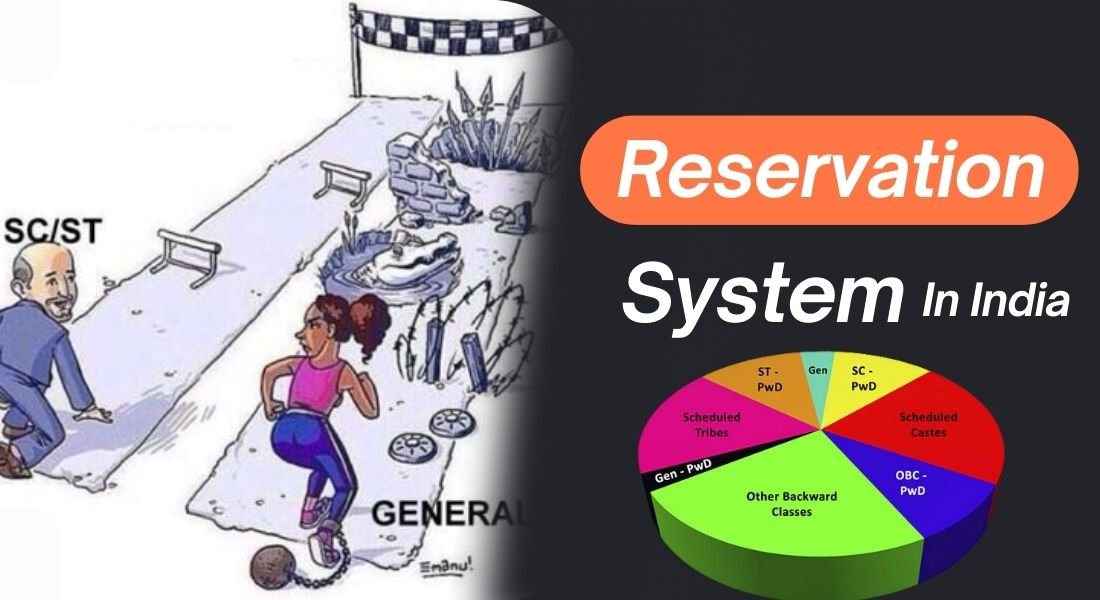
Reservation in India remains one of the country’s most debated public policies. For supporters, it is a constitutional tool to correct centuries of social exclusion and improve representation in education, public employment and legislatures. Critics argue that the system should evolve to reflect changing social and economic realities. The debate has intensified in recent years following new constitutional amendments, Supreme Court rulings and state-level policy changes. Yet one fact is beyond dispute: reservation has become a defining feature of India’s governance and affirmative action framework.
Unlike welfare schemes that primarily focus on income, reservation is rooted in constitutional provisions designed to improve opportunities for historically disadvantaged communities. It applies across admissions to many government-funded educational institutions, recruitment to public services, political representation, and several forms of horizontal reservation such as benefits for Persons with Benchmark Disabilities (PwBD). While the Central Government follows a broadly uniform framework, individual states have adopted their own reservation policies, resulting in significant regional variation.
Reservation in India: Meaning and Objectives
Reservation is a system of affirmative action under which a fixed proportion of seats or posts are reserved for eligible communities in educational institutions, government employment and elected bodies. Its objective is to improve representation of groups that have historically experienced social and educational disadvantage rather than simply provide economic assistance.
The Constitution empowers the State to introduce such measures through Articles 15 and 16 while also directing it to promote the educational and economic interests of weaker sections through Article 46. Over the decades, Parliament and the Supreme Court have refined these provisions through constitutional amendments and landmark judgments, making reservation one of the most developed areas of Indian constitutional law.
Objectives of the Reservation System
The reservation framework seeks to achieve several constitutional goals:
- Improve access to higher education for disadvantaged communities.
- Increase representation in Central and State Government employment.
- Reduce the long-term effects of historical discrimination.
- Promote equality of opportunity rather than formal equality alone.
- Strengthen political participation through reserved legislative seats.
- Encourage diversity within public institutions.
The policy is therefore intended to create a more inclusive public sector while recognising that equal treatment does not always produce equal opportunities.
Also Read: Co-Education
Reservation in India: Evolution
The present reservation system developed over more than a century through social reform movements, constitutional reforms and judicial interpretation.
| Year | Milestone | Significance |
| 1902 | Chhatrapati Shahu Maharaj introduced reservation in Kolhapur | Considered India’s first modern reservation policy |
| 1932 | Poona Pact | Reserved legislative seats for the Depressed Classes within a joint electorate |
| 1950 | Constitution came into force | Constitutional framework for reservation established |
| 1951 | First Constitutional Amendment | Enabled special provisions for socially and educationally backward classes |
| 1979 | Mandal Commission constituted | Studied backward classes and recommended OBC reservation |
| 1990 | Mandal recommendations implemented | Introduced 27% reservation for OBCs in Central Government services |
| 1992 | Indra Sawhney judgment | Upheld OBC reservation, introduced the creamy layer principle and the 50% ceiling doctrine |
| 2019 | 103rd Constitutional Amendment | Introduced 10% reservation for Economically Weaker Sections (EWS) |
| 2024 | Supreme Court allowed SC sub-classification | Permitted states to create internal SC classifications based on empirical evidence |
Evolution of India’s Reservation Framework
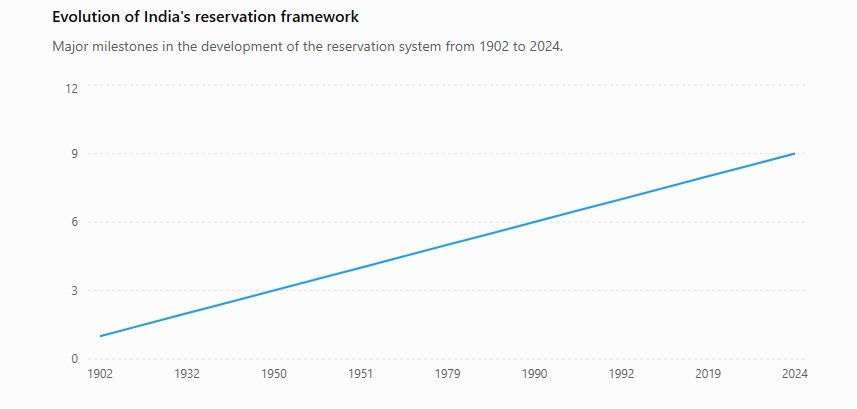
The reservation framework has continued to evolve through later constitutional amendments, judicial decisions and administrative rules, reflecting changing constitutional priorities as well as new debates over representation, equality and social justice.
Reservation Percentage in India (2026)
At the Central Government level, reservation is implemented through constitutionally recognised categories and applies to many government-funded educational institutions and public sector recruitment. States, however, are free to adopt different reservation structures within the constitutional framework, which explains why percentages vary significantly across India.
| Category | Reservation (Central Government) |
| Scheduled Castes (SC) | 15% |
| Scheduled Tribes (ST) | 7.5% |
| Other Backward Classes (OBC – Non-Creamy Layer) | 27% |
| Economically Weaker Sections (EWS) | 10% |
| Persons with Benchmark Disabilities (Horizontal Reservation) | 4% |
Central Government Reservation Percentages
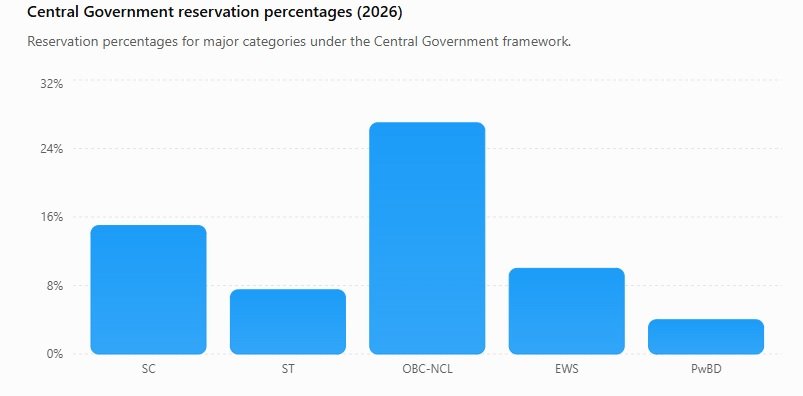
These percentages generally apply to Central Government educational institutions and services. Some states exceed the traditional 50% reservation benchmark because of state-specific legislation and judicial developments. Tamil Nadu, for example, continues to operate under a 69% reservation model, while several other states have introduced their own backward class categories, internal quotas and horizontal reservations.
Also Read: Online Vs Offline Education
Central and State Reservation Are Not the Same
One of the most common misconceptions is that reservation percentages are identical across India. They are not.
The Central Government follows a largely uniform framework for its institutions and recruitments. States determine their own reservation policies based on local demographics, backward class commission recommendations, legislation and court decisions. As a result, a community recognised as OBC in one state may not automatically qualify under the Central OBC List used for Central Government jobs and institutions.
This distinction became even more important after the 105th Constitutional Amendment, which restored the power of states to identify socially and educationally backward classes for their own purposes.
Constitutional Framework
Reservation is not governed by a single law. Instead, it is built upon multiple constitutional provisions that collectively empower governments to promote substantive equality while balancing the principle of equal opportunity.
Key Constitutional Articles
| Article | Purpose |
| Article 15(4) | Allows special provisions for socially and educationally backward classes, SCs and STs in education. |
| Article 15(5) | Permits reservation in admissions to many educational institutions, including private unaided institutions except minority institutions. |
| Article 15(6) | Introduced EWS reservation. |
| Article 16(4) | Enables reservation in public employment for inadequately represented backward classes. |
| Article 16(4A) | Allows reservation in promotions for SCs and STs under prescribed conditions. |
| Article 16(4B) | Permits carry-forward of backlog vacancies. |
| Article 46 | Directs the State to promote the educational and economic interests of weaker sections, particularly SCs and STs. |
| Article 335 | Balances reservation in services with administrative efficiency. |
| Articles 341 & 342 | Empower the President to notify Scheduled Castes and Scheduled Tribes. |
Together, these provisions form the constitutional backbone of India’s reservation policy and explain why reservation extends beyond simple seat allocation to include promotions, political representation and educational access.
Also Read: Online Vs Offline Shopping
Constitutional Amendments That Changed Reservation
Several constitutional amendments have significantly reshaped reservation policy over the past seven decades.
| Amendment | Major Change |
| First Amendment (1951) | Enabled special provisions for backward classes. |
| 77th Amendment (1995) | Reservation in promotions for SC/ST employees. |
| 81st Amendment (2000) | Carry-forward of backlog vacancies. |
| 82nd Amendment (2000) | Relaxation in qualifying marks for SC/ST promotions. |
| 85th Amendment (2001) | Consequential seniority in promotions. |
| 93rd Amendment (2005) | Reservation in many educational institutions through Article 15(5). |
| 102nd Amendment (2018) | Constitutional status for the National Commission for Backward Classes. |
| 103rd Amendment (2019) | Introduced 10% EWS reservation. |
| 104th Amendment (2020) | Extended political reservation for SCs and STs. |
| 105th Amendment (2021) | Restored states’ power to identify backward classes. |
| 106th Amendment (2023) | Provides one-third reservation for women in the Lok Sabha and State Legislative Assemblies, with implementation linked to delimitation and related constitutional requirements. |
Also Read: Life Without Music
Constitutional Amendments Shaping Reservation
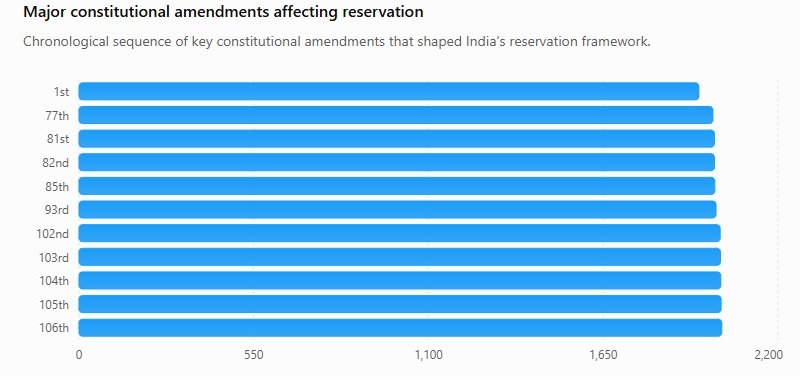
These amendments demonstrate that India’s reservation framework has evolved continuously in response to judicial decisions, social demands and changing constitutional priorities. While the original Constitution established the legal foundation, subsequent amendments expanded reservation into areas such as promotions, educational institutions, Economically Weaker Sections (EWS) and women’s political representation.
Landmark Supreme Court Judgments
The Supreme Court has played a decisive role in interpreting reservation law. Several landmark judgments continue to influence admissions, public employment, promotions and state reservation policies.
| Case | Year | Key Outcome |
| State of Madras v. Champakam Dorairajan | 1951 | Struck down caste-based reservations under the original Constitution, leading to the First Constitutional Amendment. |
| Indra Sawhney v. Union of India | 1992 | Upheld 27% OBC reservation, introduced the creamy layer principle and held that reservations ordinarily should not exceed 50%. |
| M. Nagaraj v. Union of India | 2006 | Upheld reservation in promotions while requiring states to justify it with quantifiable data. |
| Jarnail Singh v. Lachhmi Narain Gupta | 2018 | Modified parts of M. Nagaraj and clarified requirements for reservation in promotions. |
| Janhit Abhiyan v. Union of India | 2022 | Upheld the constitutional validity of the 103rd Constitutional Amendment introducing 10% EWS reservation. |
| State of Punjab v. Davinder Singh | 2024 | Held that states may create sub-classifications within Scheduled Castes based on empirical evidence to ensure benefits reach the most disadvantaged groups. |
These rulings illustrate that reservation policy continues to evolve through constitutional interpretation as much as through legislation. Courts have clarified issues ranging from the creamy layer principle and promotion quotas to economic reservation and internal classification within Scheduled Castes.
Also Read: Creativity vs Knowledge – Which Is Better?
Types of Reservation in India
Reservation in India is broadly divided into vertical reservation and horizontal reservation. While both are designed to improve representation, they operate differently and often work together during admissions and recruitment.
Vertical reservation is based on constitutionally recognised social categories such as Scheduled Castes (SC), Scheduled Tribes (ST), Other Backward Classes (OBC–Non-Creamy Layer), and Economically Weaker Sections (EWS). Horizontal reservation, on the other hand, cuts across these categories and benefits groups such as Persons with Benchmark Disabilities (PwBD), women (where applicable), ex-servicemen and other state-notified categories.
Vertical vs Horizontal Reservation
| Vertical Reservation | Horizontal Reservation |
| Scheduled Castes (SC) | Persons with Benchmark Disabilities (PwBD) |
| Scheduled Tribes (ST) | Women (where applicable) |
| Other Backward Classes (OBC-NCL) | Ex-servicemen |
| Economically Weaker Sections (EWS) | Other state-notified horizontal categories |
Distribution of Major Vertical Reservation Categories
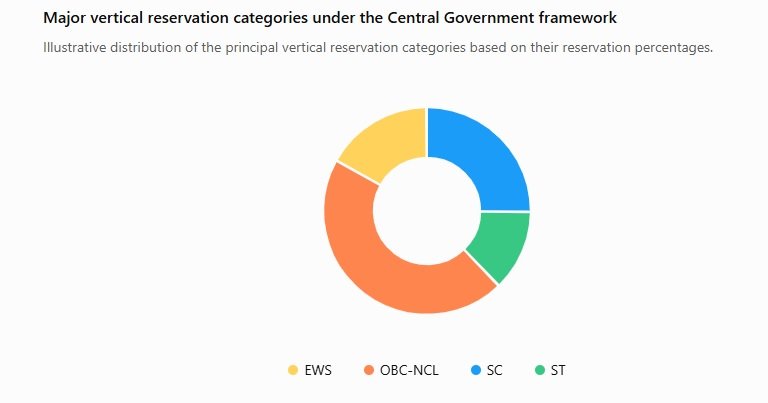
A candidate generally belongs to one vertical reservation category but may simultaneously qualify under one or more horizontal categories. For example, an OBC candidate may also be eligible under the PwBD category. During admissions and recruitment, horizontal reservations are adjusted within the applicable vertical category according to the relevant rules.
Also Read: Organic Farming — Good or Bad
Who Is Eligible for Reservation?
Reservation eligibility depends on the category claimed, the applicable Central or State Government rules, and the recruitment or admission notification.
Merely belonging to a community is not always sufficient. Candidates must also satisfy eligibility requirements prescribed by the concerned authority and produce valid supporting documents during verification.
Reservation Eligibility
| Category | Primary Requirement | Certificate Required |
| Scheduled Castes (SC) | Community notified under Article 341 | Scheduled Caste Certificate |
| Scheduled Tribes (ST) | Community notified under Article 342 | Scheduled Tribe Certificate |
| OBC (Non-Creamy Layer) | Community included in the applicable OBC list and not falling within the creamy layer | OBC Non-Creamy Layer Certificate |
| Economically Weaker Sections (EWS) | Family satisfies prescribed income and asset criteria and does not belong to SC, ST or OBC reservation categories | Income & Asset Certificate |
| Persons with Benchmark Disabilities (PwBD) | Disability recognised under applicable law | Disability Certificate |
Candidates should always verify whether the Central Government list or the relevant State Government list applies before submitting an application. Using an incorrect category certificate is one of the most common reasons reservation benefits are denied during counselling or recruitment.
Also Read: Cashless Economy – Pros and Cons
Reservation Certificates
Most admissions and government recruitment processes require candidates to submit reservation certificates issued by the competent authority.
Commonly required documents include:
| Reservation Category | Certificate Required | Issuing Authority |
| SC | Scheduled Caste Certificate | Competent Revenue Authority |
| ST | Scheduled Tribe Certificate | Competent Revenue Authority |
| OBC | OBC Non-Creamy Layer Certificate | Competent Revenue Authority |
| EWS | Income and Asset Certificate | Competent Authority notified by the State or Union Territory |
| PwBD | Disability Certificate | Authorised Medical Board |
Many recruitment agencies prescribe specific certificate formats and validity dates. Applicants should follow the latest official notification instead of relying on previously issued certificates or unofficial templates.
Understanding the Creamy Layer
The creamy layer principle applies to Other Backward Classes (OBC) under the Central Government reservation framework.
Its objective is to ensure that reservation benefits reach socially and educationally disadvantaged members of OBC communities rather than families that are considered socially and economically advanced.
In general:
- OBC candidates belonging to the Non-Creamy Layer (NCL) remain eligible for reservation.
- Candidates falling within the creamy layer are not entitled to OBC reservation under the Central Government framework.
- The creamy layer principle does not ordinarily apply to Scheduled Castes (SCs) or Scheduled Tribes (STs) under the current Central Government reservation system.
This distinction is frequently misunderstood and has been the subject of repeated judicial interpretation.
Also Read: Peer Pressure
Reservation in Education
Reservation applies to admissions in many government-funded educational institutions, including Central Universities, National Institutes of Technology (NITs), Indian Institutes of Information Technology (IIITs), government medical colleges and several other centrally funded institutions.
Applicants seeking reservation benefits generally need to:
- Apply under the appropriate reservation category.
- Submit valid certificates in the prescribed format.
- Complete document verification during counselling.
- Meet all educational eligibility requirements specified by the institution.
Admission authorities such as those conducting JEE Main and NEET counselling also publish detailed category-wise document requirements before each admission cycle.
Reservation in Government Jobs
Reservation is also implemented across many Central and State Government recruitments.
Depending on the recruitment notification, eligible candidates may receive:
- Reservation in vacancies.
- Age relaxation.
- Fee concessions.
- Relaxation in qualifying marks where specifically notified.
- Reservation in promotions for eligible SC and ST employees, subject to constitutional provisions and judicial safeguards.
It is important to distinguish reservation from relaxation. Reservation refers to reserved seats or posts, whereas relaxations such as age limits or examination fees are separate concessions and vary from one recruitment to another.
Applicants should therefore rely on the official recruitment notification issued by the concerned authority rather than assuming identical reservation rules apply across all examinations.
Also Read: Mob Lynching in India
State-Wise Reservation Policies in India
Although the Constitution provides the legal foundation for reservation, state governments have the authority to frame their own reservation policies within constitutional limits and judicial guidelines. As a result, reservation percentages, eligible categories and internal classifications differ across India.
Some states have introduced separate quotas for Most Backward Classes (MBCs), Extremely Backward Classes (EBCs), Nomadic Tribes or other locally recognised communities. Others have adopted internal reservation within Scheduled Castes or expanded horizontal reservations for women, persons with disabilities and ex-servicemen.
Examples of State Reservation Policies
| State | Key Features |
| Tamil Nadu | Follows a 69% reservation model under state legislation. |
| Karnataka | Introduced internal Scheduled Caste sub-classification following recent Supreme Court rulings. |
| Rajasthan | Provides reservation for Most Backward Classes (MBCs) and additional state-specific categories. |
| Maharashtra | Includes categories such as Nomadic Tribes and Special Backward Classes under state policy. |
| Bihar | Operates under reservation percentages that differ from the Central Government framework. |
Because state reservation policies evolve through legislation and court decisions, candidates should always refer to the latest recruitment notification or admission brochure issued by the relevant authority rather than relying on general reservation percentages.
Also Read: Children’s Education Allowance
Constitutional Bodies Associated with Reservation
Several constitutional institutions are responsible for monitoring safeguards available to reserved communities and advising governments on reservation-related issues.
| Institution | Constitutional Provision | Primary Function |
| National Commission for Scheduled Castes (NCSC) | Article 338 | Safeguards the interests of Scheduled Castes and investigates complaints. |
| National Commission for Scheduled Tribes (NCST) | Article 338A | Protects the rights and constitutional safeguards available to Scheduled Tribes. |
| National Commission for Backward Classes (NCBC) | Article 338B | Advises the Central Government on matters relating to Socially and Educationally Backward Classes. |
These constitutional bodies submit reports to the President, review implementation of safeguards and recommend policy improvements where necessary.
Also Read: Unemployment Rate in India
Advantages of Reservation
Supporters argue that reservation has played an important role in expanding opportunities for historically disadvantaged communities and improving representation within public institutions.
Some of the major advantages include:
- Increased access to higher education.
- Better representation in government services.
- Greater political participation through reserved legislative seats.
- Improved social inclusion.
- Enhanced diversity within public institutions.
- Greater opportunities for communities that historically faced discrimination and exclusion.
Supporters also argue that reservation seeks to achieve substantive equality, recognising that equal treatment alone may not overcome historical inequalities.
Also Read: Women’s Empowerment: Pros and Cons
Challenges and Criticisms
Reservation continues to generate significant legal, political and academic debate.
Some of the most frequently discussed concerns include:
- Whether reservation should continue to rely primarily on caste-based criteria.
- The effectiveness of the creamy layer principle.
- Wide variation in reservation policies across different states.
- Administrative challenges relating to certificate verification and reservation rosters.
- Frequent litigation leading to uncertainty in admissions and recruitment.
- Debate over balancing affirmative action with merit and administrative efficiency.
Successive Supreme Court judgments have attempted to balance these competing constitutional principles while recognising the importance of both equality and social justice.
Common Misconceptions About Reservation
| Myth | Fact |
| Reservation is only caste-based. | Reservation also includes Economically Weaker Sections (EWS) and horizontal categories such as Persons with Benchmark Disabilities (PwBD). |
| Creamy layer applies to every reserved category. | Under the Central Government framework, the creamy layer principle generally applies only to OBC reservation. |
| Reserved-category candidates cannot compete on merit. | Candidates from reserved categories can compete for open (unreserved) seats based solely on merit. |
| Reservation percentages are identical across India. | Every state may prescribe different reservation percentages and categories within the constitutional framework. |
Also Read: Love vs Arranged Marriage – Which One is Better?
Latest Reservation Developments (2024–2026)
Reservation law has continued to evolve through constitutional interpretation and policy reforms.
Some of the most significant recent developments include:
- SC Sub-classification (2024): The Supreme Court held that states may create sub-classifications within Scheduled Castes based on empirical evidence to ensure reservation benefits reach the most disadvantaged groups.
- Women’s Reservation: The Constitution (106th Amendment) Act provides one-third reservation for women in the Lok Sabha and State Legislative Assemblies. Its implementation is linked to future delimitation and other constitutional requirements.
- State-Level Reforms: Several states have reviewed reservation policies, internal classifications and recruitment rosters following recent judicial decisions.
These developments demonstrate that reservation policy continues to evolve through both legislative action and judicial interpretation.
Frequently Asked Questions
What is the Reservation System in India?
The Reservation System in India reserves opportunities for eligible disadvantaged communities.
What is the reservation percentage in India?
Central reservation includes 15% SC, 7.5% ST, 27% OBC, 10% EWS and 4% PwBD.
Who can claim reservation?
Eligible candidates with valid category certificates can claim reservation benefits.
Does the creamy layer apply to SC and ST reservation?
No, the creamy layer generally applies only to OBC reservation.
Can reserved-category candidates compete in the open category?
Yes, reserved-category candidates can compete for unreserved seats on merit.
Why do reservation percentages differ across states?
States frame reservation policies within the constitutional framework.
What is the creamy layer in OBC reservation?
The creamy layer excludes socially advanced OBC families from reservation benefits.
Does reservation apply to private-sector jobs?
No, reservation generally applies only to government institutions and public employment.
Which constitutional articles govern reservation?
Articles 15, 16, 46, 335, 341 and 342 primarily govern reservation.
What is EWS reservation?
EWS reservation provides 10% quota for eligible economically weaker general-category candidates.
What is horizontal reservation?
Horizontal reservation applies across all vertical categories, including PwBD and women.
Can EWS candidates also claim OBC reservation?
No, EWS reservation excludes candidates eligible under SC, ST or OBC categories.
Which documents are required for reservation?
Applicants need valid caste, income or disability certificates, depending on the category.
Who decides reservation policies in India?
Parliament, state governments and courts collectively shape reservation policies.
Can reservation policies change?
Yes, reservation policies change through legislation, constitutional amendments and court judgments.
- References:
- https://dpe.gov.in/sites/default/files/Reservation_Brochure-2.pdf
- https://www.iasexpress.net/reservation-system-in-india-upsc-ias-gk/
- https://en.wikipedia.org/wiki/Reservation_in_India
- https://www.legalserviceindia.com/legal/article-7730-reservation-in-india.html
- https://dopt.gov.in/sites/default/files/FAQ_SCST.pdf