
Vedic astrology, or Jyotish, which is originated from the Vedas, is a more than 5000-year-old horoscope traditional system of astrology from India. Astrology is part of the Indian Vedic tradition. Vedic astrology is not just about future predictions; it is also about human life and cosmic movements analysis. A survey by Pew Research (2022) found that over 65% of Indians believe astrology influences daily life. At the same time, more than 70% of youth in urban India check horoscopes online before making personal or career decisions. These stats show the connection between modern interest and ancient Vedic knowledge. Let’s explore with us the science behind Vedic Astrology
What is Vedic Astrology?
Vedic Astrology, also known as Jyotish Shastra, is the traditional Hindu system of astrology. The word Vedic comes from “Vedas,” which is an Indian sacred scripture. By using the Sidereal Zodiac, it calculates the planets and stars’ position and movement to predict human life patterns, personality, and destiny. It calculates planetary positions based on their actual location relative to fixed stars, a difference that has led to a noticeable shift between the two systems over time.
The Science Behind Vedic Astrology
Many critics call astrology unscientific, but many theories have a scientific reasoning:
| Astrological Concept | Scientific Link |
| Gravitational pull of planets | Planets like Jupiter and Saturn exert a gravitational force on Earth |
| Lunar effect | The Moon impacts ocean tides; it may also influence human emotions (as humans are 70% water) |
| Circadian rhythm | Planetary positions can affect sleep cycles and biological clocks |
| Seasonal influence | The movement of the Sun impacts agriculture, weather, and festivals in India |
The Role of the Birth Chart
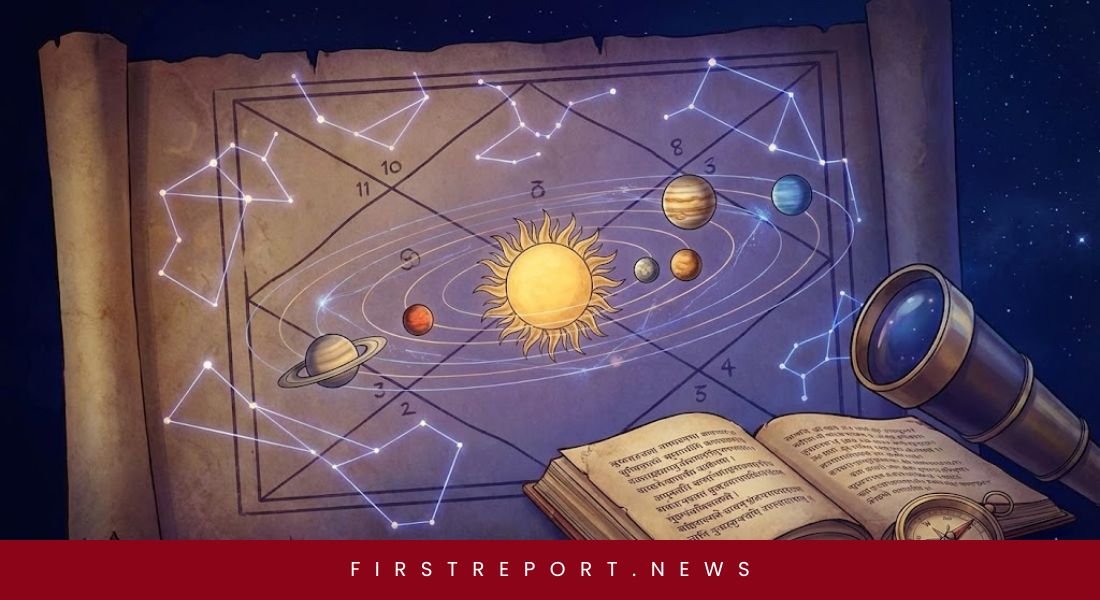
A Birth Chart, also known as a Janam kundli or Natal Chart, is in Vedic astrology. Astrologers use the birth date, time, and place of a person to make this chart. At the time of birth, planets’ positions are placed in different houses. These 12 house positions represent the life of a person, like health, career, relationships, and spirituality. The influence of the planets varies from house to house. In short, a birth chart is a blueprint of a person’s life.
The interaction between planets (Grahas), zodiac signs (Rashis), and houses (Bhavas) forms the basis of accurate astrological predictions.
Principles of Vedic Astrology
The Vedic astrology system follows four principles. These are the nine planets (Navagrahas), twelve zodiac signs (Rashis), twelve houses (Bhavas), and twenty-seven constellations (Nakshatras). The interaction of these principles shows aspects of life. Together, they create a birth chart, which guides astrologers in providing insights into personality, relationships, and life events.
1. Nine planets (Navagrahas)
| Planet (Graha) | Associated Deity (Hinduism) | Role & Symbolism |
| Sun | Surya | Represents the soul, power, and authority. |
| Moon | Chandra | Represents the mind, emotions, and intuition. |
| Mars | Mangala | Represents energy, courage, and action. |
| Mercury | Budha | Represents communication, intellect, and logic. |
| Jupiter | Brihaspati | Represents wisdom, knowledge, and prosperity. |
| Venus | Shukra | Represents love, beauty, and creative arts. |
| Saturn | Shani | Represents discipline, duty, and karma. |
| Rahu (North Lunar Node) | Rahu | Represents ambition, desire, and worldly pursuits. |
| Ketu (South Lunar Node) | Ketu | Represents liberation, spirituality, and detachment. |
2. Twelve zodiac signs (Rashis)
| Zodiac Sign | Rashi | Symbol | Element |
| Aries | Mesha | Ram | Fire |
| Taurus | Vrishabha | Bull | Earth |
| Gemini | Mithuna | Twins | Air |
| Cancer | Karka | Crab | Water |
| Leo | Simha | Lion | Fire |
| Virgo | Kanya | Maiden | Earth |
| Libra | Tula | Scales | Air |
| Scorpio | Vrishchika | Scorpion | Water |
| Sagittarius | Dhanu | Archer | Fire |
| Capricorn | Makara | Sea-goat | Earth |
| Aquarius | Kumbha | Water-bearer | Air |
| Pisces | Meena | Fish | Water |
3. Twelve houses (Bhavas)
| House | Bhava | Represents |
| First House | Tanu Bhava | Self, physical body, personality |
| Second House | Dhana Bhava | Wealth, family, speech |
| Third House | Sahaja Bhava | Siblings, communication, short trips |
| Fourth House | Sukh Bhava | Home, mother, emotional security |
| Fifth House | Putra Bhava | Children, creativity, intellect |
| Sixth House | Ripu Bhava | Health, debt, enemies, service |
| Seventh House | Jaya Bhava | Marriage, partnerships, relationships |
| Eighth House | Mrityu Bhava | Longevity, transformation, hidden matters |
| Ninth House | Dharma Bhava | Higher learning, father, luck, travel |
| Tenth House | Karma Bhava | Career, status, public life |
| Eleventh House | Labha Bhava | Income, friends, goals |
| Twelfth House | Vyaya Bhava | Loss, spirituality, seclusion |
4. Nakshatras (constellations)
| Nakshatra (Constellation) | Ruling Planet (Graha) | Associated Symbolism |
| Ashwini | Ketu | Healing, new beginnings, quick action |
| Bharani | Venus | Creation, nourishment, and karma |
| Krittika | Sun | Fire, purification, and determination |
| Rohini | Moon | Growth, fertility, and creativity |
| Mrigashirsha | Mars | Searching, curiosity, and travel |
| Ardra | Rahu | Transformation, storms, and grief |
| Punarvasu | Jupiter | Renewal, restoration, and compassion |
| Pushya | Saturn | Nurturing, prosperity, and spiritual strength |
| Ashlesha | Mercury | Clinging, introspection, and serpent power |
| Magha | Ketu | Royalty, heritage, and ancestral connection |
| Purva Phalguni | Venus | Leisure, pleasure, and artistic expression |
| Uttara Phalguni | Sun | Success, loyalty, and social service |
| Hasta | Moon | Craftsmanship, skill, and practical ability |
| Chitra | Mars | Art, creation, and brilliance |
| Swati | Rahu | Independence, flexibility, and business |
| Vishakha | Jupiter | Purpose, ambition, and resolve |
| Anuradha | Saturn | Friendship, loyalty, and relationships |
| Jyeshtha | Mercury | Protection, authority, and leadership |
| Mula | Ketu | Roots, destruction, and searching for truth |
| Purva Ashadha | Venus | Invincibility, courage, and victory |
| Uttara Ashadha | Sun | Perseverance, dedication, and long-term success |
| Shravana | Moon | Learning, listening, and wisdom |
| Dhanishta | Mars | Wealth, fame, and rhythm |
| Shatabhisha | Rahu | Healing, secrecy, and spiritual insight |
| Purva Bhadrapada | Jupiter | Fierceness, change, and spiritual cleansing |
| Uttara Bhadrapada | Saturn | Wisdom, patience, and stability |
| Revati | Mercury | Wealth, journeys, and spiritual release |
Also Read: Auspicious Dates To Buy a New Home in 2026
Why People Still Believe in Vedic Astrology
People have been following Vedic astrology for hundreds of years, and it remains relevant even today. Without being affected by advanced science and technology, people still search for Vedic astrology for guidance, answers, and before any sacred work and important decisions in their lives.
- Provides an understanding of life’s events and challenges
- Guides relationships, careers, and personal choices
- Vedic Astrology is deeply connected to cultural and spiritual traditions.
- This has been going on from generation to generation, keeping faith alive
- Seen as a means of self-reflection and awareness
- Provides comfort and reassurance in uncertain times
- Blends mythology, astronomy, and philosophy into daily life
Here are some statistics for astrology belief & usage
- In the US, 27% of adults say they believe astrology—that the positions of stars or planets can affect someone’s life.
- About 30% of Americans consult astrology or fortune-telling (or tarot) at least once a year.
- Among younger American adults (under 30), belief in astrology rises: around 37% in that age group report believing it.
- In India, Gen Z (late-1990s to early-2010s) makes up about 60.2% of online astrology users in cities with high social media activity.
- In India’s astrology app market in 2024, Vedic astrology holds over 60% market share among astrology-app types.
- Among Indian singles, 51% say zodiac compatibility matters (though not absolutely deciding), and 49% have used astrology to understand themselves or partners better.
Astrology Connection to Science and Modern Adaptation
The connection between science and astrology is not direct. Modern Science and astrology are different. Science uses the scientific method and practicality; on the other hand, astrology depends on the mathematical calculations of planetary positions, ancient sacred texts, and observations.
Many researchers acknowledge its role in mental health and decision-making. Nowadays, Vedic astrology is adapted through online consultations, apps, and websites that use AI-based birth chart analysis, making it easier for young people to access in daily life.
The science of Vedic astrology is rooted in a blend of astronomy, mathematics, and observation of natural cycles. While its accuracy remains debated, its popularity in India and abroad reflects its strong cultural and emotional value. Understanding it as a guide rather than a fixed destiny makes Vedic astrology even more meaningful.
References: