

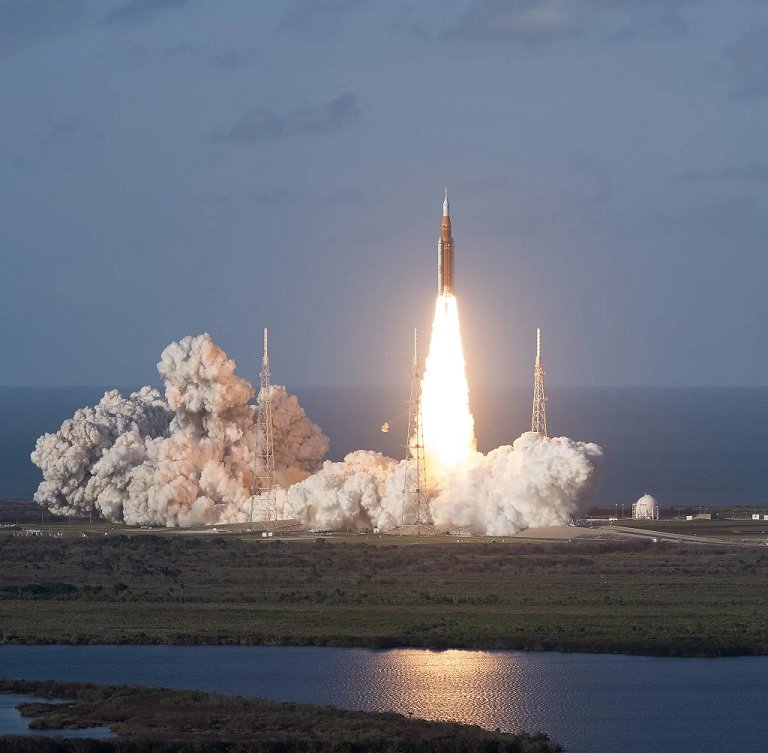
A Historic Launch Or a Very Expensive Test?
On April 1, 2026, at Kennedy Space Center, NASA launched its most ambitious mission in decades: the Artemis II moon mission. For the first time since the Apollo era, humans are heading back toward the Moon.
The four astronauts: Reid Wiseman, Victor Glover, Christina Koch, and Jeremy Hansen are now on a 10 day journey around the Moon, traveling farther than any humans in over 50 years. The Washington Post
NASA called it a “defining moment for our nation,” while officials insisted the mission is “the start of something bigger.” cbsnews.
But here’s the uncomfortable truth: they’re not landing.
Not a Moon Mission , A Dress Rehearsal
Despite the hype, the Artemis II moon mission essentially is a test flight. The crew will perform a lunar flyby using a free return trajectory, looping around the Moon and coming back without landing. NASA’s Artemis Program
Why? Because NASA still isn’t fully confident in its own technology.
The mission is testing:
- Life support systems
- Heat shield performance
- Navigation in deep space
After spending over $100 billion on the Artemis program, this raises a serious question, why are we still testing basics? – The Washington Post
Representation Meets Reality
NASA is celebrating diversity and rightly so.
- Christina Koch will become the first woman to orbit the Moon
- Victor Glover, the first Black astronaut on a lunar mission
- Jeremy Hansen, the first non-American to go that far – Vogue
But symbolism alone doesn’t make a mission successful.
Inside the Orion capsule, astronauts are living in cramped quarters barely bigger than Apollo era modules, surviving on rehydrated meals and sleeping in bags.
So while the optics are modern, the reality still feels… primitive.
The Bigger Picture: A New Space Race
Let’s not ignore the geopolitical angle. Artemis II is not just science, it’s strategy.
The United States is racing against rising space powers, especially China, to dominate the next phase of lunar exploration.
As one observer bluntly put it: this is “the boldest step yet” toward reclaiming space leadership. – Reuters
So… Is This Really Progress?
Artemis II is historic, no doubt. But it also exposes a paradox:
- We’ve advanced enough to go farther than ever
- Yet we’re still cautious, testing, and uncertain
NASA says this mission will pave the way for a Moon landing by 2027–28.
But until humans actually step back on the Moon, one question remains:
Are we witnessing a giant leap or just a very expensive rehearsal?
For more updates follow: First Report News