

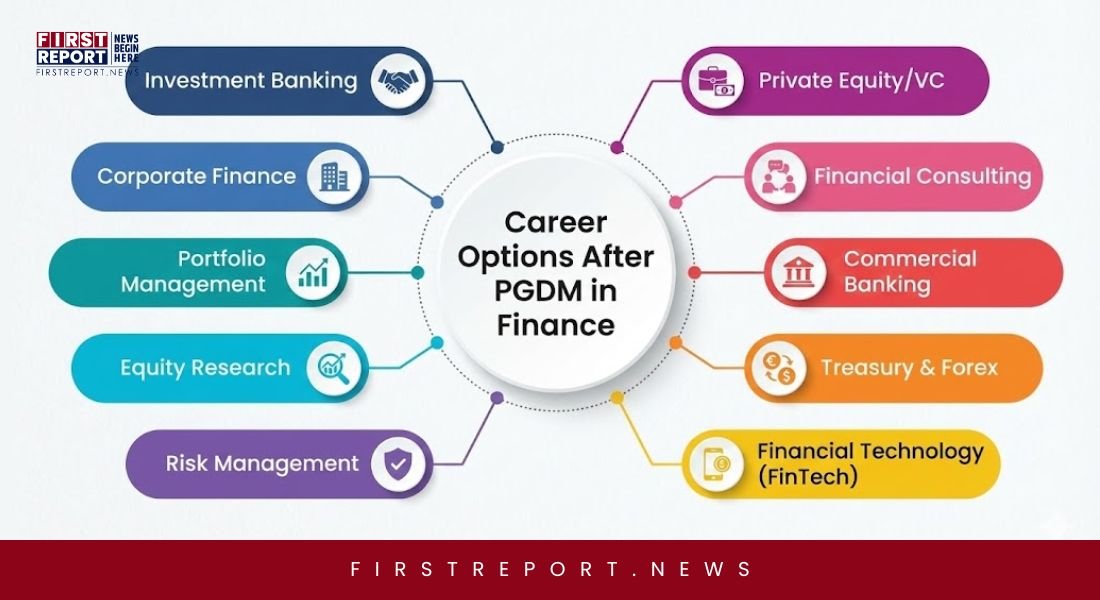
Over 25% of MBA graduates in India specialise in Finance every year, according to the data from the All India Council for Technical Education (AICTE). MBA/PGDM in finance is still one of the popular specializations, as it offers high-paying job roles across industries. MBA/PGDM in finance makes your analytical, decision-making, and financial management skills strong. It provides opportunities in banking, investments, consulting, fintech, and more. Here are a few career options after an PGDM in Finance
An MBA in Finance prepares graduates for many lucrative roles. Here are career paths with typical job roles and approximate starting salaries in India.
Career Options After PGDM in Finance
| S. No | Career Path | Job Roles | Approx. Starting Salary (LPA) | Industries |
| 1. | Investment Banking | Analyst, Associate | 12 – 20 | Banking, Consulting |
| 2. | Corporate Finance | Financial Analyst, Controller | 8 – 15 | FMCG, Manufacturing, IT |
| 3. | Portfolio Management | Portfolio Manager, Investment Analyst | 10 – 18 | Investment Firms, Banks |
| 4. | Equity Research | Research Analyst, Sector Specialist | 7 – 14 | Brokerage, Research Firms |
| 5. | Risk Management | Risk Analyst, Credit Officer | 7 – 12 | Insurance, Banking |
| 6. | Private Equity/VC | Associate, Investment Analyst | 15 – 25+ | Finance, Start-ups |
| 7. | Financial Consulting | Consultant, Advisory Associate | 9 – 16 | Advisory, Consulting |
| 8. | Commercial Banking | Relationship Manager, Product Manager | 7 – 12 | Banks, NBFCs |
| 9. | Treasury & Forex | Treasury Manager, Forex Dealer | 8 – 15 | Export-Import, MNCs |
| 10. | Financial Technology (FinTech) | Product Manager, Business Analyst | 10 – 18 | Start-ups, Tech Companies |
Investment Banking

Investment Banking helps in focusing on raising a company’s capital and making strategic deals. This field’s professional helps in mergers, acquisitions, and public offerings. They develop financial models, analyse market data, and structure the transitions. For this role, strong Communication skills are necessary, with a focus on each small detail. Mostly, Investment bankers work with big corporations and government entities, so they must need to know how to manage financial communications. This investment banking career gave opportunity to work with different industries in the global market. With experience, one can switch roles in senior advisory and move to private equity for better pay. Investment banking connects financial strategy with business growth opportunities.
Corporate Finance

Corporate finance manages a company’s financial resources. Professionals ensure the business has enough funds available for operations, growth, and investments. They plan budgets, evaluate investments, and analyze performance. Their main goal is to maximize shareholder value while maintaining stability. This field involves close coordination with departments like accounting and strategy. For this field, strong analytical and problem-solving skills are necessary. With experience, professionals take on roles like financial controller or chief financial officer (CFO). Corporate finance is suitable for those who enjoy decision-making based on data. It plays a vital role in keeping organizations profitable and financially healthy.
Portfolio Management

Portfolio Management targets investing funds to achieve specific financial goals. Managers decide how to divide funds and whom to allocate, in the form of Shares, Bonds, and other assets. They kept their eye on the market trends, and with the change in market conditions, they made changes in the company portfolio. Their goal is to maintain a balance between the risk and return. Portfolio managers work with people, firms, and institutions. They use financial models and research to guide investment choices. Communication skills are necessary to communicate effectively with clients to understand their risk tolerance. A career in Portfolio Management encourages analytical thinking and Market understanding. Portfolio managers blend data analysis with strategic investment planning.
Equity Research

Equity research focuses on analyzing companies and their stocks. Analysts analyze the industry trends, market conditions, and financial statements. They prepare a detailed analysis of whether to buy, hold, or sell the shares. Their research insights help investors to understand and make informed decisions. Equity researchers work with Investment bankers and portfolio managers. For this field, strong writing and quantitative skills are required. Mostly, they specialize in technology, energy, or healthcare sectors. With experience, Equity research analysts switch into a fund management or corporate strategy role for a hike. This field is suitable for those with an interest in research and a strong financial understanding.
Also Read: Top MBA Colleges For Finance in Jaipur
Risk Management

A risk manager identifies and manages the potential risks to a company’s assets and earnings. Professionals’ financial, operational, and market risk assessed. They predict potential outcomes with the help of data, models, and trends, and then they make the required decisions or strategy to mitigate or transfer those risks. Analytical thinking and practical judgment skills are required in this field. Risk managers work with banks, corporations, and insurance companies. Risk managers ensure adherence to the regulations and internal policies. Their aim is to protect business stability while achieving growth. With experience, they may lead enterprise-wide risk management programs or policy design teams.
Private Equity/Venture Capital

Private Equity/Venture Capital focuses on investing in private businesses. They pitch for raising capital or funds from investors and identify promising companies. Mostly, Venture capital targets are startups with growth potential. In private equity, target investments are with well-established companies that require restructuring or expansion. Private Equity/Venture Capital analysts execute due diligence, financial modeling, and valuation. They provide a guidance portfolio to the companies towards profitability. Profitability depends on long-term success, not short-term gains. The Private Equity/Venture Capital field requires skills such as strategic thinking and negotiation skills. Private Equity/Venture Capital blends finance with business strategy.
Financial Consulting

Financial consulting provides expert advice to improve business performance. Consultants assess financial health, manage budgets, and recommend strategic plans. They help clients to optimize cash flow, reduce costs, and plan investments. Financial consultants also help during mergers, valuations, and restructurings. This field requires analytical and communication skills. Consultants work with diverse industries and provide customized financial solutions. They gave measurable results in the short term. This career is suitable for those who enjoy problem-solving and a variety of work. With experience, Consultants switch to senior advisory or management positions.
Commercial Banking

Commercial banking provides services to individuals, small businesses, and corporations. They offer services such as loans, credits, and savings solutions. A commercial banker manages customer relationships and evaluates their creditworthiness. Their goal is to increase deposits and minimize risks; financial analysis and customer contact are involved in this work. Commercial bankers manage business transactions and working capital. With experience, they specialize in corporate lending or relationship management. Commercial banking combines financial understanding with a service orientation.
Treasury & Forex

Treasury & Forex exchange management manages cash flow, investments, and currency operations. They ensure that the company always has the necessary funds available and manage liquidity, debt, and short-term investments. Forex professionals deal with foreign exchange transactions and hedging. They are also responsible for minimizing currency risks with the help of global market trends. This field requires accuracy, speed, and awareness of international financial trends, and also involves coordination with banks and regulators. With experience, Treasury & Forex exchange management managers switch into strategic financial planning roles.
Also Read: Best Colleges in Jaipur Offering MBA in Finance and Business Analytics
Financial Technology (FinTech)

Fintech combines finance and technology to improve financial services. Fintech professionals design digital solutions like mobile banking apps, payment systems, and trading platforms. They work with data analytics, blockchain, and artificial intelligence. Their aim is to make financial access easy to use, faster, accessible, and more efficient. In fintech, career options are in startups, banks, and technology firms. In this field, innovation, problem-solving, and adaptability skills are required. This offers opportunities for those who are interested in both finance and technology.