
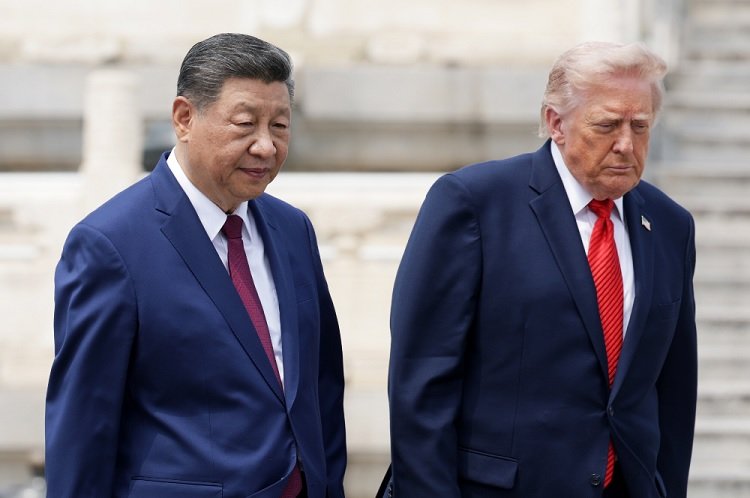
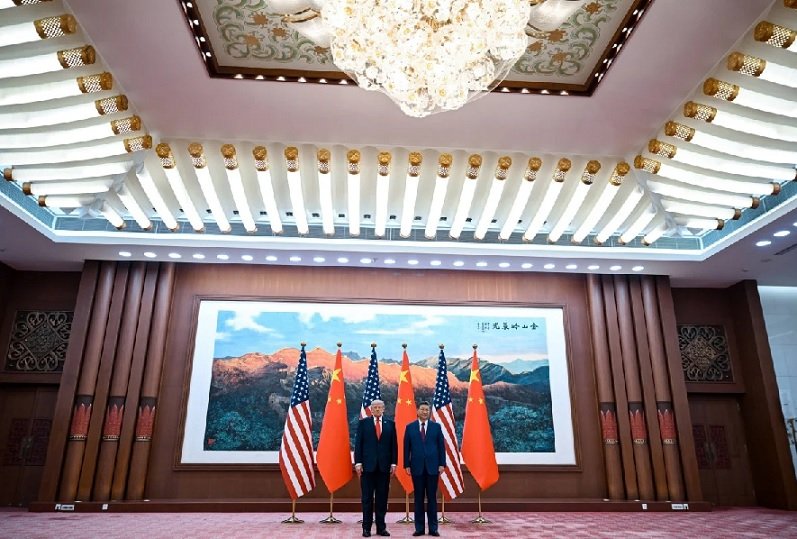
“The Trump-Xi summit in Beijing ended with modest trade signals and few major breakthroughs.“
Beijing- US President Donald Trump arrived in Beijing this week promising to “open up” China’s economy, but by Friday the tone around the summit had shifted sharply. Officials on both sides were talking less about breakthroughs and more about keeping relations from deteriorating further.
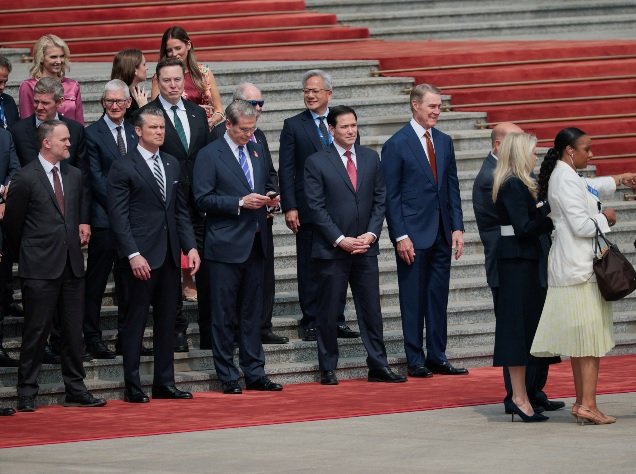
Trump met Chinese President Xi Jinping during 2 days of talks centered on tariffs, AI chips, investment access and supply chains. The US president was joined by several business leaders, including Tesla chief Elon Musk, Apple CEO Tim Cook and Nvidia chief Jensen Huang. No major trade agreement emerged.
What’s happening around the world: Trump and Xi Strike Tone in Beijing as US-China Tensions Simmer
Also see: India Slovakia Comprehensive Partnership Unveiled
Tariffs remain high despite truce talks
The summit comes after years of escalating economic pressure between the world’s two largest economies. According to the Peterson Institute for International Economics, average US tariffs on Chinese goods now stand at 47.5%, up from 3.1% before Trump’s first term. China’s average tariffs on US goods reached 31.9%. Two-way trade dropped to roughly $415bn in 2025 from a peak of $690bn in 2022.
Trump said China had agreed to buy 200 Boeing aircraft and increase purchases of US agricultural products. Reports say that administration officials expected deals worth “double-digit billions” for American farmers. Chinese officials did not publicly confirm those figures.
Also see: Michael Dell Pentagon Contract Follows $6.25 Billion Donation
Also see: Trump Yet to Approve Proposed U.S.-Iran 60-Day Ceasefire Deal as Nuclear Talks Intensify
Also see: Marco Rubio India Visit Begins in Kolkata Ahead of Quad Talks
AI chips and rare earths dominate discussions
Much of the summit focused on technology restrictions. The US has tightened export controls on advanced semiconductors while still allowing Nvidia to sell modified chips such as the H20 in China.
Claire E Reade, a former US Trade Representative official, said “China does not trust the US, and China wants to beat the US in what it sees as long-term global competition.”
“This limits what can be agreed,” she added.
Analysts say Beijing now has more leverage than during Trump’s first trade war. China controls much of the world’s rare earth processing industry, a supply chain critical for weapons systems, EV batteries and semiconductor manufacturing.
Deborah Elms of the Hinrich Foundation said Beijing was unlikely to offer major concessions. “Very little”, she said when asked what Trump was offering China in return. Behind the diplomatic language, the rivalry remains intact.
Also see: Xi Jinping North Korea Visit: China Seeks Greater Influence
Also see: India Rebukes Pakistan at UN, Reasserts Kashmir Claim Amid Fresh Row Over Gilgit-Baltistan Elections
Also see: Trump Yet to Approve Proposed U.S.-Iran 60-Day Ceasefire Deal as Nuclear Talks Intensify